A Serene Exploration of Abstraction: Decoding Kandinsky’s *Sky Blue*
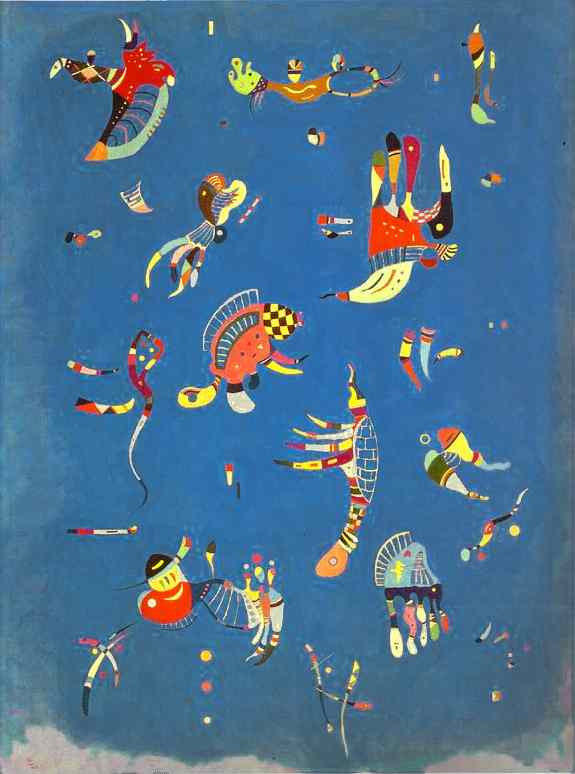
This captivating painting by Wassily Kandinsky, created in 1940, represents a pivotal moment in the artist's mature abstract style. More than just an arrangement of shapes and colors, it is a visual poem reflecting Kandinsky’s lifelong fascination with the spiritual power of art and his synesthetic belief in the connection between color and sound. Measuring 35 x 46 cm and currently housed at the Guggenheim Museum in New York City, *Sky Blue* offers a poignant glimpse into artistic explorations during a period of global upheaval.
Historical Context & Artistic Evolution
By 1940, Kandinsky had already revolutionized the art world as a pioneer of abstract expressionism. Having fled Nazi Germany after the closure of the Bauhaus (where he taught from 1922-1933), he found himself in Paris navigating a new artistic landscape and witnessing the looming shadow of World War II. This period saw a shift in his work towards smaller formats and more delicate compositions, a departure from the larger, bolder canvases of his earlier years. His journey began with representational beginnings influenced by Impressionism, progressed through the explosive energy of *Der Blaue Reiter* (The Blue Rider) group he co-founded in Munich, and culminated in this late style characterized by lyrical abstraction. This painting embodies a newfound sense of intimacy and refinement, born perhaps from personal displacement and uncertainty.
Visual Language & Technique
The canvas is dominated by a spectrum of blues—from deep cerulean and indigo to softer sky hues—creating an atmosphere of serenity and contemplation. Scattered across this blue field are dynamic forms: circles, triangles, lines, and amorphous shapes that seem to float and interact with one another. These aren’t arbitrary arrangements; Kandinsky believed each color and shape possessed its own inherent spiritual resonance. The use of layered forms creates a sense of depth despite the overall flatness of the composition.
Visible brushstrokes add texture and subtle energy to the surface, contributing to the painting’s harmonious balance – these marks are carefully considered, not spontaneous.
Symbolism & Synesthetic Resonance
Kandinsky's theories on art were deeply rooted in his belief that color could evoke emotional and spiritual responses akin to music. He famously described wanting to paint as a musician composes – believing colors had their own “inner sound.” In *Sky Blue*, the blues might represent tranquility, depth, or even melancholy, while the contrasting shapes symbolize different musical notes or tones. The interplay between these elements suggests a complex emotional landscape, inviting viewers to interpret the painting through their own subjective experiences. Some scholars suggest that the seemingly random arrangement of forms reflects Kandinsky’s exploration of cosmic energies and unseen forces.
He sought to express inner necessity – an artistic impulse driven by spiritual truth.
Emotional Impact & Interior Design Considerations
This painting evokes a sense of calm introspection and quiet beauty. It's not an artwork demanding immediate attention, but rather one that rewards prolonged contemplation. The predominantly cool color palette makes it exceptionally versatile for interior design. It would complement modern or minimalist spaces, adding a touch of sophistication and intellectual depth. Its smaller size lends itself well to intimate settings – a study, bedroom, or quiet corner of a living room. A high-quality reproduction can bring a sense of serenity and artistic inspiration into any home.
Kandinsky’s Enduring Legacy
Wassily Kandinsky remains one of the most influential figures in modern art. His groundbreaking exploration of abstraction paved the way for countless artists to break free from representational constraints and explore the expressive potential of color, form, and line. *Sky Blue* stands as a testament to his enduring vision – a powerful reminder that art can transcend the material world and connect us to something deeper within ourselves.
- Style: Lyrical Abstraction, Abstract Expressionism
- Medium: Oil on Canvas
- Dimensions: 35 x 46 cm
- Location: Solomon R. Guggenheim Museum, New York City