A World Within Worlds: Decoding Kandinsky’s “Small Worlds III”
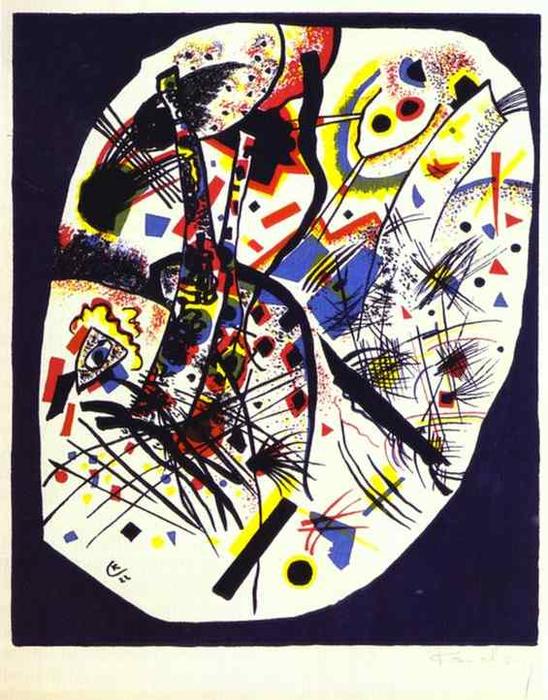
Wassily Kandinsky's 1922 lithograph, “Small Worlds III,” is a pivotal work in the evolution of abstract art, embodying his lifelong exploration of the spiritual and emotional power of form and color. This piece isn’t merely an aesthetic arrangement; it’s a visual articulation of inner worlds, reflecting Kandinsky’s synesthetic experiences – where he perceived colors as having corresponding sounds and emotions.
Deconstructing the Composition
“Small Worlds III” presents a dynamic interplay of geometric shapes against a predominantly white background. The composition is anchored by an oversized, oval form that subtly suggests a head or mask, though Kandinsky intentionally avoids representational clarity.
- Circles: Dominating the artwork are numerous circles – large and small – which Kandinsky associated with spirituality, wholeness, and cosmic energy.
- Geometric Precision: Intersecting lines, triangles, and squares introduce a sense of structure and dynamism. These shapes aren’t arbitrary; they represent for Kandinsky the building blocks of reality, imbued with inherent emotional resonance.
- Color as Emotion: The vibrant color palette – blues, reds, yellows, and greens – is crucial. Kandinsky believed colors directly impacted the soul, and their arrangement here creates a palpable sense of energy and movement.
The Constructivist Influence & Historical Context
Created in 1922, “Small Worlds III” exists within the burgeoning artistic landscape of post-WWI Europe. While deeply rooted in Kandinsky’s own abstract expressionism, it also reflects elements of
Constructivism, a movement championed by artists like Vladimir Tatlin and Alexander Rodchenko. Constructivism sought to reflect modern industrial society through austere geometric forms. Kandinsky, however, infuses this structural approach with his signature spiritual depth, creating a unique synthesis. He was teaching at the Bauhaus during this period, which further influenced his work towards more systematic explorations of form and color relationships.
Symbolism & Interpretation
The symbolism within “Small Worlds III” is deliberately open-ended, inviting individual interpretation. The central oval shape could represent the self, a universal archetype, or simply a focal point for contemplation. The surrounding geometric forms might symbolize external forces, internal conflicts, or the complexities of human experience. Kandinsky himself resisted prescriptive interpretations, believing that art should evoke feeling rather than dictate meaning. It’s a visual poem, not a riddle to be solved.
Emotional Resonance & Lasting Impact
“Small Worlds III” is more than just an intellectual exercise; it's an emotionally engaging experience. The vibrant colors and dynamic composition create a sense of optimism and vitality. The work’s enduring appeal lies in its ability to tap into universal human emotions – joy, anxiety, wonder – without relying on representational imagery. It continues to inspire artists and captivate audiences with its timeless beauty and profound spiritual depth.
Integrating “Small Worlds III” into Your Space
This lithograph’s bold colors and dynamic composition make it a striking focal point for any interior. Its relatively small size (27 x 23 cm) allows for versatile placement – from intimate studies to larger gallery walls. “Small Worlds III” pairs beautifully with modern furniture, minimalist décor, or spaces that celebrate artistic expression. A high-quality reproduction captures the vibrancy and nuance of Kandinsky’s original vision, bringing a touch of abstract brilliance into your home or office.