A Universe in Miniature: Exploring Kandinsky’s ‘Small Worlds XI’
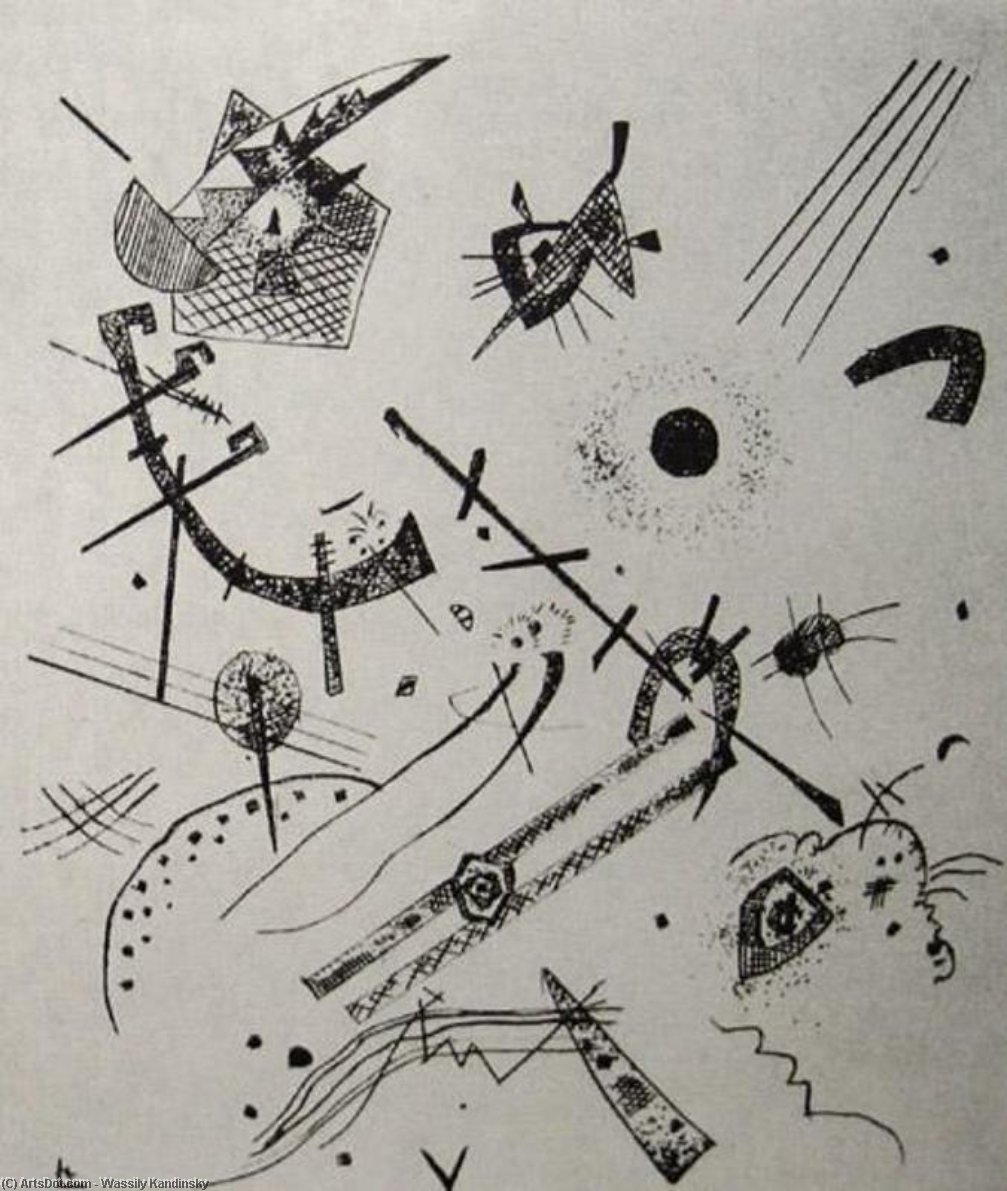
Wassily Kandinsky's ‘Small Worlds XI’, created in 1922, is a captivating example of his mature abstract style. Measuring just 23 x 20 cm, this black and white ink drawing belies its small size with an expansive energy and complex visual language. It’s a work that invites close contemplation, revealing layers of form and feeling within its seemingly chaotic arrangement.
Deconstructing the Abstract Form
This piece is resolutely non-representational. There are no recognizable objects or figures; instead, Kandinsky constructs a dynamic world from fragmented geometric shapes – angular shards juxtaposed with flowing curves and organic forms. The composition is deliberately asymmetrical and crowded, creating a sense of contained dynamism. Lines aren’t merely outlines but active elements, varying in weight and density to build texture through hatching techniques. Diagonal movements sweep across the paper, guiding the eye through this intricate network of shapes. Scattered circular forms, some containing smaller dots, add further visual interest and rhythm.
Kandinsky's Artistic Journey & The Birth of Abstraction
Born in Moscow in 1866, Kandinsky’s path to abstraction was unconventional. Initially trained in law and economics, a transformative experience witnessing Monet’s “Haystacks” ignited his passion for painting. He moved to Munich, immersing himself in the burgeoning Expressionist movement. By 1910, Kandinsky began to move away from representational art, believing that color and form could evoke emotions directly, independent of recognizable subjects. This belief was deeply rooted in his synesthetic experiences – a neurological phenomenon where stimulation of one sense triggers experiences in another (in Kandinsky’s case, he often ‘saw’ colors when hearing music). ‘Small Worlds XI’, created after his time with the influential *Der Blaue Reiter* group and during his teaching period at the Bauhaus, demonstrates a refined control over abstract principles.
Symbolism & Emotional Resonance
While Kandinsky intentionally moved away from depicting concrete reality, his work wasn’t devoid of meaning. He believed abstraction could express inner spiritual realities and emotional states. The fragmented forms in ‘Small Worlds XI’ can be interpreted as representing the complexities of the subconscious mind – a swirling vortex of thoughts, feelings, and memories.
The interplay between sharp angles and soft curves might symbolize conflict and harmony, while the circular shapes could represent wholeness or cycles of life. Ultimately, Kandinsky aimed to create art that resonated with viewers on an emotional level, allowing them to project their own interpretations onto the work.
Technique & Materials
Executed in black ink on paper, ‘Small Worlds XI’ showcases Kandinsky's masterful draftsmanship. The piece is a testament to his skill in freehand drawing and his ability to create depth and texture through line variation.
The stark contrast between black and white emphasizes the formal elements of the composition, highlighting the interplay of shapes and lines. This intimate scale suggests it may have been a study for larger works or a personal exploration of abstract ideas.
Collecting & Interior Design Considerations
‘Small Worlds XI’ offers a sophisticated aesthetic that complements both modern and traditional interiors. Its monochromatic palette makes it incredibly versatile, working well with a variety of color schemes.
- Consider pairing it with minimalist furniture and neutral tones to create a serene atmosphere.
- Alternatively, juxtapose it with bold colors and eclectic décor for a more dynamic effect.
- Its small size makes it ideal for smaller spaces or as part of a gallery wall arrangement.
A high-quality reproduction of ‘Small Worlds XI’ allows art enthusiasts to experience the power and beauty of Kandinsky's abstract vision, bringing a touch of artistic innovation and intellectual depth into their homes.