The Genesis of Abstraction: Unveiling "Study for Chacun pour soi"
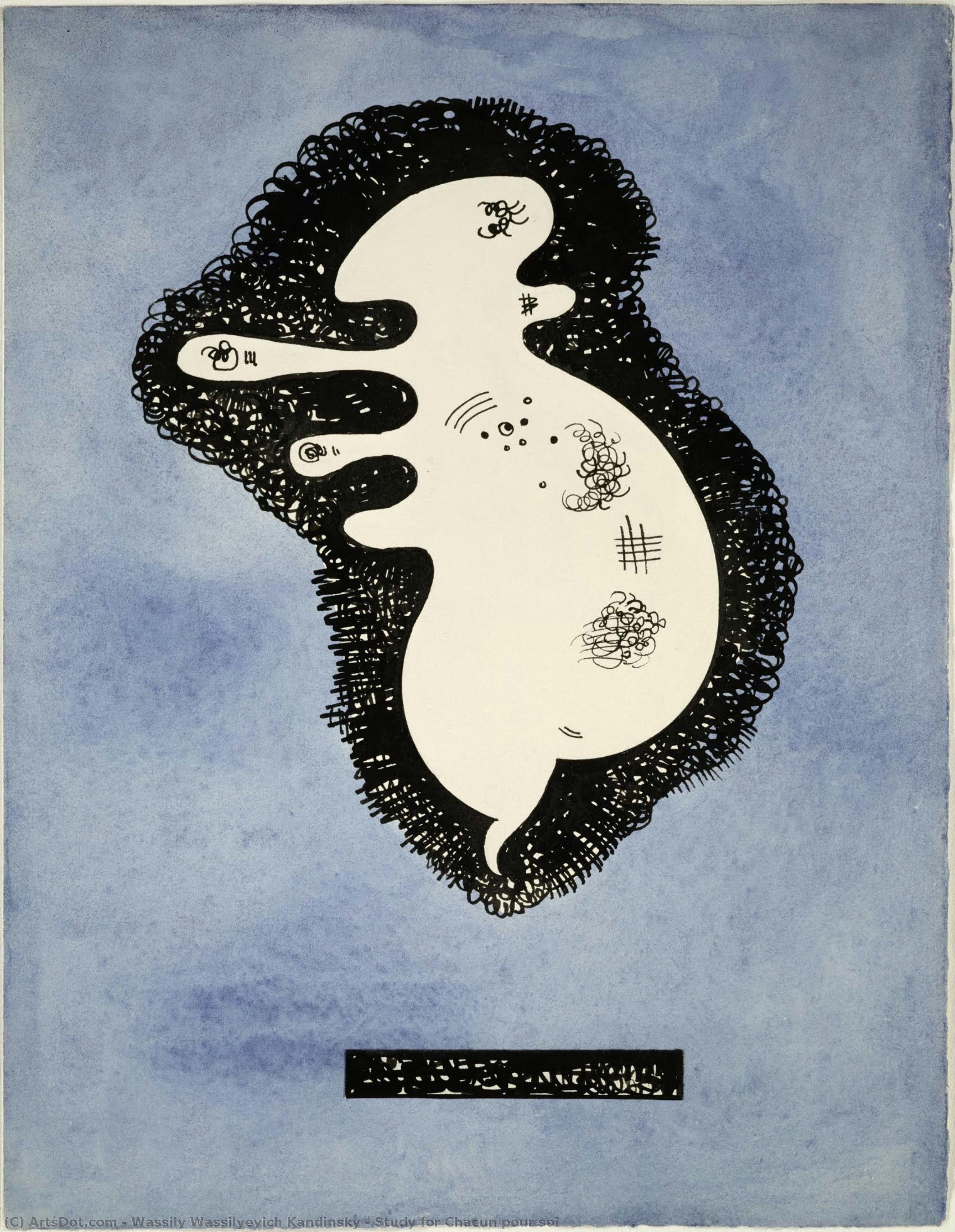
Wassily Kandinsky's 1934 work, “Study for Chacun pour soi” (French for “Each for Himself”), isn’t merely a painting; it’s a visual distillation of the artist’s lifelong quest to translate inner experience into tangible form. Born in Moscow amidst a rich tapestry of Russian folklore and deeply influenced by the burgeoning world of Impressionism – particularly Monet's evocative landscapes – Kandinsky embarked on a radical journey, ultimately pioneering abstraction as a legitimate artistic language. This particular study, created during a period of intense introspection and experimentation, represents a pivotal moment in his development, foreshadowing the vibrant, emotionally charged abstract compositions that would define his legacy. The painting’s genesis lies not in external observation but within Kandinsky's own spiritual and psychological landscape – a realm he sought to render visible through color, line, and form.

A Symphony of Color and Form: Technique and Composition
The painting’s immediate impact is dominated by a striking blue background, providing a serene yet dynamic stage for the central figure – a complex, almost monstrous form constructed from fragmented limbs, arms, and a head. This creature isn't rendered with realistic detail; instead, it exists as an assemblage of geometric shapes and organic curves, meticulously outlined in stark white. Scattered across the canvas are numerous dots, adding a layer of texture and depth that subtly shifts the perception of space. Kandinsky’s technique is characterized by a deliberate simplification of form, prioritizing emotional resonance over literal representation. He employed watercolor and ink on paper, a combination that lends the work a delicate yet forceful quality – the colors bleed slightly, creating an ethereal effect while the sharp white lines assert a powerful presence. The composition itself is deliberately unbalanced, mirroring the inherent tension within the subject matter.
Decoding the Symbolism: “Chacun pour soi” and its Implications
The title "Chacun pour soi" – “Each for Himself” – immediately introduces a complex layer of meaning. It’s not simply a statement about individualism, though that certainly plays a role. Kandinsky was deeply interested in the relationship between art, spirituality, and human consciousness. The painting can be interpreted as an exploration of this tension: the struggle to find one's own voice and identity within a world often characterized by conflict and isolation. The fragmented form suggests a broken or incomplete self, while the scattered dots represent individual elements striving for connection. Some scholars have linked the imagery to Kandinsky’s interest in Jungian psychology, suggesting that the creature embodies archetypal figures representing primal instincts and unconscious forces. The painting's creation during a period of political upheaval in Europe further amplifies this sense of inner turmoil and uncertainty.
A Bridge Between Inner Worlds: Historical Context and Legacy
“Study for Chacun pour soi” was created in 1934, a time when Kandinsky was grappling with the rise of totalitarianism and the increasing fragmentation of European society. His work reflects this broader cultural anxiety, yet it also embodies his unwavering belief in the transformative power of art. It’s a key example of his development towards pure abstraction, moving away from representational imagery to focus on the emotional and spiritual impact of color and form. This piece is considered alongside other studies he created during that period, such as “Study for Auf Weiss II,” demonstrating a consistent exploration of geometric forms and their expressive potential. Today, "Study for Chacun pour soi" stands as a testament to Kandinsky’s revolutionary vision – a powerful reminder that art can transcend the limitations of reality and offer a glimpse into the depths of human experience. Reproductions of this work continue to captivate viewers with its enigmatic beauty and profound symbolism.