A Symphony of Chaos: The Visionary World of Kandinsky
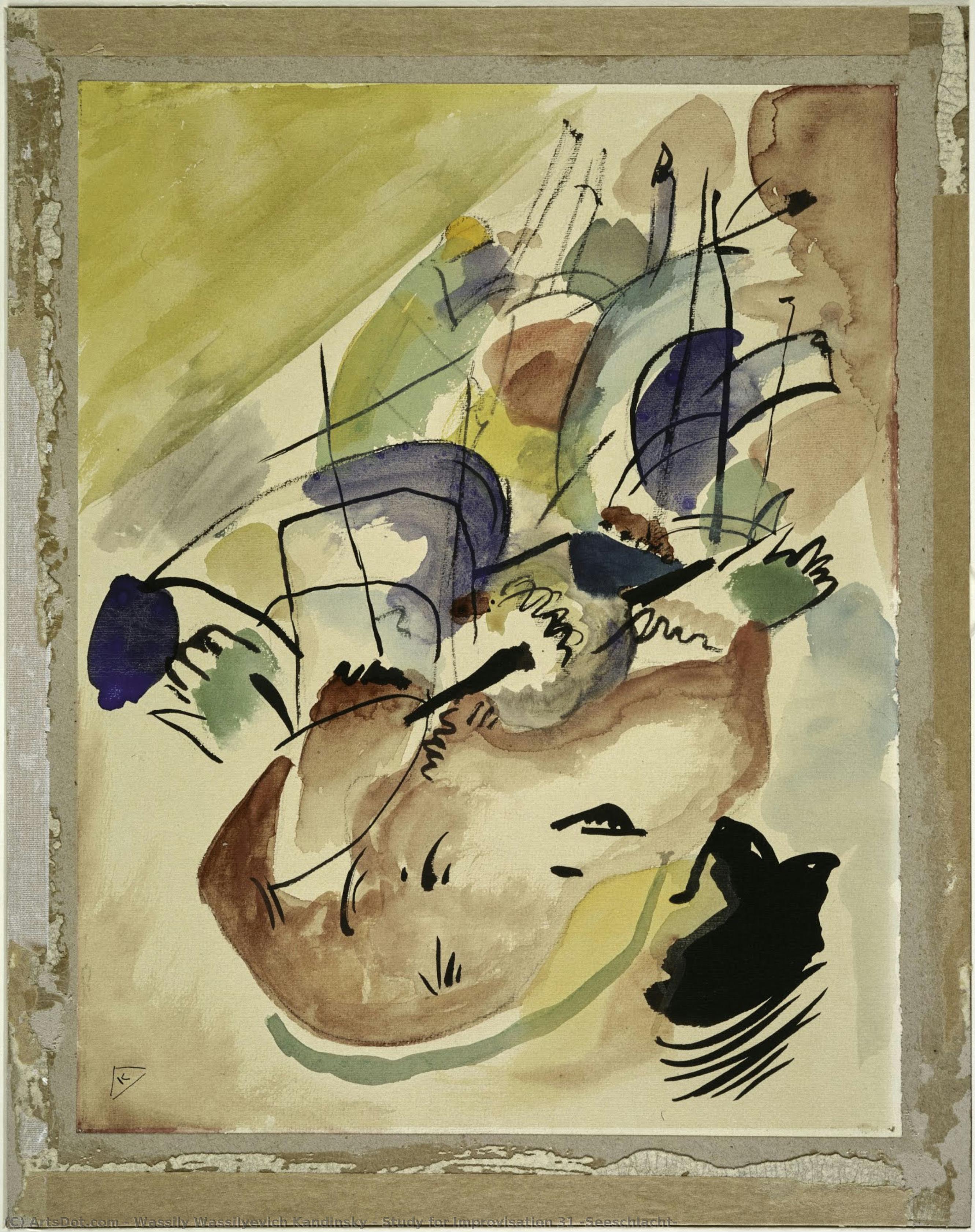
In the realm of early twentieth-century modernism, few works capture the raw, unbridled energy of transition quite like Wassily Kandinsky’s Study for Improvisation 31 (Seeschlacht). Created in 1913, this watercolor is far more than a mere maritime sketch; it is a profound window into the soul of an artist attempting to dismantle the boundaries of reality. At its heart, the piece explores the concept of a naval battle, yet through Kandinsky’s revolutionary lens, the conflict transcends physical ships and cannons to become a spiritual struggle between opposing cosmic forces. To gaze upon this work is to witness the birth of abstraction, where the tangible world begins to dissolve into a rhythmic dance of color and form.
The composition vibrates with an almost musical intensity, a direct reflection of Kandinsky’s deep-seated belief in the synesthetic connection between sound and sight. Much like a Wagnerian opera, the painting utilizes improvisation—not as a lack of structure, but as a spontaneous outpouring of emotion. The viewer is drawn into a swirling vortex where slender black lines suggest masts and weaponry, yet these elements are secondary to the overwhelming sensory experience of the washes of color. It is a piece that demands attention, offering a sense of movement that feels both chaotic and meticulously orchestrated, making it an extraordinary focal point for any collection dedicated to the avant-garde.
Technique and the Alchemy of Color
Kandinsky’s mastery of the watercolor medium is on full display here, as he utilizes the transparency of the pigment to create a sense of ethereal depth. The technique is characterized by loose, expressive brushstrokes that allow colors to bleed into one another, creating soft transitions that mimic the unpredictable nature of sea spray and smoke. This fluidity is essential to the artwork's impact; it prevents the eye from resting on any single static object, instead encouraging a continuous journey across the canvas. The layering of pigments creates a luminous quality, where light seems to emanate from within the paper itself.
The color palette serves as the emotional heartbeat of the work. Kandinsky famously viewed yellow as the "soul of painting," and in this study, splashes of brilliant yellow act as beacons of spiritual illumination amidst the turmoil. These warm tones are set against deep, melancholic blues and energetic reds, creating a chromatic tension that mirrors the subject of battle. For the discerning collector or interior designer, these vibrant hues offer a sophisticated way to introduce dynamic energy into a space, providing a sophisticated balance of warmth and contemplative depth that can anchor a room's aesthetic.
A Legacy of Spiritual Abstraction
To understand this piece is to understand the historical pivot point of 1913. This was an era of intense intellectual ferment, where artists were eager to move beyond the "representational illusion" and tap into something more primal. Kandinsky’s work during this period was heavily influenced by his interest in Russian folklore and the apocalyptic imagery found in the Book of Revelation, suggesting that the "sea battle" might be a metaphor for the upheaval of the modern age. By stripping away the literal details of a naval engagement, he invites the viewer to experience the essence of conflict and resolution.
For those seeking to bring a piece of art history into their personal environment, a high-quality reproduction of this study offers more than just decoration; it offers an invitation to contemplation. It is a work that rewards repeated viewing, revealing new layers of complexity with every encounter. Whether placed in a contemporary gallery setting or a curated residential space, Study for Improvisation 31 stands as a testament to the enduring power of the human spirit to find beauty and meaning within the heart of chaos.