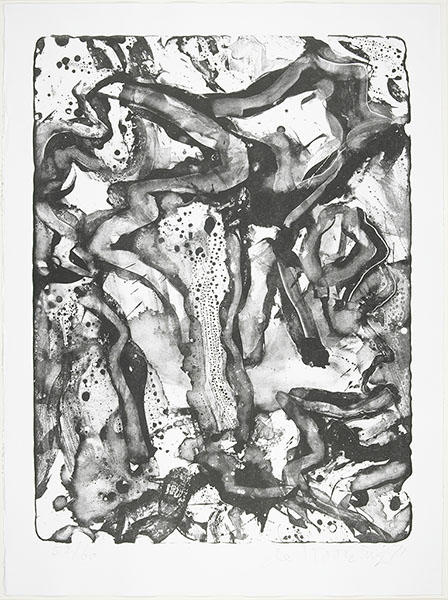
Explore Willem de Kooning's 'Landscape at Stanton Street,' a dynamic lithograph capturing urban energy through swirling lines and abstract forms. A raw, expressive piece of American Abstract Expressionism.
Discover Willem de Kooning (1904-1997), a pivotal Abstract Expressionist. Explore his iconic 'Woman' series & dynamic paintings known for bold brushwork, emotional intensity, and influence on the New York School.
Landscape at Stanton Street: A De Kooning Vision of Urban Flux
Willem de Kooning’s “Landscape at Stanton Street,” painted in 1971, isn't merely a depiction of a street scene; it’s an intensely felt embodiment of urban energy and the complexities of modern life. This lithograph, born from the raw dynamism of Abstract Expressionism, invites us into a world where recognizable forms dissolve into swirling lines and gestural marks, creating a powerful visual experience that resonates with both anxiety and exhilaration. De Kooning, already a titan of his era, was grappling with the shifting landscape of New York City – its relentless growth, its fractured identities, and the sense of disorientation it could evoke – and this work serves as a potent distillation of those feelings. The piece’s genesis in a lithograph technique is crucial; the inherent texture of the stone or metal plate, combined with the careful application of ink, lends an immediate physicality to the image, mirroring the energy de Kooning sought to convey.
The Language of Line and Form
At first glance, “Landscape at Stanton Street” appears chaotic – a tangle of dark and light, thick and thin lines that seem to collide and intertwine. However, beneath this apparent disorder lies a carefully constructed composition. De Kooning masterfully employs curvilinear forms, reminiscent of both organic growth and the rigid geometry of cityscapes, creating a sense of movement and flow. There’s no single point of focus; instead, the eye is drawn on a journey across the surface, following the currents of line and shape. The deliberate absence of traditional perspective—the vanishing point, the illusion of depth—further contributes to the feeling of disorientation, mirroring the experience of navigating an unfamiliar urban environment. The monochromatic palette – primarily shades of black, white, and gray – amplifies this effect, stripping away any distractions and forcing us to confront the raw materiality of the lines themselves.
A Technique of Controlled Chaos
The lithograph process itself is integral to understanding “Landscape at Stanton Street.” Lithography demands a delicate balance between control and spontaneity. De Kooning’s initial sketch guides the artist as he applies ink to the stone, creating an image that is both meticulously planned and intuitively executed. The resulting surface isn't smooth; it’s textured with subtle variations in tone and density, reflecting the physicality of the process and adding a layer of visual interest. The use of overlapping lines creates a sense of layering and recession, suggesting depth without relying on traditional perspective techniques. This technique allows de Kooning to capture not just the appearance of a landscape but also its underlying energy and emotional resonance. The influence of artists like Franz Kline, known for his bold, gestural marks, is clearly evident in this work—a deliberate departure from representational painting towards an expressionistic approach.
Symbolism and Emotional Resonance
While “Landscape at Stanton Street” resists straightforward interpretation, it’s impossible to ignore the underlying symbolism. The fragmented forms can be seen as representing the fractured nature of urban life – its constant change, its conflicting identities, and its potential for both beauty and alienation. The swirling lines evoke a sense of movement and dynamism, mirroring the relentless pace of city life. The work's emotional impact is undeniably complex; it’s not simply joyful or melancholic but rather a potent blend of both. There’s an underlying tension, a feeling of unease that speaks to the anxieties inherent in navigating a rapidly changing world. It’s a landscape viewed through the lens of experience—a reflection on the human condition within the context of a sprawling metropolis.
Bringing De Kooning's Vision Home
ArtsDot offers meticulously crafted hand-painted reproductions of “Landscape at Stanton Street,” allowing you to bring this iconic work into your own space. Our artists replicate de Kooning’s distinctive style and technique with exceptional precision, capturing the raw energy and emotional depth of the original lithograph. Whether you're an art collector, a design enthusiast, or simply someone seeking a unique piece of art for your home, a ArtsDot reproduction offers a beautiful and authentic way to experience the power of Willem de Kooning’s vision. Explore our selection today and discover how this captivating landscape can transform your surroundings.