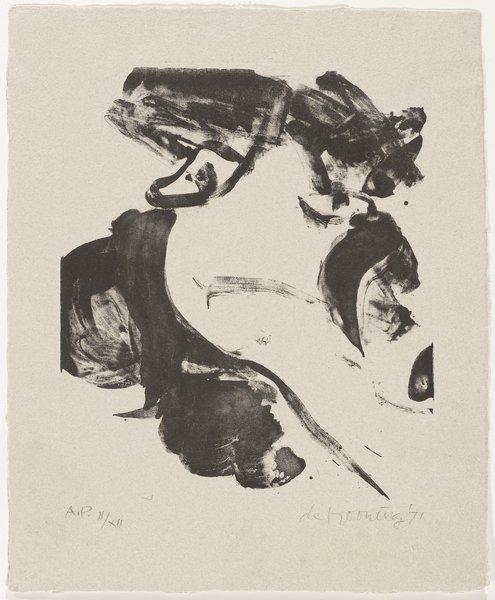
With Love by Willem de Kooning – An intimate portrait rendered in stark black and white, capturing the artist's signature expressive brushstrokes and conveying a profound sense of emotion. Explore this iconic piece of Abstract Expressionism.
A Portrait of Turbulent Emotion: Willem de Kooning’s “With Love”
Willem de Kooning's "With Love," created in 1971, isn’t merely a painting; it’s an embodiment of the artist’s signature style—Abstract Expressionism—a movement that sought to liberate art from representational constraints and prioritize raw emotion as its primary driver. Produced by Hollander Graphic Workshop and Xavier Fourcade Gallery, this striking print captures a fragment of De Kooning's monumental canvas, offering viewers a glimpse into his intensely personal vision.
- Subject Matter: The artwork centers on a close-up portrait of a human face—a figure rendered in shades of gray and white—that exudes palpable anxiety and vulnerability. Despite the seemingly simple composition, De Kooning skillfully conveys a complex psychological state.
- Style & Technique: Characteristic of Abstract Expressionism, “With Love” abandons traditional perspective and anatomical accuracy. Instead, De Kooning employs bold brushstrokes and textured surfaces to create an impressionistic effect—a deliberate blurring of lines that emphasizes the emotional resonance of the image rather than precise visual detail.
The painting’s historical context is crucial to understanding its significance. De Kooning emerged as a leading figure in the postwar art scene, reacting against the formalism prevalent in Europe and establishing New York City as the epicenter of American artistic innovation. He was deeply influenced by Surrealism and Jungian psychology, exploring themes of unconsciousness and primal instinct within his work—a desire to tap into the deepest recesses of human experience.
Symbolism: The muted color palette contributes significantly to the artwork’s symbolic power. Gray represents ambiguity and uncertainty, mirroring the subject's emotional turmoil. The closed eyes suggest introspection and a retreat from external stimuli, highlighting the importance of inner contemplation.
Finally, “With Love” possesses an undeniable emotional impact. It compels viewers to confront uncomfortable truths about human vulnerability and resilience—a reminder that beauty can reside in imperfection and that art serves as a conduit for conveying profound psychological states. Its enduring appeal lies in its ability to provoke reflection and resonate with audiences across generations.
Exploring De Kooning’s Bold Brushstrokes & Textured Surface
De Kooning's technique involved layering paint onto canvas, building up thick impasto—a sculptural buildup of pigment—that creates palpable ridges and crevices. This textural element isn't merely decorative; it actively contributes to the painting's expressive qualities, mirroring the turbulent emotions depicted within.
A Reflection on Surrealist Influences & Psychological Depth
Like many Surrealists before him, De Kooning investigated dreamlike imagery and irrational associations—drawing inspiration from Jung’s theories of archetypes and collective unconsciousness. This exploration of the subconscious informs his artistic process and imbues “With Love” with a sense of unsettling mystery.
The Legacy of Abstract Expressionism & Its Enduring Relevance
“With Love” stands as a testament to the transformative power of Abstract Expressionism—a movement that fundamentally altered the course of art history and continues to inspire artists today. Its focus on emotion, spontaneity, and textural materiality remains remarkably pertinent in contemporary artistic discourse.