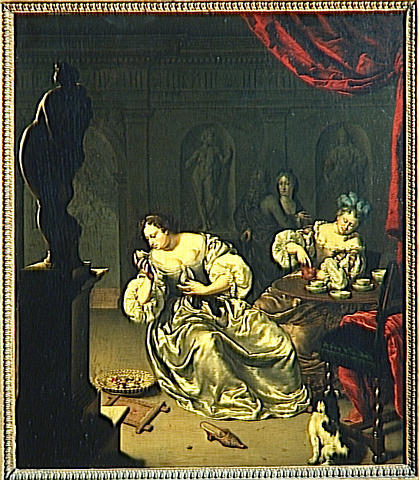
This stunning oil on canvas reproduction showcases Willem van Mieris’s signature style: genre painting emphasizing domestic interiors with meticulous realism. Observe the serene atmosphere illuminated by soft light as figures engage in tea preparation, reflecting the cultural significance of leisure and social status during the Dutch Baroque era.
Willem van Mieris (1662-1747) was a Dutch fijnschilder known for elegant genre scenes & portraits of upper-class society. A master of detail, he continued the Leiden tradition alongside his father, Frans van Mieris the Elder.
Explore the Louvre Museum in Paris! Home to iconic masterpieces like the Mona Lisa & Venus de Milo, journey through art history from ancient Egypt to Renaissance icons. Plan your visit today!
A Moment of Refinement: Exploring Willem van Mieris’s “Le Thé”
“Le Thé,” painted circa 1690 by Willem van Mieris, offers a captivating glimpse into the opulent domestic interiors characteristic of Dutch Golden Age painting. More than just a depiction of tea preparation—a pastime gaining considerable prestige during the seventeenth century—the artwork embodies an ethos of elegance and social status, meticulously rendered with unparalleled attention to detail. This essay delves into the multifaceted layers of artistic merit embedded within this iconic genre scene, examining its composition, color palette, stylistic influences, and enduring emotional resonance.
Composition & Spatial Narrative
The painting’s central focus is a trio engaged in the ritualistic act of brewing tea—two women meticulously arranging tea leaves into a delicate dish while a man observes from behind, partially obscured by shadow. Van Mieris skillfully orchestrates this tableau within an expansive room adorned with classical architectural elements: towering columns and arched doorways contribute to a sense of grandeur and reinforce the impression of affluence. The placement of figures is deliberate; their positioning guides the viewer’s gaze across the canvas, fostering a feeling of immersive realism. Furthermore, the subtle use of perspective creates depth, anchoring the scene within its environment and enhancing its visual impact.
Color Palette & Atmospheric Light
Dominating the color scheme are warm hues—creams, golds, browns, and muted reds—creating an inviting ambiance that speaks to the comfort and sophistication of the era. Pale blues appear sparingly in drapery and clothing, providing a subtle counterpoint to the dominant warmth and emphasizing textural nuances. Van Mieris’s masterful manipulation of light is equally noteworthy; diffused illumination emanates from an unseen source, casting soft shadows and illuminating faces with gentle radiance. This technique not only enhances realism but also imbues the scene with an emotional quality—a quiet intimacy punctuated by moments of observation and contemplation.
Style & Technique: The Legacy of Leiden’s Fijnschilders
“Le Thé” exemplifies the hallmarks of Leiden’s fijnschilder movement, spearheaded by artists like Gerrit Dou and Frans van Mieris the Elder. Like his father, Willem meticulously adhered to the principles of realism championed by Dou—a commitment to capturing subtle nuances of human expression and portraying everyday life with remarkable accuracy. The artist's technique is characterized by painstaking detail; brushstrokes are delicately blended to achieve smooth surfaces and convincingly render textures – from the velvety sheen of silk garments to the rough surface of stone columns and the delicate arrangement of tea leaves. This meticulous approach underscores Van Mieris’s dedication to upholding Leiden’s artistic tradition and elevating genre painting to new heights of sophistication.
Symbolism & Contextual Significance
Beyond its aesthetic beauty, “Le Thé” carries symbolic weight, reflecting the burgeoning fascination with tea culture in Europe during the seventeenth century. Tea drinking was viewed as a mark of refinement and leisure—a pastime enjoyed by members of the aristocracy and upper classes—and Van Mieris’s depiction captures this social milieu perfectly. The inclusion of a dog at the woman's feet serves as a charming domestic detail, reinforcing the scene’s portrayal of comfortable familial life. Ultimately, “Le Thé” transcends mere representation; it encapsulates an ideal of civilized society and invites viewers to contemplate the pleasures of quiet contemplation amidst beauty and refinement.
Concluding Reflection
Willem van Mieris's "Le Thé" remains a testament to the artistic prowess of the Dutch Golden Age—a masterpiece that continues to inspire admiration for its masterful composition, luminous color palette, and unwavering commitment to realism. Reproductions offer an exceptional opportunity to experience this iconic artwork firsthand, transporting viewers back in time to appreciate the elegance and sophistication of seventeenth-century Dutch culture.