A Window into the 18th Century Marketplace
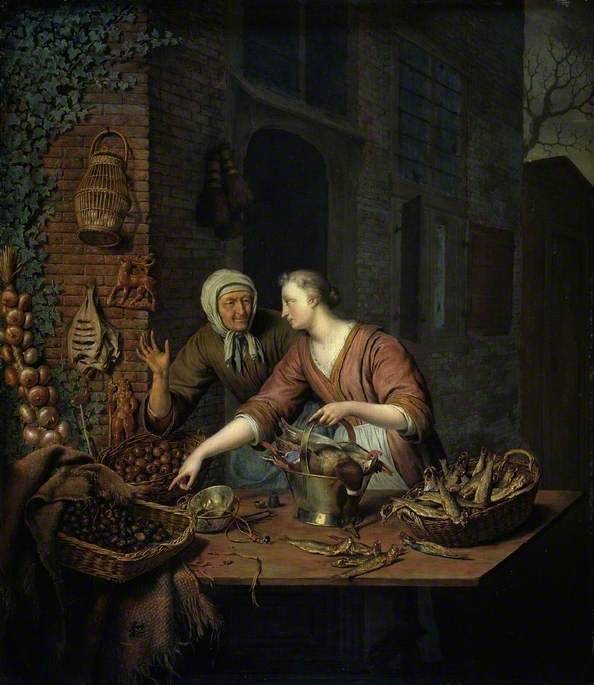
In the quiet, meticulous strokes of Willem van Mieris’s "The Market Stall," we are transported away from the frenetic pace of modern life and into the intimate, textured reality of an 18th-century European street. Painted in 1730, this exquisite oil on panel serves as more than just a depiction of commerce; it is a profound study of human connection and the beauty found in the mundane. The scene unfolds within the narrow confines of what appears to be a cobblestone alleyway, where the sunlight filters softly to illuminate a moment of quiet negotiation. At the heart of the composition, two figures are locked in a silent dialogue—one gesturing with the practiced ease of a merchant toward baskets of fresh produce, the other listening with a focused, contemplative stillness. This interaction captures the very pulse of Dutch social life, where every transaction was an opportunity for community engagement.
The mastery of the Leiden fijnschilder technique is on full display here, offering a feast for the eyes that delights both the casual observer and the seasoned collector. Van Mieris employs a sophisticated palette of muted earth tones—deep ochres, soft umbers, and subtle creams—which lends the work an organic, timeless quality. His ability to manipulate light and shadow creates a palpable sense of three-dimensional depth; one can almost feel the rough texture of the brick wall in the background and the cool, damp surface of the fish resting in their woven baskets. The meticulous attention to detail, from the delicate weave of the containers to the glint of light on a piece of fruit, exemplifies the Dutch Golden Age tradition of hyper-realism, making each element feel heavy with presence and importance.
Symbolism and the Art of Everyday Life
Beyond its surface beauty, "The Market Stall" is rich with the subtle symbolism characteristic of the Dutch Baroque period. The abundance of the foreground—the overflowing baskets of vegetables and the carefully arranged bowls—serves as a celebration of prosperity and the bounty of the earth. In the context of the 18 and early 19th centuries, such imagery often reflected a sense of stability and the rewards of honest labor. The composition itself, focusing on the intimate space between the buyer and seller, elevates the act of daily commerce to something sacred and dignified. There is a rhythmic balance in the arrangement of objects that guides the viewer's eye through the narrative, ensuring that no detail is lost in the atmospheric haze of the marketplace.
For the discerning interior designer or art enthusiast, this piece offers an unparalleled sense of warmth and historical gravity. A high-quality reproduction of this work does not merely decorate a wall; it anchors a room with a sense of heritage and quiet sophistication. The painting’s ability to evoke nostalgia while maintaining a contemporary aesthetic appeal makes it a versatile choice for curated collections or elegant living spaces. It invites conversation, prompting viewers to linger on the fine details and reflect on the enduring simplicity of human interaction. To possess such a work is to hold a fragment of history, a beautifully preserved moment of light, shadow, and life.