A Tender Departure: The Emotional Resonance of Bouguereau’s Masterpiece
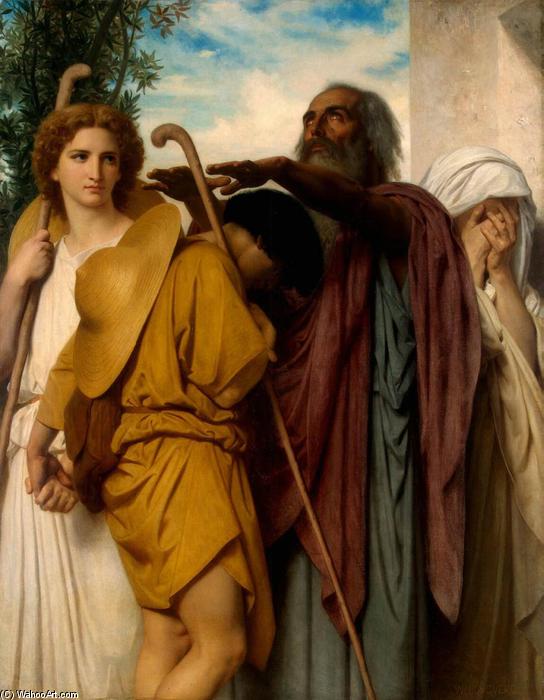
In the quiet, evocative depths of William-Adolphe Bouguereau’s 1860 masterpiece, Tobias Saying Farewell to his Father, we find a moment suspended in the amber of eternal emotion. This monumental canvas, currently preserved within the hallowed halls of The Hermitage Museum, is far more than a mere historical tableau; it is a profound meditation on the fragility of human connection and the bittersweet nature of transition. As the eye wanders through the composition, one is immediately struck by the palpable tension between the warmth of familial devotion and the chilling reality of separation. Bouguereau, a master of the academic tradition, invites us into a sacred space where the boundaries between the earthly and the divine seem to blur, capturing a narrative that feels as intimate as a whispered prayer.
The scene unfolds with a carefully orchestrated dialogue between generations. At its heart lies the poignant interaction between Tobias and his father, a moment defined by both tenderness and a heavy sense of resignation. The figures are arranged in a way that draws the viewer into their private orbit, creating an atmosphere of profound vulnerability. A subtle yet powerful symbolic element resides in the upper corner—a bird that serves as a silent sentinel of hope and remembrance, fluttering amidst the melancholy of parting. Even the inclusion of everyday details, such as the presence of skis, grounds this high-drama moment in the universality of human experience, suggesting that even within grander historical or religious narratives, the small, tangible elements of life remain ever-present.
Technical Virtuosity and the Radiance of Realism
To behold this work is to witness the pinnacle of 19th-century painterly excellence. Bouguereau’s technique is a triumph of academic realism, characterized by an almost supernatural ability to manipulate light and texture. Through the painstaking application of multiple glazes, the artist achieves a luminous quality that makes the skin of his subjects appear to glow from within. This meticulous layering allows for a seamless transition between shadow and highlight, lending the figures a sculptural three-dimensionality that commands the viewer's attention. The textures—from the heavy, rich folds of the red cloak to the soft, delicate rendering of the surrounding landscape—are executed with such precision that one can almost feel the weight of the fabric and the coolness of the air.
For the discerning collector or interior designer, this painting offers an unparalleled opportunity to introduce a sense of classical grandeur and emotional depth into a space. The harmonious blend of soft, rounded forms and a balanced color palette makes it a versatile centerpiece for sophisticated environments. Whether placed in a sunlit gallery or a more intimate study, the artwork acts as a window into a world of idealized beauty and historical significance. It is not merely a decoration but an invitation to contemplation, offering a timeless elegance that transcends modern trends and provides a lasting legacy of artistic sophistication.