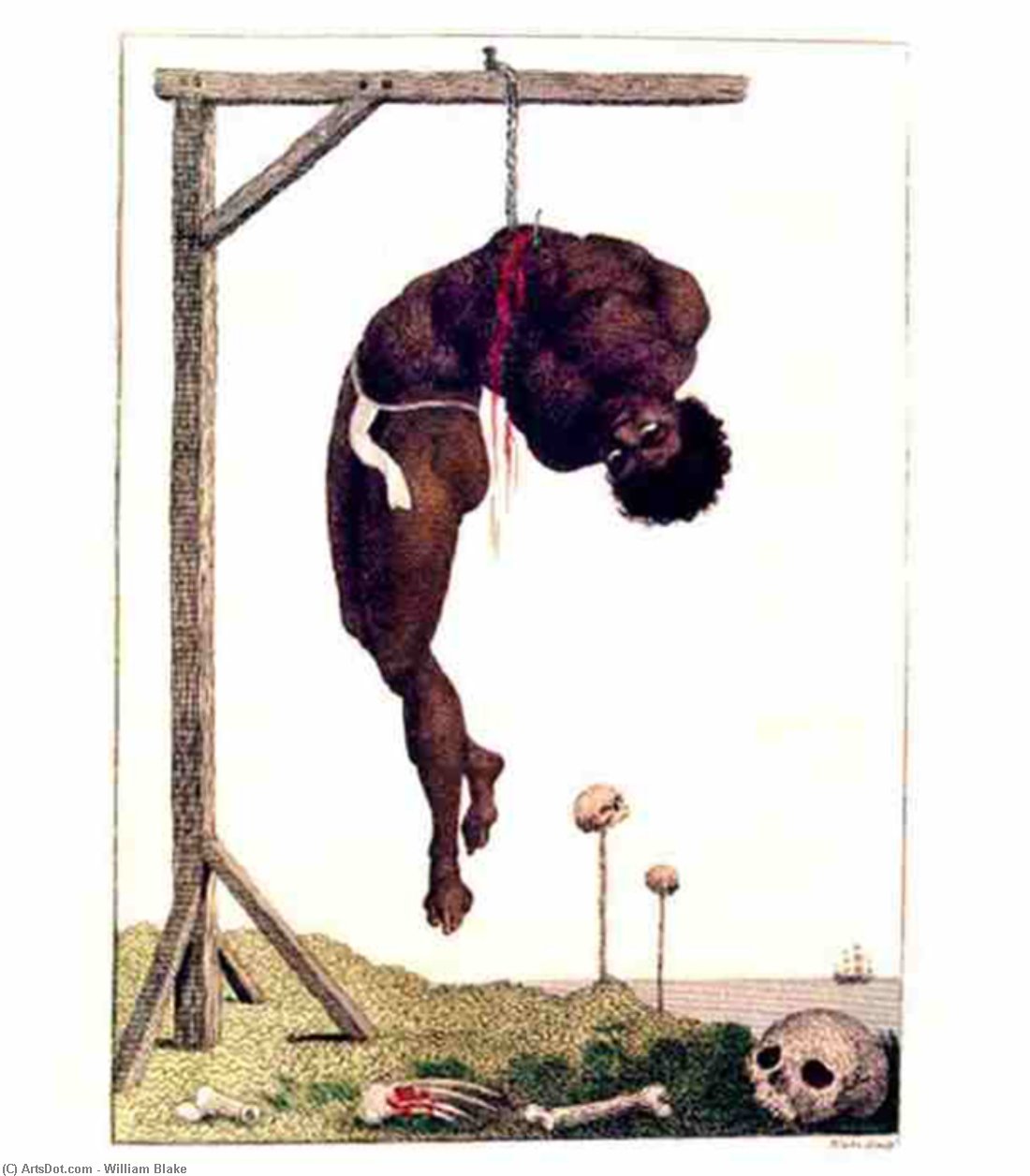
This unsettling print portrays a man suspended from a gallows, reflecting Blake’s Romantic fascination with death and suffering. Executed in etching with aquatint and hand-coloring, it captures the grim realities of Suriname's slave trade and utilizes symbolic imagery—crucifixion, skulls—to convey horror and critique.
Explore William Blake's visionary art & poetry (1757-1827). A Romantic icon known for mystical themes, illuminated printing, & works like 'The Tyger'. Discover his legacy!
A Grim Testament of Suffering: William Blake’s “A Negro Hung Alive by the Ribs”
The etching, titled "A Negro Hung Alive by the Ribs," stands as a chilling emblem of Romantic horror and social critique—a visceral depiction born from John Gabriel Stedman's harrowing firsthand account of slavery in Suriname. Created in 1796, Blake’s artwork transcends mere visual representation; it embodies a profound engagement with moral concerns prevalent during its time, cementing its place within the broader artistic landscape of the era.
The Narrative Behind the Image
Stedman’s expedition into Suriname aimed to quell slave uprisings fueled by brutal conditions and systematic cruelty—a mission documented in excruciating detail within his *Narrative*. Blake skillfully captured Stedman's observations, translating them into a powerfully unsettling image that confronts viewers with the barbarity of colonial exploitation. Stedman recounted that the victim was kept alive for three days before succumbing to death without complaint – a poignant juxtaposition against the gruesome spectacle unfolding before him. This observation underscores the pervasive horror of the scene and is amplified by the symbolic presence of skulls and bones in the foreground, representing mortality and decay—a deliberate allusion to the inescapable fate awaiting all human beings. The distant ship serves as an unsettling reminder of journeys beyond life, furthering the artwork’s thematic exploration of death and transcendence.
Blake's Technique: Etching with Aquatint and Hand-Coloring
William Blake’s artistic prowess is evident in his masterful execution of etching with aquatint—a technique that allows for nuanced tonal gradations—combined with meticulous hand-coloring. The copper plate was meticulously incised, creating a dense matrix of lines that would absorb ink during the printing process. Subsequent application of aquatint produced subtle shading effects, enhancing the overall mood and contributing to the artwork’s dramatic impact. Finally, Blake painstakingly applied watercolor pigments to accentuate specific areas—primarily the man's skin tone, the grassy foreground, and around the rope—adding depth and vibrancy while simultaneously emphasizing key visual elements. This combination of etching and hand-coloring exemplifies Blake’s commitment to pushing the boundaries of printmaking and conveying complex emotional narratives.
Symbolism: Crucifixion and Mortality
“A Negro Hung Alive by the Ribs” is laden with symbolic significance, reflecting Blake's preoccupation with religious iconography and philosophical contemplation. The figure’s posture mimics the crucifixion—a gesture universally associated with sacrifice and suffering—drawing parallels to Christ’s martyrdom and elevating the image beyond a mere depiction of torture. Simultaneously, the scattered skulls and bones serve as potent reminders of mortality—a stark confrontation with the inevitability of death that underscores the artwork's moral dimension. Blake’s deliberate use of these symbols invites viewers to grapple with profound questions about human existence and spiritual redemption.
A Gothic Vision Within Romanticism
Blake’s style seamlessly blends elements of Romanticism with a gothic sensibility—a stylistic fusion characterized by heightened emotion, dramatic lighting, and an exploration of dark psychological themes. The flattened perspective contributes to the artwork's somber atmosphere, eschewing spatial depth in favor of conveying immediacy and emotional intensity. Cross-hatching and stippling techniques create textural surfaces that heighten visual impact, mirroring the roughness of wood and skin—a deliberate choice reflecting Blake’s fascination with materiality and his desire to evoke visceral responses from the audience. Ultimately, “A Negro Hung Alive by the Ribs” remains a haunting testament to human cruelty and compassion—a timeless masterpiece that continues to provoke contemplation and inspire artistic interpretation.