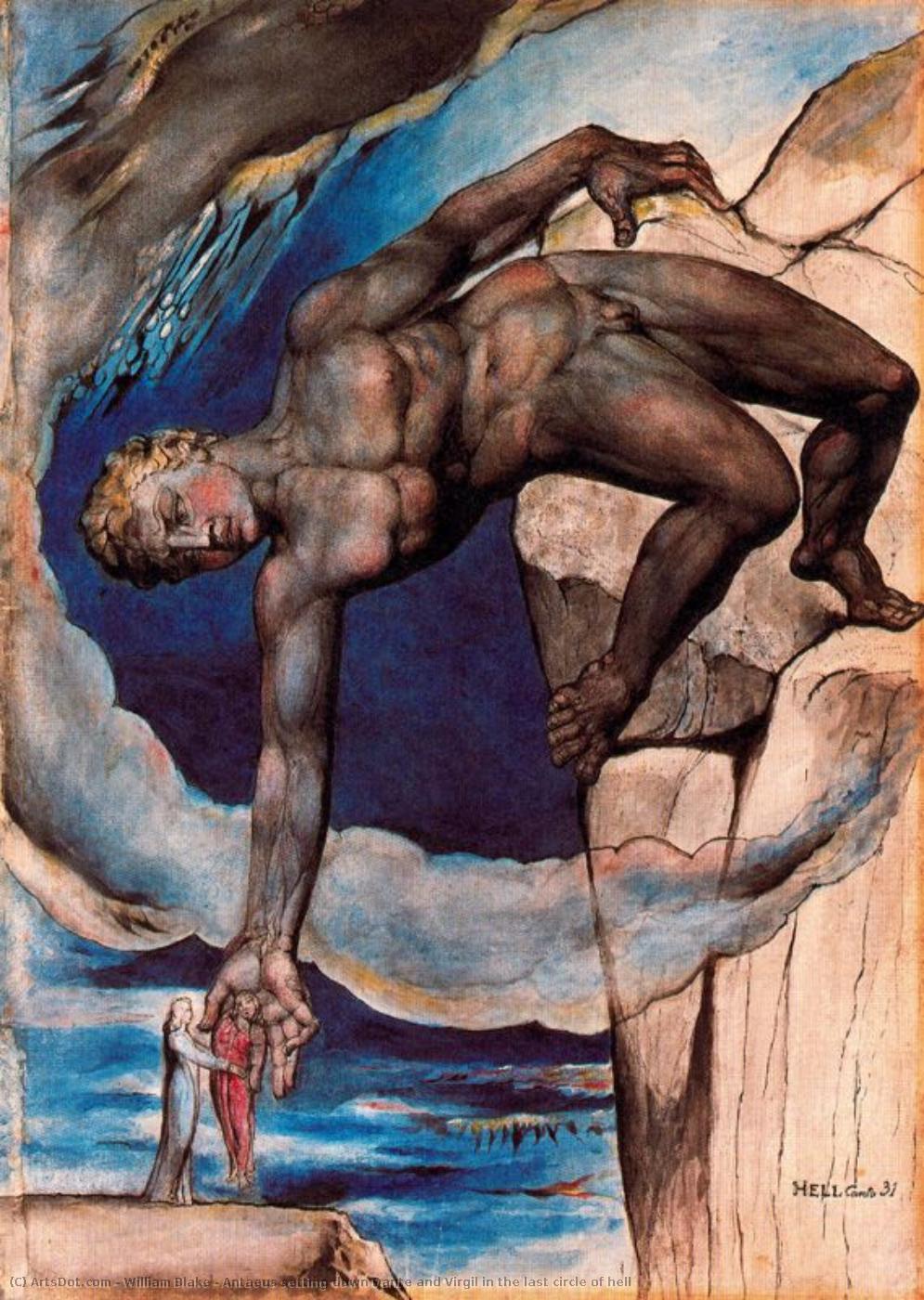
A Descent Into Darkness: William Blake’s “Antaeus Setting Down Dante and Virgil”
William Blake's "Antaeus Setting Down Dante and Virgil in the Last Circle of Hell," painted in 1827, is not merely a depiction of a biblical scene; it’s a profound exploration of human experience, morality, and the inescapable pull of darkness. This arresting image, rendered in a strikingly intimate scale of 37 x 53 cm, immediately draws the viewer into a landscape both terrifying and strangely compelling – a volcanic realm mirroring the depths of the soul. Blake, a figure perpetually ahead of his time, masterfully utilizes symbolic representation to convey layers of meaning rooted in Dante Alighieri’s *Inferno* and his own intensely personal spiritual beliefs.
The central figures—Antaeus, the titan forever bound to the earth, and Dante and Virgil—are presented in a moment of intense physicality. Antaeus, with arms outstretched as if grasping for salvation, is lowering the weary Dante and Virgil onto the jagged rocks of the ninth circle – the realm of those who betrayed faith. The posture of each figure speaks volumes: Dante’s face etched with exhaustion and despair, Virgil’s bearing resolute yet burdened by the task of guiding his master through this harrowing journey. Blake deliberately avoids romanticizing the scene; there's no heroic grandeur here, only a raw, almost brutal depiction of suffering and the consequences of transgression.
The Alchemy of Print: Technique and Style
Executed as an engraving with watercolor additions – a technique Blake favored to achieve both intricate detail and luminous color—the work showcases his unparalleled mastery of printmaking. The stark lines of the engraving, particularly evident in Antaeus’s form and the surrounding landscape, provide a powerful foundation for the delicate washes of watercolor that imbue the scene with an unsettling atmosphere. Blake's use of chiaroscuro – the dramatic contrast between light and shadow – is exceptionally effective, emphasizing the jagged edges of the rocks, the looming darkness, and the vulnerability of the figures. This interplay of light and dark isn’t simply aesthetic; it represents the struggle between hope and despair, knowledge and ignorance.
The choice to render this scene through printmaking itself is significant. Blake viewed engraving as a means of accessing a deeper truth, believing that it allowed for a more direct engagement with the subject matter than painting alone. The process of creating an image from a matrix demanded meticulous planning and execution, reflecting Blake’s rigorous intellectual approach to his art.
Symbolism and Spiritual Resonance
“Antaeus Setting Down Dante and Virgil” is saturated with symbolism drawn from both classical mythology and Christian theology. Antaeus, the titan who could only draw strength from contact with the earth, represents humanity's primal connection to the material world – a connection that can also be a source of weakness and corruption. Dante, as the pilgrim, embodies the human soul’s journey towards redemption, while Virgil serves as his guide, representing reason and knowledge. The last circle of Hell, reserved for those who betrayed faith, symbolizes the ultimate consequence of moral failure.
Furthermore, Blake's personal spiritual beliefs—rooted in a complex blend of pantheism, mysticism, and radical social critique—are subtly woven into the composition. The volcanic landscape itself can be interpreted as a metaphor for the internal turmoil of the human psyche, while the figures’ postures suggest a profound meditation on themes of guilt, repentance, and the possibility of spiritual rebirth. The inclusion of the background figure hints at an unseen force, perhaps representing divine judgment or the ever-present awareness of mortality.
A Timeless Vision: Reproduction and Collecting
This powerful image by William Blake transcends its historical context, continuing to resonate with viewers today. ArtsDot offers meticulously crafted hand-painted reproductions that faithfully capture the nuances of this iconic work. Each reproduction is created using traditional techniques, ensuring a remarkable level of detail and color accuracy. Whether adorning a study, a gallery wall, or serving as a focal point in an interior design scheme, “Antaeus Setting Down Dante and Virgil” offers a captivating glimpse into the visionary world of one of history’s most enigmatic artists. Its evocative imagery and profound symbolism make it not just a beautiful artwork, but a compelling meditation on the human condition – a timeless treasure for collectors and art lovers alike.