A Celestial Record Keeper: Unveiling William Blake’s ‘El Ángel que conserva el gran libro de los actos buenos y los malos’
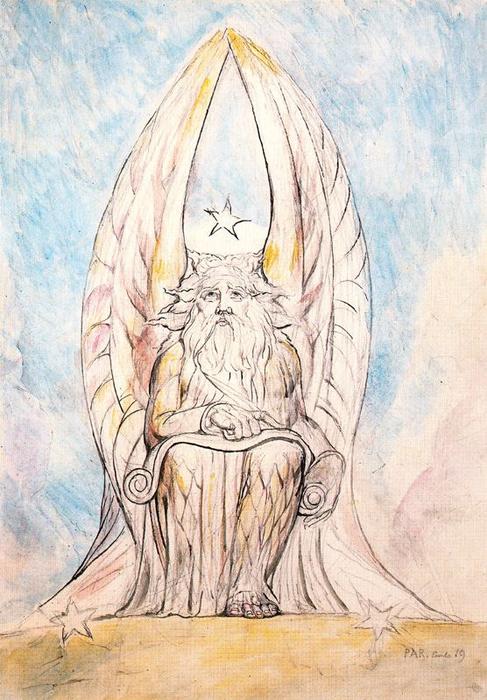
This captivating colored pencil drawing by the visionary artist William Blake presents a profound meditation on morality, judgment, and divine oversight. The artwork, titled “El Ángel que conserva el gran libro de los actos buenos y los malos” (The Angel who keeps the great book of good and evil deeds), is not merely an image but a window into Blake’s complex spiritual universe.
Subject & Composition: A Throne of Thought
At its heart, the composition features a seated figure – an angel or perhaps a prophetic being – enthroned within an elaborate architectural framework. The figure's aged and wise countenance suggests accumulated knowledge and authority. This isn’t a depiction of earthly power, but rather a representation of cosmic justice. The throne itself is not simply a seat, but a constructed environment that seems to both support *and* contain the angel, emphasizing their weighty responsibility. A single star positioned above the figure's head acts as a halo or beacon, signifying enlightenment and divine connection.
Style & Technique: Romantic Symbolism in Delicate Detail
Blake’s style here blends elements of
Romanticism and
Symbolism. While possessing a degree of realism in the rendering of the figure, the overall effect is ethereal and dreamlike. The meticulous technique – colored pencil on paper – allows for an incredible level of detail, particularly in the intricate lines defining the throne’s structure and the subtle shading that sculpts the angel's form. Hatching and cross-hatching create texture and depth, while the predominantly cool color palette (blues, greys, whites) evokes a sense of solemnity and contemplation. Warmer tones are strategically used to draw attention to the figure’s face and hands – the instruments of perception and action.
Historical Context & Blake's Vision
William Blake (1757-1827) was a unique voice in British art, rejecting conventional artistic norms in favor of his own intensely personal mythology. He lived during a period of significant social and political upheaval, and his work often reflects concerns about religious dogma, industrialization, and the human condition. Unlike many artists of his time, Blake wasn’t focused on realistic representation; he aimed to depict *spiritual* truths. This drawing exemplifies that pursuit – it's less concerned with accurate depiction and more interested in conveying a profound emotional and philosophical message.
Symbolism & Interpretation: The Book of Life
The central symbol, the “great book,” is immediately evocative of divine record-keeping—a concept found across many religious traditions. It represents the totality of human actions, both good and evil, being meticulously documented for eventual judgment. The angel’s role as its keeper suggests a compassionate yet impartial observer. The flattened perspective contributes to the symbolic nature of the work; it's not meant to be a realistic scene but rather an allegorical representation of universal truths.
Emotional Impact & Interior Design Considerations
“El Ángel que conserva el gran libro de los actos buenos y los malos” evokes feelings of reverence, introspection, and perhaps even a touch of awe. The artwork’s subdued color palette and contemplative mood make it suitable for spaces designed to encourage quiet reflection – libraries, studies, or meditation rooms. Its intricate detail and historical significance also lend themselves well to more formal settings. A high-quality reproduction would serve as a striking focal point in any collection, offering a glimpse into the mind of one of history’s most original and compelling artists.
- Ideal for: Collectors of Romantic art, those interested in spiritual themes, and interior designers seeking unique statement pieces.
- Color Palette: Cool blues, greys, and whites with accents of warmer tones.
- Mood: Contemplative, reverent, and thought-provoking.