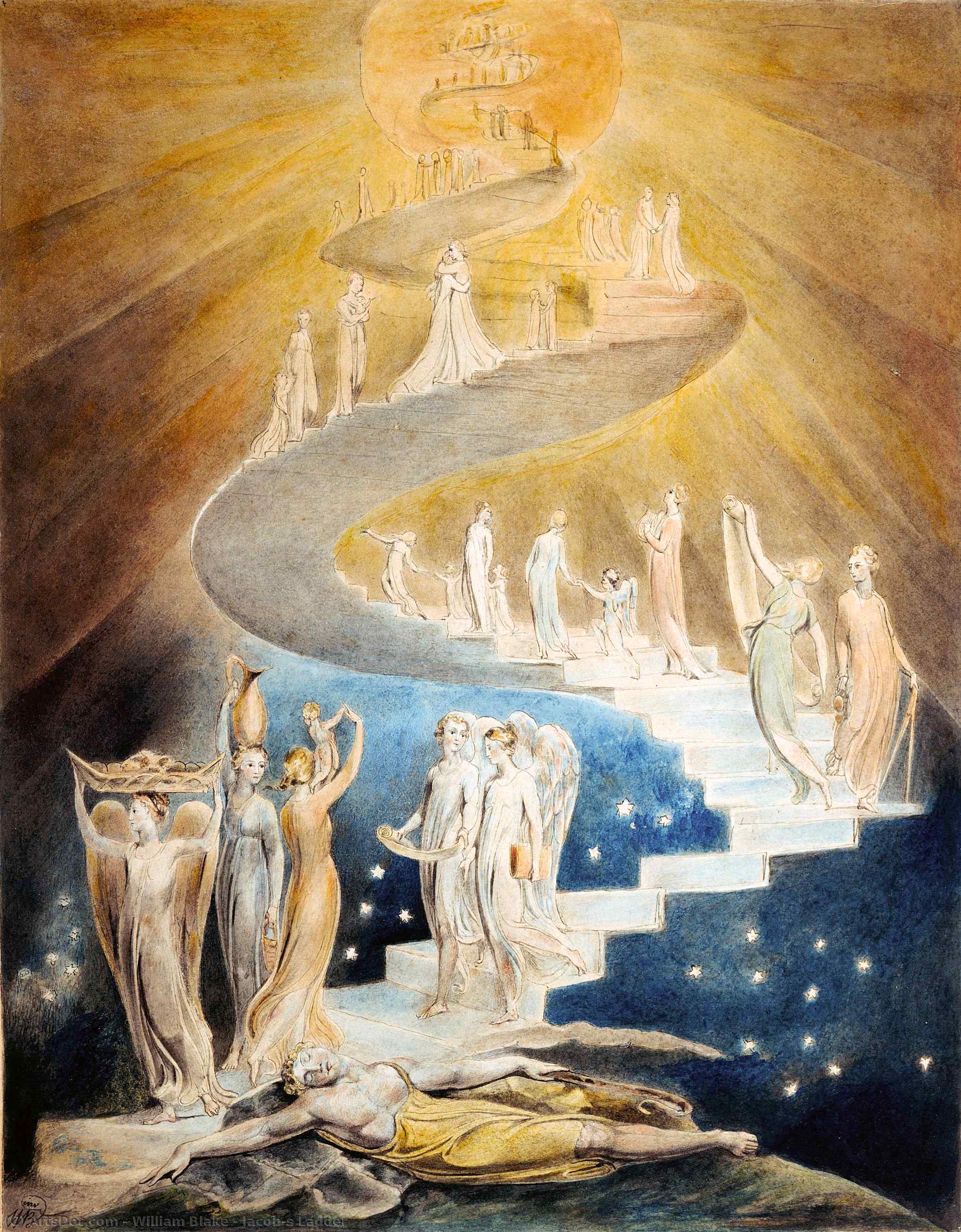
William Blake’s Jacob’s Ladder: A mesmerizing depiction of faith and spiritual ascent. Explore the illuminated staircase to heaven, symbolizing humanity's journey through intricate symbolism & masterful technique.
Explore William Blake's visionary art & poetry (1757-1827). A Romantic icon known for mystical themes, illuminated printing, & works like 'The Tyger'. Discover his legacy!
Jacob's Ladder: A Stairway to Spiritual Revelation
William Blake, a visionary artist and poet whose spirit defied the conventions of his era, gifted us with Jacob’s Ladder (circa 1799-1806), an artwork that transcends mere visual representation—it embodies a profound exploration of faith, mysticism, and the human yearning for transcendence. Created during the tumultuous Romantic period, Blake's masterpiece stands as a testament to his singular artistic vision and continues to resonate with audiences today.
Composition and Technique: An Illuminated Dreamscape
The painting’s central motif is undeniably striking: a spiraling staircase ascending towards a radiant celestial realm. Executed in watercolor and pencil on paper, Blake skillfully employs delicate washes of color—primarily golds and blues—to evoke an ethereal luminescence that permeates the entire composition. The meticulous detail achieved through pencil rendering lends texture and depth to the architectural elements of the ladder itself, emphasizing its monumental scale against the expansive backdrop of a sunlit sky. Notably, Blake’s use of illuminated printing techniques – a method he pioneered – further enhances the artwork's symbolic power, layering translucent inks over the watercolor base to create an otherworldly glow reminiscent of biblical manuscripts.
Symbolism and Biblical Inspiration
Blake’s Jacob’s Ladder draws directly from Genesis 28:12-22, recounting Jacob’s prophetic dream wherein he envisions a ladder reaching heaven, populated by angels descending and ascending. Blake interprets this narrative not merely as a retelling of scripture but as an allegory for the soul's journey towards divine grace. The staircase itself symbolizes the arduous ascent from earthly limitations to spiritual enlightenment, while the angelic figures represent messengers of God guiding humanity toward salvation. Furthermore, the luminous sky serves as a visual representation of paradise—a realm of purity and illumination unattainable through mundane experience.
Influence Beyond Art: Echoes in Literature and Culture
Blake’s Jacob’s Ladder exerted considerable influence on subsequent artistic movements and thinkers. Sigmund Freud recognized Blake's preoccupation with unconscious symbolism and psychological depth, mirroring his own explorations into the subconscious mind. Bob Dylan and Jim Morrison similarly embraced Blake’s poetic language and mystical imagery as inspiration for their songwriting endeavors. More broadly, Blake’s work continues to inspire artists and art enthusiasts alike, prompting contemplation on themes of spirituality, imagination, and the transformative potential of artistic expression. Its enduring legacy speaks to a timeless fascination with the intersection of faith and visual storytelling.
A Timeless Reflection: Jacob's Ladder Today
Even centuries after its creation, Jacob’s Ladder retains an undeniable emotional impact. The painting invites viewers to contemplate questions of belief, purpose, and the human desire for connection with something greater than oneself. Its luminous palette and intricate detail capture the essence of Romantic idealism—a conviction that art possesses the capacity to elevate consciousness and illuminate the hidden realities of existence. Owning a high-quality reproduction allows you to experience this captivating artwork's beauty and symbolism firsthand, bringing Blake’s visionary spirit into your home or studio.