A Dramatic Encounter with Divine Justice
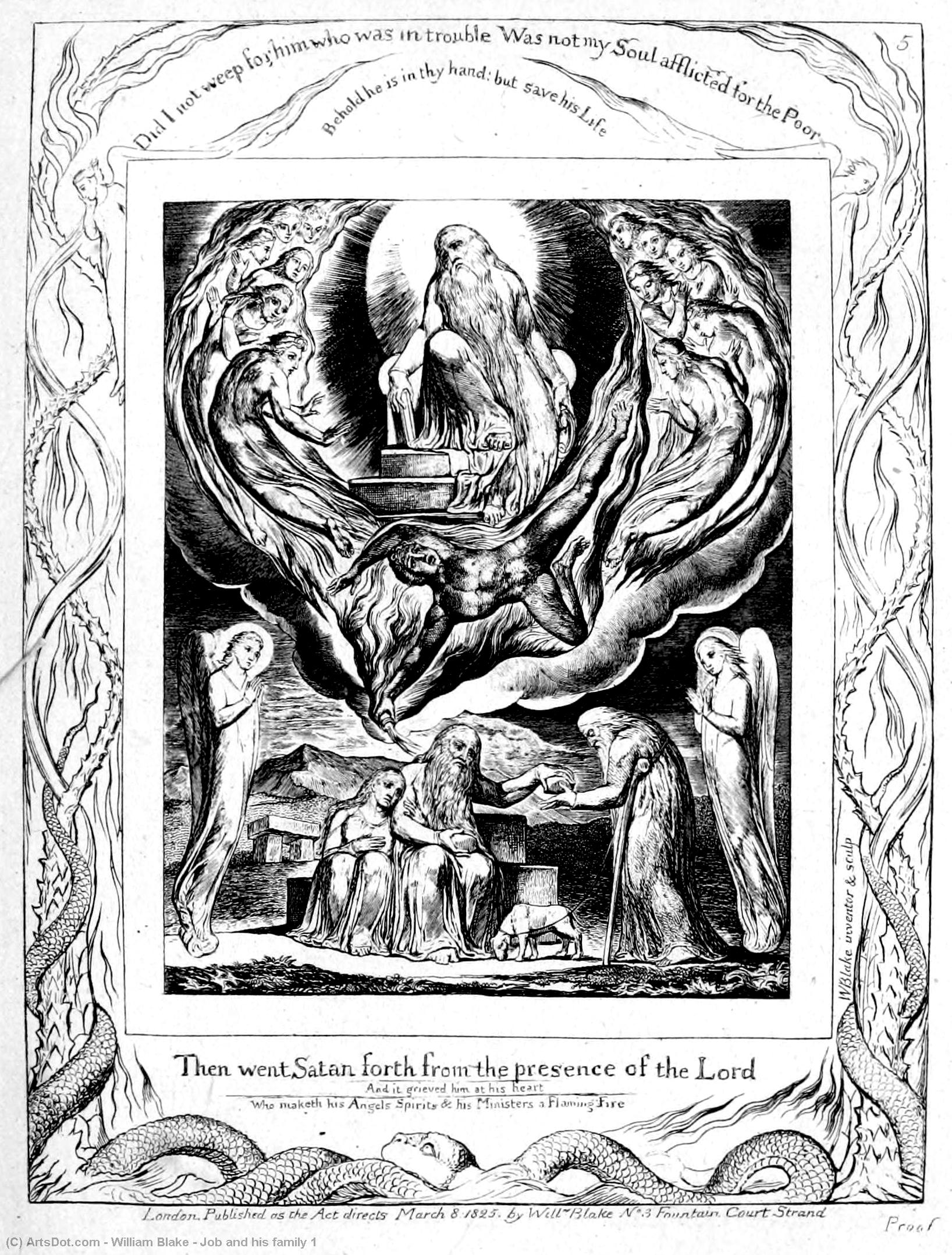
William Blake’s “Job and His Family” stands as a monumental achievement in Romantic engraving, capturing the profound spiritual struggle at the heart of the biblical tale. Published in 1825-26 during Blake's prolific artistic output, this artwork transcends mere illustration; it embodies a deeply felt meditation on faith, loss, and the enduring presence of divine compassion amidst earthly torment. The print’s immediate impact is one of arresting visual drama—a swirling vortex of figures rendered with meticulous detail against a backdrop of luminous celestial light. Blake's masterful use of hatching and cross-hatching creates an illusion of palpable texture, conveying both the harshness of Job’s predicament and the ethereal beauty of God’s intervention.
- Artist: William Blake (British, London 1757–1827 London)
- Medium: Engraving on Paper
- Date: 1825-26
The Composition’s Choreography of Suffering and Grace
Blake skillfully orchestrates a complex visual narrative centered around Job and his family—a tableau depicting the biblical patriarch facing unimaginable misfortune. At the core is a circular grouping portraying Job seated with his wife and sons, symbolizing familial unity under duress. Above them ascend angelic figures engaged in dynamic poses, their forms interwoven with swirling clouds – representing divine messengers bearing both comfort and judgment. Below, serpentine creatures writhe menacingly, embodying Satan’s influence and disrupting the tranquility of God's realm. This juxtaposition underscores Blake’s exploration of theological themes: the battle between good and evil, the questioning of faith in times of adversity, and ultimately, the promise of divine redemption.
Blake’s Romantic Style: Line Work as Emotional Expression
Blake’s distinctive artistic style is immediately recognizable through his unparalleled command of line engraving technique. Fine, intricate lines dominate the composition, meticulously crafted to delineate forms and textures with astonishing precision. Hatching and cross-hatching are employed extensively to sculpt tonal variations—creating a palpable sense of volume and depth that elevates the artwork beyond mere depiction. The curving lines contribute to an overall feeling of movement and dynamism, mirroring the turbulent emotional landscape of Job’s experience. This stylistic choice reflects Blake's Romantic conviction that line work could convey profound psychological states.
Symbolism Rooted in Biblical Narrative
“Job and His Family” is laden with symbolic representations drawn directly from the Book of Job. The serpents symbolize Satan’s temptation—a constant challenge to Job’s unwavering faith—while the angelic figures embody divine compassion and reassurance. Blake's deliberate use of light and shadow reinforces this duality, highlighting God’s benevolent presence amidst Job’s suffering. Furthermore, the central altar-like structure serves as a focal point for contemplation, representing prayer and supplication before the face of God.
A Legacy of Dramatic Visual Narrative
Blake’s “Job and His Family” continues to resonate with audiences today due to its masterful blend of artistic skill and theological insight. Its enduring appeal lies in its ability to evoke empathy for Job's plight while simultaneously conveying a powerful affirmation of faith—a testament to Blake’s visionary genius and his contribution to the Romantic canon. Reproductions offer an opportunity to experience this iconic artwork firsthand, capturing its dramatic beauty and profound spiritual depth.