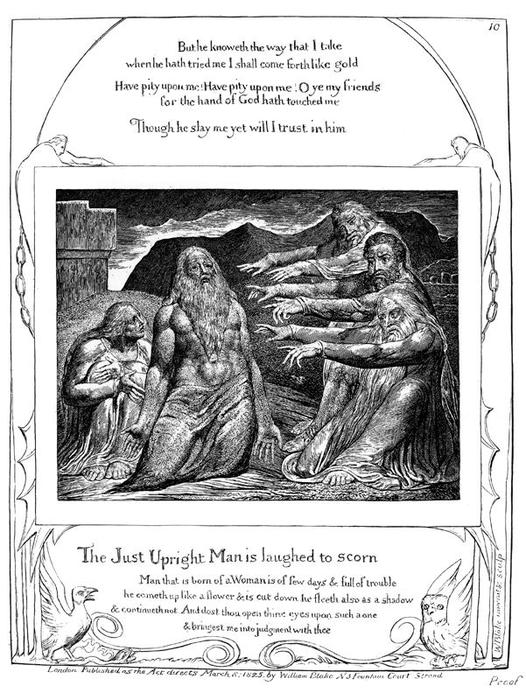
A Dramatic Encounter Between Faith and Doubt: William Blake’s Engraving
William Blake's “Job Rebuked by His Friends,” created in 1825, stands as a cornerstone of Romantic art—a testament to the artist’s singular vision and his masterful command of printmaking technique. This striking monochrome engraving captures a pivotal moment from the biblical Book of Job, portraying the fraught exchange between Job and two companions who attempt to dissuade him from lamenting his suffering.
- Composition & Setting: The scene unfolds against a towering mountainscape shrouded in darkness—a deliberate choice by Blake that symbolizes Job’s overwhelming predicament. Three figures dominate the composition, clustered together with palpable tension, emphasizing the claustrophobic atmosphere of their confrontation.
- Line Work & Texture: Blake's signature style is immediately evident in the intricate network of fine lines that define every element of the image—from the rugged contours of the mountains to the expressive faces of Job and his companions. Hatching and crosshatching techniques are employed extensively, generating a rich textural surface that conveys both solidity and vulnerability.
- Symbolism & Emotion: The dark background serves as a powerful visual metaphor for Job’s despair and torment, while the expressions on each figure's face communicate a spectrum of emotions—ranging from righteous indignation to profound sorrow. Blake skillfully utilizes these elements to evoke a deeply melancholic mood.
Technique: The Art of Engraving
Blake’s “Job Rebuked by His Friends” exemplifies the engraving process, where lines are incised into a metal plate—typically copper or steel—before being inked and pressed onto paper. This method allowed for exceptional precision in detail rendering and tonal gradation—crucial to Blake's ability to convey both visual realism and profound psychological depth.
- Material Considerations: The artwork utilizes a metal plate, etching needles or engravers, ink, and paper – materials carefully selected to achieve the desired aesthetic outcome.
- Printing Process: Blake’s meticulous approach ensured that each print possessed remarkable tonal variation and textural nuance—a hallmark of his artistic legacy.
Historical Context & Influence
Created during the Romantic era, “Job Rebuked by His Friends” reflects the broader intellectual currents of its time—particularly the preoccupation with faith, doubt, and the human condition amidst adversity. Blake’s work aligns with the movement's emphasis on imagination and emotion, establishing him as a pivotal figure in British art history.
- Blake’s Visionary Style: The engraving embodies Blake’s distinctive artistic style—characterized by expressive line work, dramatic compositions, and symbolic imagery.
- Connections to Romanticism: It shares affinities with other Romantic artists who explored themes of spirituality and moral struggle, cementing Blake's place as a visionary innovator.
A Legacy of Artistic Expression
"Job Rebuked by His Friends" continues to resonate with audiences today—inspiring admiration for its technical brilliance and prompting contemplation on enduring questions about human experience. Its haunting beauty and profound emotional impact solidify Blake’s reputation as one of the most influential artists of his generation.