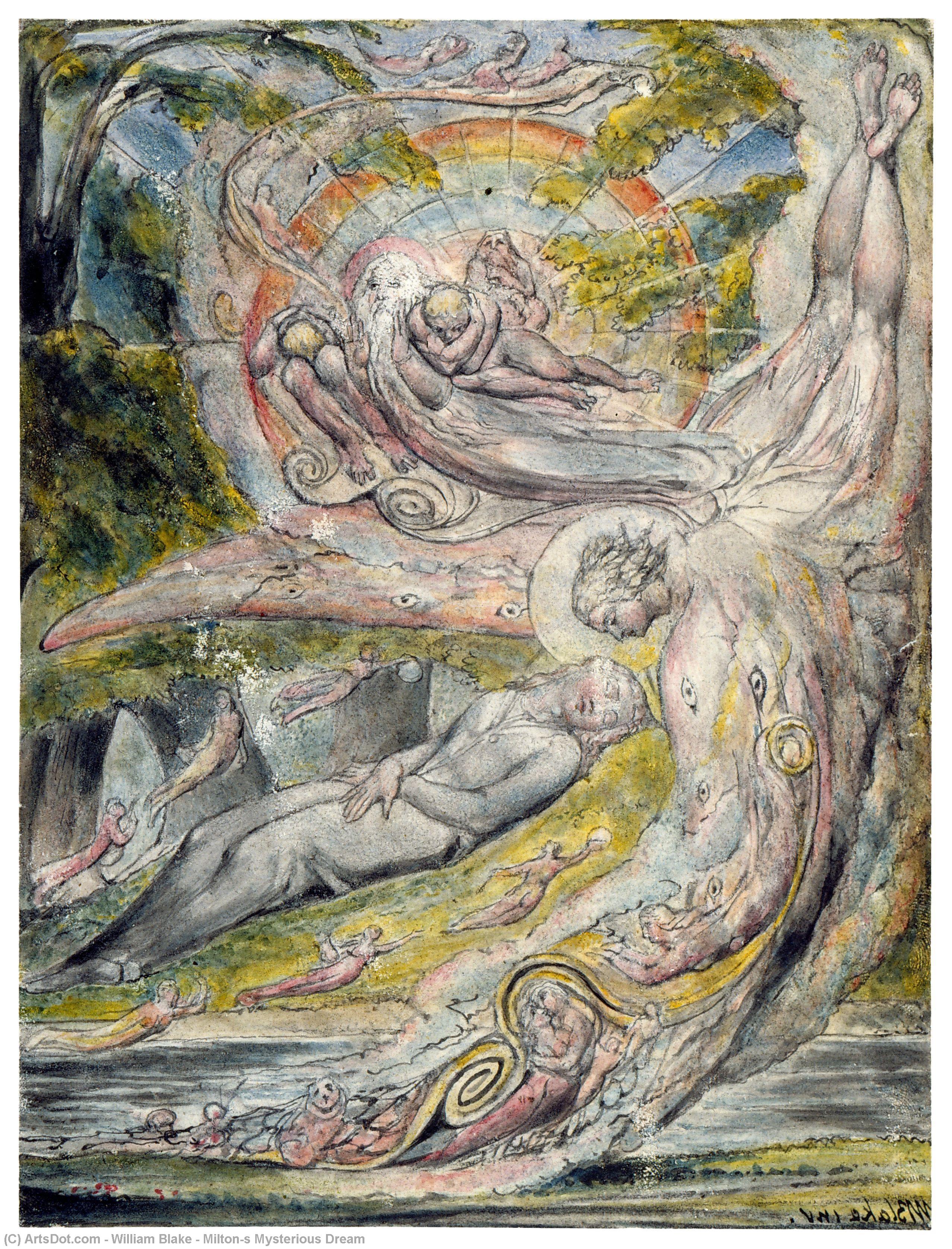
Milton’s Mysterious Dream: A Visionary Descent into Paradise Lost
William Blake’s “Milton’s Mysterious Dream” (1820) is a captivating watercolor painting that plunges the viewer into the turbulent world of John Milton's *Paradise Lost*. More than just an illustration, it’s a powerful visual interpretation of Satan’s fall from grace and his complex psychological state – a pivotal moment in literary history brought to life with Blake’s unique artistic vision.
Subject & Narrative
The artwork depicts a swirling vortex of figures and forms, seemingly suspended within an ethereal space. At its heart lies a central figure, widely interpreted as Satan, not as a monstrous villain but as a being undergoing a profound – and agonizing – transformation. He is surrounded by other spectral shapes, possibly representing fallen angels or the tormented thoughts that plague him. The scene isn’t literal; it's an embodiment of Milton’s poetic descriptions of inner turmoil and the chaotic aftermath of rebellion against divine authority. Blake doesn’t show us *what* happened, but rather *how it felt*.
Style & Technique: Romantic Intensity
“Milton’s Mysterious Dream” is a quintessential example of
Romanticism, characterized by its emphasis on emotion, imagination, and the sublime. Blake's technique is remarkably innovative for its time. He employs layered watercolor washes, building up color and texture with visible brushstrokes that create a sense of movement and energy. The flattened perspective – lacking traditional depth cues – contributes to the dreamlike quality, drawing the viewer into the scene’s psychological space. Lines are organic and flowing, mirroring the chaotic forces at play.
Symbolism & Interpretation
The painting is rich in symbolism. The swirling forms can be seen as representing the chaos of Hell or the internal struggles within Satan's mind. The dramatic lighting – bright highlights contrasting with deep shadows – emphasizes the conflict between good and evil, light and darkness.
Blake’s use of color, dominated by muted earth tones punctuated by flashes of white and pale blues, evokes a sense of both decay and ethereal beauty. It is important to note that Blake often imbued his work with personal mythology and spiritual beliefs, adding layers of meaning for those familiar with his broader oeuvre.
Historical Context & Artistic Legacy
Created during a period when Blake was deeply engaged with Milton’s poetry, this artwork reflects his own unique theological and philosophical views. He wasn't simply illustrating *Paradise Lost*; he was responding to it, offering his own interpretation of the epic poem’s themes.
Blake’s illuminated printing, though not directly used in this watercolor, informed his approach to visual storytelling – a fusion of text and image that aimed to convey complex ideas with emotional resonance. He stands as a bridge between the artistic traditions of the past and the burgeoning modernism of the 19th century.
Emotional Impact & Interior Design
“Milton’s Mysterious Dream” evokes a powerful sense of turmoil, spiritual struggle, and the tragic consequences of ambition. It's a piece that demands contemplation and invites multiple interpretations.
For interior design, this artwork would serve as a striking focal point in a study, library, or living room – particularly spaces designed to inspire creativity and intellectual discourse. Its muted color palette allows it to complement a variety of décor styles, while its dramatic composition adds depth and visual interest. A high-quality reproduction captures the essence of Blake’s vision, bringing a touch of Romantic intensity into any home.
- Ideal for: Art collectors, lovers of Romantic literature, those seeking statement art pieces.
- Style Suitability: Traditional, eclectic, modern with vintage accents.
- Emotional Resonance: Thought-provoking, dramatic, spiritually evocative.