The Shadow Before God’s Throne: William Blake's ‘Satan Before the Throne of God’
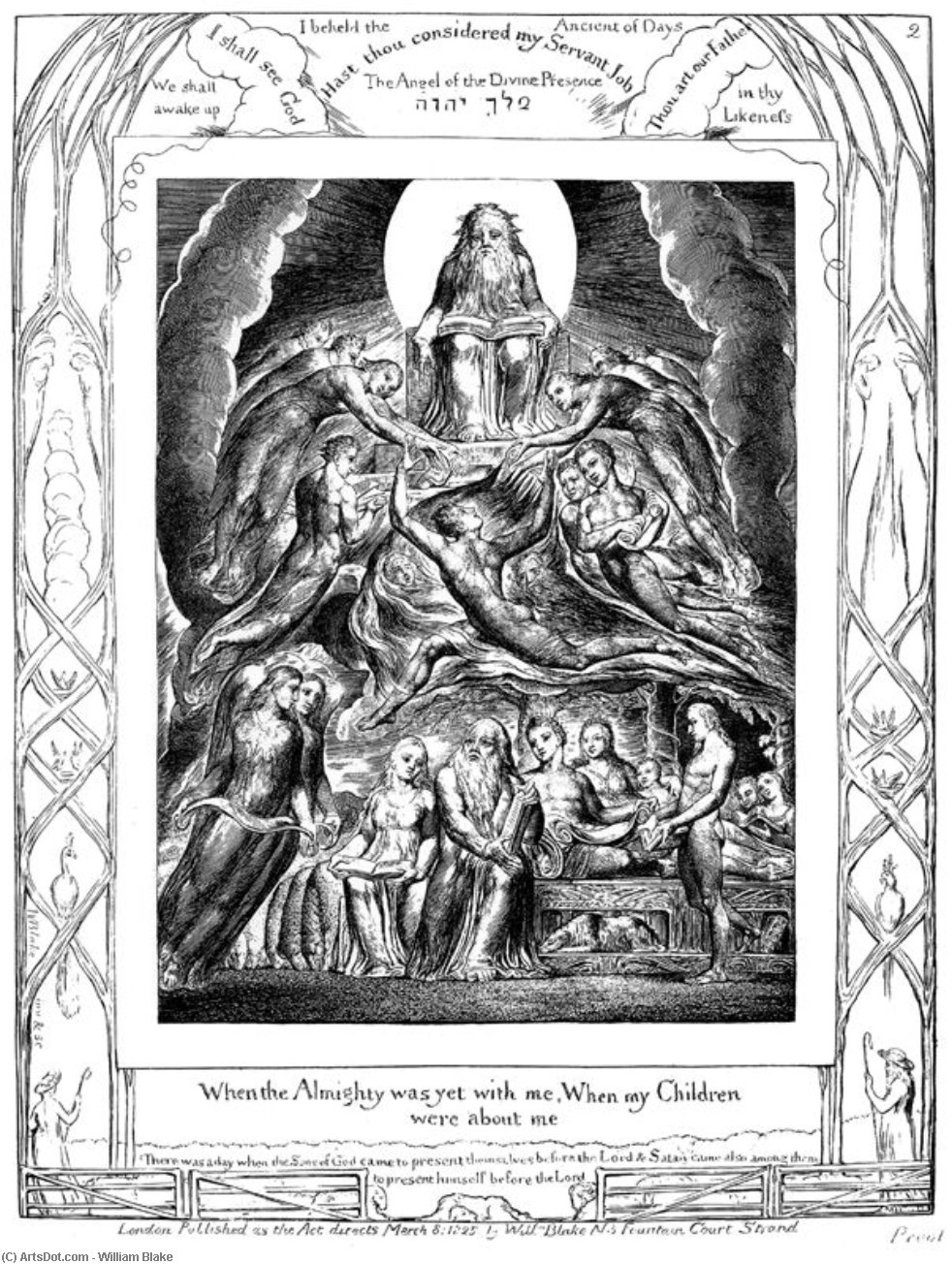
William Blake’s “Satan Before the Throne of God,” created in 1825, is not merely a depiction of biblical drama; it’s a profound exploration of faith, doubt, and the internal struggle between spiritual aspiration and worldly complacency. This powerful engraving, now housed at the Wichita Art Museum, offers a visceral glimpse into Blake's intensely personal and often unsettling vision of God and humanity. It transcends its subject matter to become a meditation on the nature of belief itself, rendered with the meticulous detail characteristic of his late work.
The scene unfolds within an elaborate, Gothic-inspired architectural framework—a swirling vortex of arches, columns, and intricate patterns that immediately establishes a sense of grandeur and otherworldly intensity. At its heart stands Satan, not as a monstrous demon, but as a figure of unsettling allure, his form partially obscured by shadow and smoke. He’s presented in a dynamic pose, descending upon the prone figure of Job, who lies amidst flames rising from beneath his bed – a potent symbol of divine retribution and personal torment. The composition is hierarchical, placing God—represented as a towering, almost overwhelming presence—at the apex of the scene, observing this pivotal moment with an expression that suggests both judgment and perhaps even a hint of sorrow.
A Masterclass in Engraving Technique
Blake’s skill as an engraver is immediately apparent. The image is executed with astonishing precision, utilizing a technique known as ‘line engraving,’ where the artist meticulously cuts lines into a metal plate to create the final image. This method lends itself perfectly to Blake's densely layered composition and his fascination with intricate detail. Notice the subtle gradations of tone achieved through varying line weights—the darkest shadows are formed by closely spaced, parallel lines, while lighter areas are created with wider, more open strokes. The texture is remarkably rich, conveying a sense of volume and depth that belies the two-dimensional nature of the medium.
The use of cross-hatching – overlapping lines to create shading – is particularly effective in depicting the billowing smoke and the fiery glow emanating from Job’s bed. Furthermore, Blake's mastery extends beyond mere technical skill; he employs a sophisticated understanding of perspective and spatial relationships, creating a dramatic sense of depth within the confined space of the engraving. The meticulous rendering of each figure—from the anguished face of Job to the serpentine form of Satan—demonstrates an unparalleled level of control and artistic vision.
Symbolism and Blake’s Personal Theology
“Satan Before the Throne of God” is deeply rooted in Blake's own idiosyncratic theological beliefs. He rejected traditional notions of a benevolent, all-powerful God, instead envisioning a divine force that could be both merciful and punitive. In this engraving, Satan represents not simply evil, but the embodiment of worldly desires and temptations—the forces that pull humanity away from spiritual enlightenment. Job’s initial complacency, symbolized by his prayerful posture beneath the oak tree, reflects a reliance on outward observance rather than genuine faith.
The quotation inscribed within the image – “The Letter Killeth/ The spirit giveth life” – encapsulates Blake's central theme: that true understanding and spiritual growth require more than mere adherence to religious dogma. The final plate, depicting Job’s transformation, signifies a shift from external piety to an internal realization of God’s presence—a journey towards redemption through self-awareness and acceptance. The musical instruments emerging from the scene symbolize joy and liberation, suggesting that true faith is not born of suffering but of spiritual awakening.
A Timeless Exploration of Human Condition
“Satan Before the Throne of God” remains a profoundly moving and intellectually stimulating work of art. It’s a testament to Blake's extraordinary artistic talent and his willingness to challenge conventional interpretations of religious narratives. The engraving’s enduring power lies in its ability to tap into universal themes—doubt, faith, suffering, redemption—that continue to resonate with viewers today. Its dramatic composition, intricate detail, and symbolic richness make it a captivating subject for art lovers, collectors, and interior designers seeking pieces that evoke both beauty and contemplation.