The Harrowed Vision: William Blake’s ‘Satan Smiting Job with Boils’
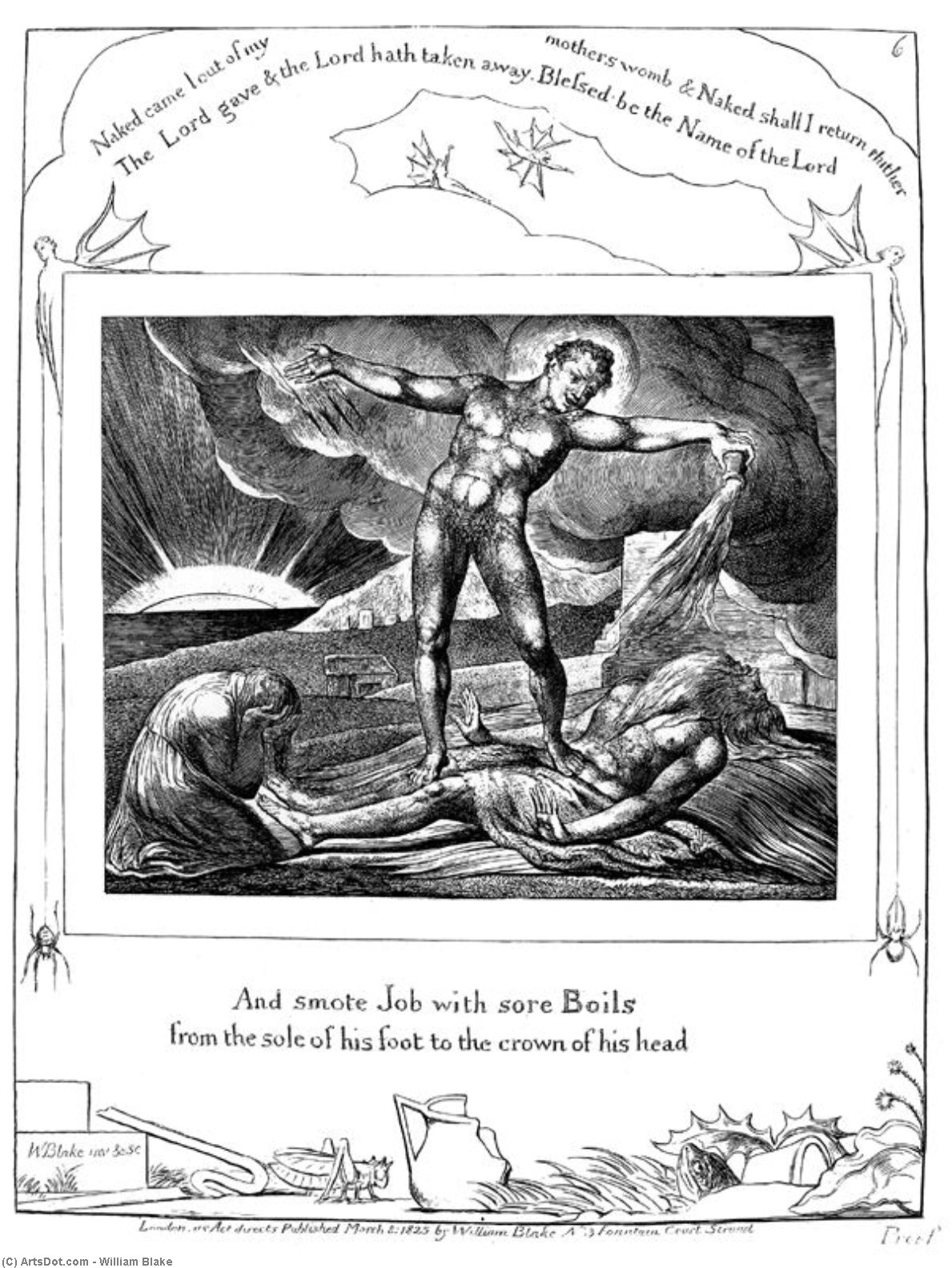
William Blake's “Satan Smiting Job with Boils” is not merely a depiction of a biblical scene; it’s a visceral plunge into the heart of human suffering, a stark meditation on faith tested by unimaginable torment, and a testament to the artist’s uniquely visionary approach. Created around 1826, this powerful engraving – one of twenty-two meticulously crafted illustrations accompanying Blake's interpretation of the Book of Job – transcends its narrative source material to become a profound exploration of morality, power, and the agonizing nature of divine justice. The image immediately commands attention with its monochromatic palette: shades of black, white, and gray converge to create an atmosphere of oppressive intensity, amplifying the drama and highlighting the stark contrast between Satan’s brutal force and Job's utter vulnerability.
Blake masterfully employs a dynamic composition, anchored by a pyramidal structure where Satan dominates the apex, his outstretched arm radiating menace. Job, prostrate on the ground, is rendered in a contorted pose of agonizing pain – a figure stripped bare not just physically but spiritually. The swirling clouds and indistinct figures in the background contribute to a sense of chaotic turmoil, mirroring Job’s internal struggle. Notice how Blake utilizes hatching and cross-hatching techniques within the engraving process, creating subtle tonal variations that add depth and texture to the forms, particularly in the depiction of Satan's muscular physique and the grotesque details of the boils themselves – symbols not just of physical affliction but also of divine punishment.
A Romantic Confrontation: Style, Technique, and Blake’s Vision
This work is a quintessential example of William Blake’s distinctive artistic style, firmly rooted in the Romantic movement yet infused with his own intensely personal and often unsettling vision. The engraving's flattened perspective, while not strictly adhering to classical rules, serves to heighten the emotional impact, drawing the viewer directly into the scene’s drama. Blake deliberately eschewed the “mixed method” favored by commercial engravers of his time, opting instead for a purely line-based approach – an extraordinary feat of technical skill that allowed him to achieve remarkable detail and expressive power with minimal shading. The fine lines delineate every muscle, every wrinkle of pain on Job’s face, and every swirling vortex in the turbulent clouds.
The choice of monochrome is crucial; it intensifies the scene's gravity, removing any potential distraction from color and focusing attention entirely on form, texture, and emotional content. The stark contrast between light and shadow further emphasizes Job’s vulnerability and Satan’s overwhelming power. Blake’s use of line isn’t merely descriptive; it’s imbued with symbolic meaning – the forceful, jagged lines representing Satan's aggression, while the more flowing, organic lines suggest Job’s suffering and resilience.
Symbolism and Spiritual Weight: Interpreting Blake’s Narrative
Beyond its immediate visual impact, “Satan Smiting Job with Boils” is rich in symbolic meaning. The boils themselves are not simply a depiction of physical wounds but represent the consequences of challenging divine authority – a punishment inflicted by God through Satan's agency. Job’s suffering serves as a potent metaphor for humanity’s struggle against adversity, questioning the nature of faith and the apparent indifference of a powerful deity. Satan, in this context, embodies temptation and the forces of evil, while Job represents innocence, endurance, and unwavering belief. The image invites contemplation on themes of justice, morality, and the human condition – questions that have resonated with viewers for centuries.
Interestingly, Blake’s interpretation of the Book of Job aligns with his own personal experiences—his struggles with poverty, rejection, and a perceived lack of divine guidance. This deeply felt empathy imbues the engraving with an unparalleled emotional intensity, transforming it from a simple illustration into a profound meditation on suffering and faith. The work's enduring power lies in its ability to evoke a visceral response, prompting viewers to confront uncomfortable truths about themselves and the world around them.