William Blake’s ‘Soothsayers and Sorcerers’: A Window into the Imagination
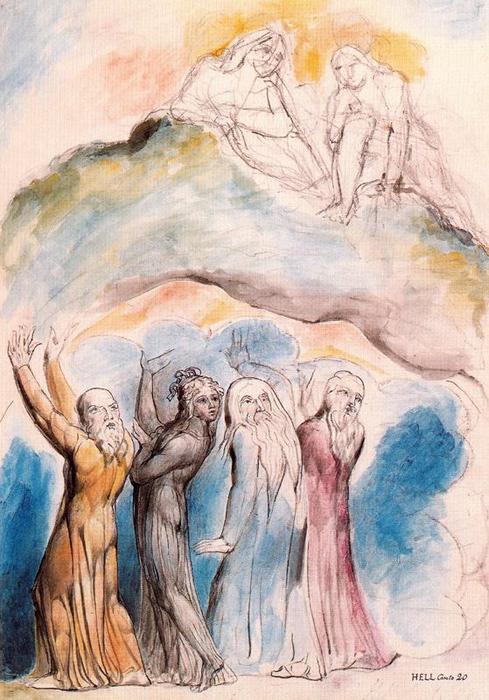
William Blake's 'Soothsayers and Sorcerers,' painted around 1790, is not merely a depiction of three figures before a mountain; it’s a profound exploration of visionary experience, spiritual inquiry, and the burgeoning Romantic fascination with the mystical. This evocative work, rendered in Blake’s signature style, captures a moment of intense communion between individuals seemingly attuned to forces beyond the rational – a theme central to his artistic and poetic output. The painting's power lies not just in its subject matter but also in the meticulous execution of Blake’s unique technique, a blend of drawing, engraving, and watercolor that creates an ethereal quality rarely found in contemporary works.
A Study in Romantic Symbolism
The composition itself is laden with symbolic weight. The three figures, positioned before the imposing backdrop of a mountain – often interpreted as representing the sublime or the divine – are engaged in what appears to be a ritualistic exchange. The woman on the left, arms raised, embodies a connection to the celestial realm, while the two men beside her represent earthly wisdom and perhaps the pursuit of knowledge through observation and interaction. The solitary figure to the right, partially obscured by shadow, adds an element of mystery and suggests the presence of unseen forces or spirits. Blake frequently employed such ambiguous figures to represent the subconscious mind and the realms of imagination, reflecting the Romantic emphasis on intuition and emotional experience over strict reason.
Blake’s Revolutionary Technique
Blake's artistic process was extraordinarily innovative for his time. He meticulously combined drawing, engraving, and watercolor techniques, a method he developed largely independently. The initial drawings were often executed with charcoal or chalk, capturing the raw energy of his visions. These sketches were then painstakingly transferred to copper plates using intricate engraving tools – a skill he honed during his apprenticeship. Finally, these engraved plates were colored by Blake himself using watercolors, layering washes of vibrant hues to create depth, luminosity, and an almost dreamlike atmosphere. This multi-layered technique is particularly evident in the rendering of the figures’ clothing and the dramatic lighting effects, contributing significantly to the painting's otherworldly quality. The use of watercolor allowed for a delicate blending of tones, creating a sense of movement and suggesting the ephemeral nature of spiritual experiences.
Historical Context and Emotional Resonance
'Soothsayers and Sorcerers’ was created during a period of immense social and intellectual change in England. The rise of industrialization, coupled with burgeoning religious dissent and philosophical questioning, fueled a renewed interest in ancient mythology, folklore, and the occult. Blake's work reflects this cultural shift, aligning him with the Romantic movement's rejection of Enlightenment rationalism and embrace of subjective experience. The painting evokes a powerful sense of mystery, contemplation, and perhaps even unease – qualities that continue to resonate with viewers today. It’s a testament to Blake’s ability to tap into universal human anxieties about mortality, knowledge, and the unknown, making it a timeless masterpiece.