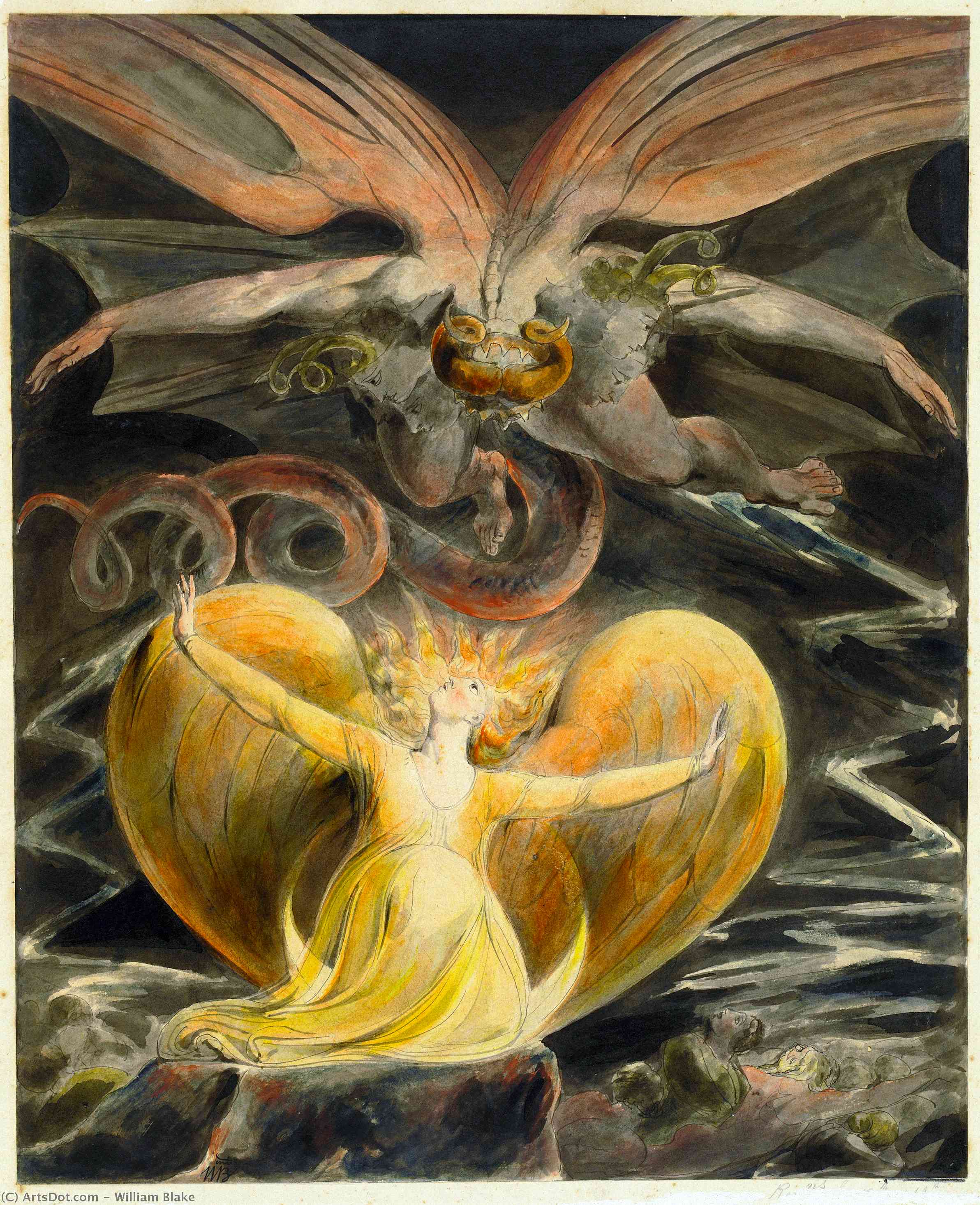
The Great Red Dragon and the Woman Clothed with Sun
William Blake’s Great Red Dragon and the Woman Clothed with Sun stands as a monumental achievement in Romantic art—a series of watercolour paintings born from Blake’s fervent engagement with biblical prophecy. Created between 1805 and 1810, these canvases weren't merely decorative; they were meticulously crafted to illuminate the Book of Revelation, embodying Blake’s singular vision of spiritual struggle and divine triumph.
The Painting's Composition: A Dance of Opposites
At first glance, the painting presents a dramatic confrontation. Dominating the upper right quadrant is a winged dragon—a terrifying embodiment of evil—its serpentine form coiled around a crown adorned with seven horns and seven eyes. Beneath it kneels a woman, radiant with luminescence, her body bathed in golden light; she holds aloft what appears to be a shield or heart, symbolizing resilience and compassion. Scattered throughout the scene are smaller figures: two birds representing innocence and vigilance, and three people embodying humanity’s vulnerability before divine judgment. Blake's masterful use of perspective draws the viewer into this turbulent tableau, emphasizing the scale of the conflict.
Blake's Artistic Style: Symbolism Unleashed
William Blake was renowned for his Romantic style—characterized by vibrant colours and intensely symbolic imagery. The Great Red Dragon series exemplifies this aesthetic perfectly. Blake employed watercolour techniques to achieve remarkable luminosity and textural depth, layering translucent washes of pigment to convey both ethereal beauty and palpable drama. His meticulous attention to detail—evident in the intricate rendering of scales, feathers, and facial expressions—reflects his belief that art should communicate profound spiritual truths.
Blake's Life and Work: A Prophet Ahead of His Time
Born November 28, 1757, William Blake was a largely unrecognized poet and artist during his lifetime. Despite facing considerable hardship and obscurity, he persevered in pursuing his artistic endeavors—primarily illuminated printing—and developed a distinctive style that would later earn him posthumous acclaim. Northrop Frye famously described Blake’s prophetic works as “what is in proportion to its merits the least read body of poetry in the English language,” highlighting their enduring significance within literary history.
Collaboration with Catherine Boucher: An Artistic Partnership
Blake's creative process was profoundly shaped by his collaboration with his wife, Catherine Boucher. She served as his printmaker and colourist, enabling him to realize ambitious projects that would have been impossible without her unwavering support. Boucher’s dedication to Blake’s vision—particularly her painstaking hand-coloring of the Great Red Dragon paintings—is a testament to their enduring artistic partnership.
For those eager to explore more of William Blake's captivating oeuvre or discover exceptional reproductions, visit https://ArtsDot.com. This platform offers an unparalleled selection of handmade oil painting reproductions by Blake and other celebrated artists—bringing the spirit of Romantic art into your home.
To delve deeper into Blake’s life and legacy, consult his biography on Wikipedia: https://en.wikipedia.org/wiki/William_Blake.