William Collins
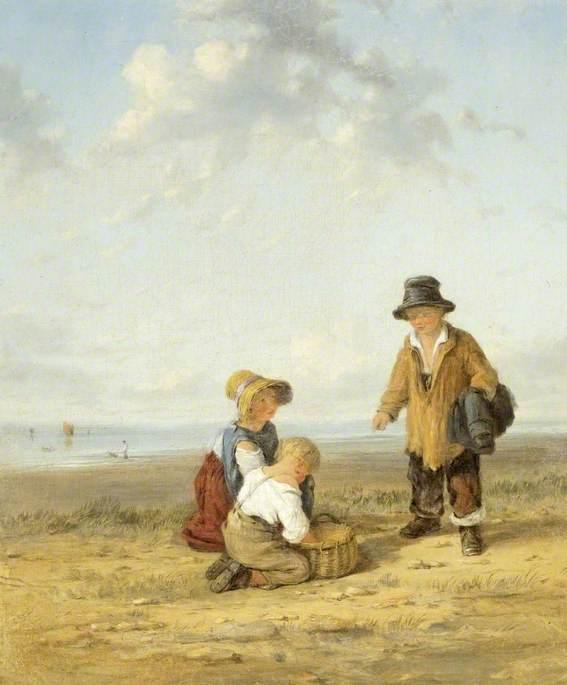
Experience the serene beauty of William Collins’ ‘Figures on the Seashore,’ a Romantic masterpiece capturing a tranquil seaside scene with tender figures and evocative light. Explore a stunning reproduction at ArtsDot.
Discover William Collins (1788-1847), a British landscape & genre painter celebrated for his sentimental scenes of rural life and charming depictions of children.
Russell
(Bournemouth, United Kingdom)
Russell-Cotes Art Gallery & Museum is a Victorian sanctuary overlooking Bournemouth’s East Cliff. Founded as Sir Merton and Lady Annie Russell-Cotes' private home, it houses an impressive collection spanning European paintings, Japanese art, and global artifacts reflecting their adventurous spirit and philanthropic legacy.
A Moment of Pastoral Tranquility: Exploring William Collins’ “Figures on the Seashore”
William Collins' "Figures on the Seashore," completed in 1835, stands as a quintessential embodiment of Romantic idealism—a scene meticulously crafted to capture not merely visual beauty but also profound emotional resonance. Painted with remarkable sensitivity and imbued with subtle stylistic nuances, this artwork transcends its depiction of a simple seaside tableau, offering viewers an invitation into a realm of contemplative serenity and idealized human connection.
The Scene Embodied: Realism Touched by Romantic Idealization
The painting’s composition immediately establishes a harmonious balance between observation and emotion. Collins skillfully employs a soft focus technique—a hallmark of the Romantic movement—to diffuse harsh light, creating an atmosphere that feels both luminous and inviting. The artist's gaze is firmly fixed on capturing the essence of rural life, prioritizing emotional impact over photographic accuracy. This deliberate choice reflects the broader Romantic preoccupation with sublime landscapes and the exploration of human psychology within natural settings. Unlike earlier artistic traditions focused on grand narratives or heroic figures, Collins’ work centers on intimate moments—a family enjoying a leisurely day by the sea—emphasizing the beauty of everyday experience.
Technique and Material Considerations: Watercolor Mastery
Collins executed “Figures on the Seashore” primarily in watercolor, demonstrating exceptional control over pigment dispersion and layering. Watercolor's inherent transparency allows for nuanced gradations of color and texture, contributing significantly to the painting’s ethereal quality. The artist meticulously blended hues—primarily muted blues and greens—to recreate the shifting tones of the ocean and sky, capturing the subtle nuances of atmospheric conditions. Furthermore, Collins skillfully utilized dry brush techniques to render the sandy beach surface, conveying a tactile sense of realism while maintaining an overall impression of softness and delicacy. Attention to detail is evident in the rendering of clothing fabrics and facial expressions, furthering the painting’s expressive power.
Historical Context: Victorian Sentimentality and Artistic Influences
“Figures on the Seashore” emerged during the Victorian era—a period characterized by a fervent belief in moral virtue and an idealized vision of domestic life. Collins' work aligns perfectly with this cultural sensibility, reflecting the Victorian fascination for pastoral landscapes and sentimental depictions of childhood innocence. The painting draws inspiration from artists like Eugène Delacroix and J.M.W Turner, whose explorations of dramatic natural phenomena—particularly stormy seas—influenced Collins’ stylistic choices. However, unlike Turner’s turbulent canvases, Collins prioritizes tranquility and harmony, conveying a message of comfort and contentment amidst the grandeur of nature.
Symbolism Beyond Surface Beauty: Reflections on Family Bonds
Beyond its aesthetic appeal, “Figures on the Seashore” carries symbolic weight—a testament to Collins' artistic prowess in communicating deeper meanings. The central figures—the woman seated, the woman walking, and the child playing—represent idealized notions of familial affection and domestic harmony. Their postures convey a sense of peaceful contemplation and shared joy, symbolizing the importance of human connection within the context of natural surroundings. The toy boat serves as a poignant emblem of childhood curiosity and wonder, reminding viewers of the simple pleasures that enrich human experience. Ultimately, Collins’ masterpiece invites us to contemplate not just what we see but also what these images communicate about our values and aspirations.