A Window Into Enlightenment: Examining William Hogarth’s “Scholars at a Lecture”
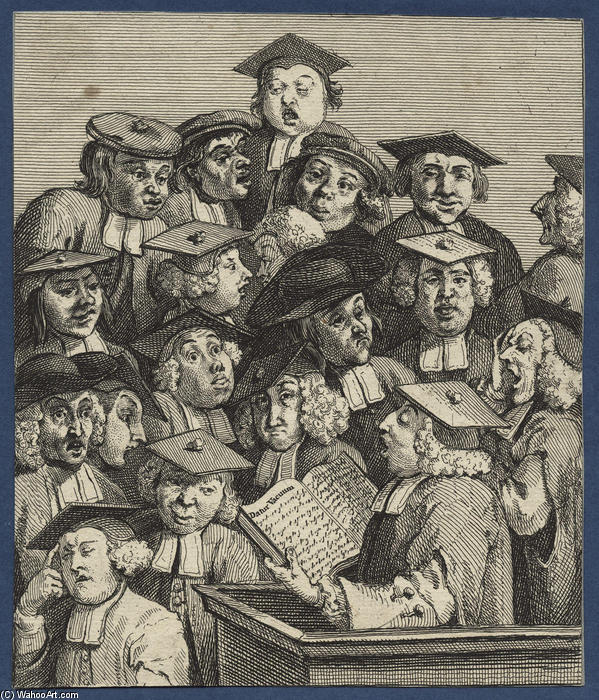
The etching by William Hogarth, "Scholars at a Lecture," transcends mere depiction; it's an exquisitely crafted snapshot of London intellectual life in the mid-18th century—a scene brimming with observation and subtly laced with critique. Executed around 1730-32, this artwork resides within Hogarth’s broader project to document the social realities of his time, aligning him firmly with the burgeoning tradition of English topographical art. Yet, unlike many of its contemporaries focused solely on architectural grandeur, Hogarth's etching delves into the complexities of human interaction and moral judgment—a feat achieved through masterful engraving technique and a keen understanding of visual storytelling.
- Style & Technique: Hogarth’s style is characterized by realism tempered with theatricality. He meticulously renders every detail, from the folds of clothing to the expressions on faces, utilizing hatching and cross-hatching—a technique honed during his apprenticeship—to create a palpable sense of depth and texture. The etching's tonal range is remarkably sophisticated, conveying not only illumination but also subtle shifts in mood and emotion.
- Historical Context: London at the time was undergoing rapid urbanization and social upheaval. Hogarth’s depiction captures a moment when scholars—primarily Oxford dons—were attempting to engage in reasoned debate about the controversial issue of papal infallibility. This event served as a catalyst for public discussion and fueled anxieties surrounding religious dogma.
Decoding Symbolism: Layers of Meaning Beyond Appearances
Beyond its immediate portrayal of individuals, “Scholars at a Lecture” is replete with symbolic elements that enrich its narrative complexity. The two chairs positioned prominently in the room represent opposing viewpoints—one occupied by a man radiating confidence and authority, while the other by a figure slumped forward, conveying disillusionment and despair. This juxtaposition underscores Hogarth’s central concern: the failure of intellectual discourse to inspire genuine conviction or moral reform. Furthermore, the book resting on the floor symbolizes knowledge and erudition but also hints at the potential for complacency—a reminder that mere possession of information does not guarantee wisdom.
Emotional Resonance: Capturing the Human Condition
Perhaps the etching’s most enduring achievement lies in its ability to evoke a profound emotional response. Hogarth doesn't simply record what he sees; he captures the essence of human experience—the anxieties, aspirations, and contradictions that define our lives. The faces of the scholars convey a spectrum of emotions: earnest contemplation mingled with skepticism, frustration battling determination. This masterful portrayal speaks to universal themes of intellectual curiosity, moral responsibility, and the struggle for meaning in an increasingly turbulent world.
A Legacy Enduring Through Reproduction
“Scholars at a Lecture” continues to fascinate art historians and collectors alike—a testament to Hogarth’s unparalleled skill as a visual communicator. High-quality reproductions offer viewers the opportunity to appreciate the etching's intricate detail and nuanced tonal range, allowing them to engage with its historical context and symbolic richness. When selecting a reproduction, consider framing options that complement the artwork’s aesthetic qualities—enhancing its impact within an interior design setting.