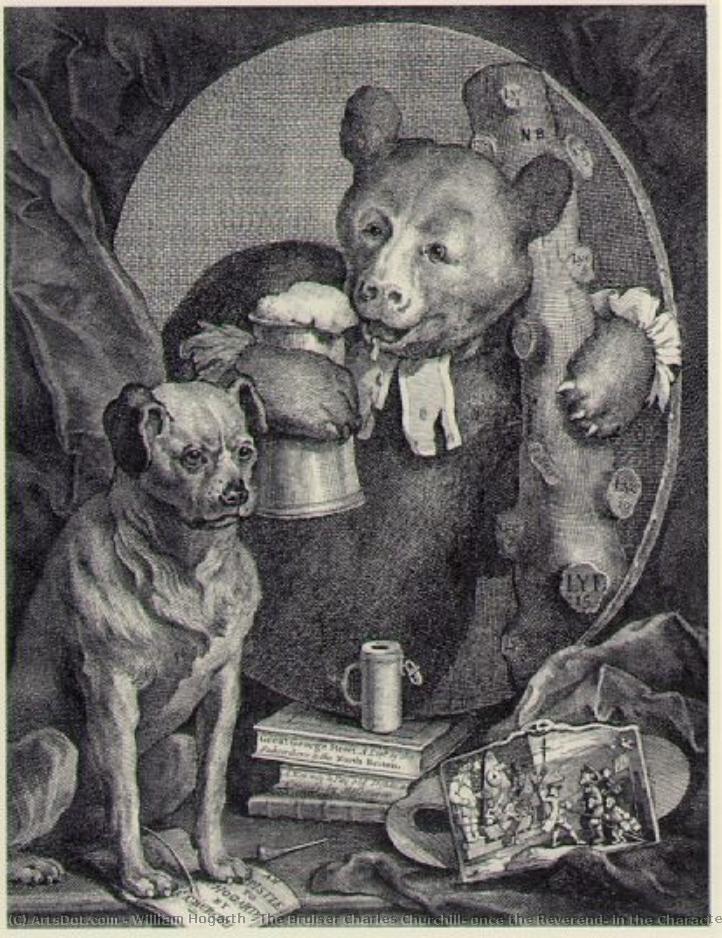
William Hogarth's satirical masterpiece, "The Bruiser," depicts a drunken clergyman and bulldog amidst scandal & controversy – a biting commentary on 18th-century society.
Explore the satirical world of William Hogarth (1697-1764), pioneering English painter & engraver. Discover *A Harlot's Progress* & insightful social commentary.
A Satirical Vision of Virtue and Vice
William Hogarth’s “The Bruiser Charles Churchill, once the Reverend, in the Character of a Russian Hercules” is not merely a print; it's a meticulously crafted social commentary, a biting satire delivered with the sharp wit and unflinching realism that defined the artist’s career. Completed in 1763, this work offers a captivating glimpse into the tumultuous world of 18th-century London – a society grappling with moral decay, political scandal, and the precariousness of reputation. The scene depicted is far from straightforward; it's a carefully constructed tableau designed to expose the hypocrisy and excesses of a prominent figure, Charles Churchill, a clergyman known for his controversial writings and flamboyant lifestyle. Hogarth masterfully utilizes caricature and symbolism to transform Churchill into an almost grotesque spectacle – a bear-like figure indulging in debauchery and surrounded by symbols of corruption and excess. The image immediately draws the viewer in with its dramatic composition and stark contrasts, inviting contemplation on the themes of virtue, vice, and the perils of unchecked ambition.
A Masterclass in Engraving Technique
Hogarth’s technical skill is undeniably evident throughout “The Bruiser.” He employs a remarkably detailed engraving technique, utilizing hatching and cross-hatching to create an astonishingly realistic depiction of texture – from the coarse fur of the bear to the smooth sheen of polished metal. The meticulous rendering of each element contributes significantly to the print’s overall impact, lending it a tangible quality that transcends its two-dimensional nature. Notice particularly the careful attention paid to the folds in Churchill's clothing and the intricate details of the table laden with objects – mugs, books, and scattered papers—each contributing to the scene’s narrative complexity. The monochromatic palette, dominated by shades of gray, black, and white, amplifies the dramatic effect, creating a sense of starkness and emphasizing the moral contrasts at play. The use of light and shadow is particularly effective in sculpting form and highlighting key details, guiding the viewer's eye through the composition with subtle yet deliberate gestures.
Symbolism and Social Critique
Beyond its immediate visual appeal, “The Bruiser” is rich in symbolism, offering a pointed critique of 18th-century society. The bear itself represents Churchill’s aggressive nature and his tendency towards impulsive behavior – a stark contrast to the image of the revered clergyman he once presented. The bulldog, seated beside the bear, embodies loyalty and perhaps stubbornness, mirroring Churchill's unwavering defense of his controversial opinions. The scattered papers on the table symbolize scandal and controversy, hinting at the public outcry surrounding Churchill’s writings. The inclusion of a miniature engraving depicting Churchill whipping John Wilkes—a prominent political opponent—further underscores the artist’s satirical intent, suggesting that Churchill was engaging in similar acts of aggression and manipulation as his target. The overall composition functions as a visual allegory, exposing the hypocrisy and moral failings of a man who had once held a position of authority and respect.
A Window into Hogarth's World
Understanding “The Bruiser” requires appreciating William Hogarth’s broader artistic vision and his deep engagement with the social and political landscape of his time. Born in London in 1697, Hogarth witnessed firsthand the rapid transformation of the city – its burgeoning wealth, its widening social inequalities, and its pervasive corruption. His art served as a powerful tool for documenting these changes and exposing their consequences. As documented by his biography, Hogarth’s early life was shaped by his father's struggles with poverty and debt, experiences that instilled in him a keen awareness of social injustice. His “modern moral subjects” series—including "A Harlot's Progress" and "A Rake's Progress"—offered unflinching depictions of the pitfalls of vice and the devastating consequences of immoral behavior. “The Bruiser,” therefore, can be seen as a continuation of this thematic exploration, offering a particularly sharp critique of a prominent figure who had succumbed to temptation and scandal. It’s a testament to Hogarth's ability to transform personal observation into enduring social commentary.