A Bold Statement in Hairdressing and Satirical Observation
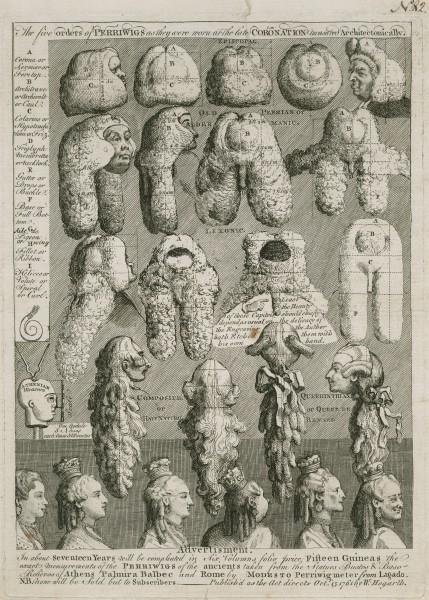
William Hogarth’s “The Five Orders of Perriwigs,” completed in 1761, stands as a remarkable achievement not merely in artistic skill but also as a shrewd commentary on the social conventions of Georgian England. More than just an illustration of hairstyles—a fascination with classical architectural principles—the engraving embodies Hogarth's characteristic blend of meticulous detail and biting critique.
- Subject Matter: The centerpiece is undeniably the display of mannequins adorned with five distinct styles of wigs, meticulously categorized according to the orders of architecture – Doric, Ionic, Corinthian, Tuscan, and Composite. This deliberate choice wasn’t arbitrary; Hogarth sought to elevate the seemingly trivial pursuit of fashionable hairpieces into a framework for broader social observation.
- Style & Technique: Executed in mezzotint engraving—a technique known for its tonal richness and ability to capture subtle nuances—Hogarth achieved an astonishing level of realism. The artist’s painstaking attention to detail extends beyond the wigs themselves, encompassing the poses of the mannequins and even a bird perched atop one, adding an element of visual complexity.
Historical Context: Enlightenment Critique
Hogarth's work emerged during the Enlightenment, a period marked by intellectual ferment and a questioning spirit. However, unlike many of his contemporaries who championed reason and progress, Hogarth relentlessly exposed hypocrisy and moral failings within the upper echelons of society. “The Five Orders of Perriwigs” exemplifies this approach; it’s not simply about depicting beauty—though the wigs are undeniably elegant—but about interrogating the values that underpinned aristocratic culture.
- Social Commentary: The engraving serves as a pointed critique of vanity and ostentation. Hogarth subtly suggests that excessive concern with appearances masks deeper moral deficiencies, mirroring broader anxieties about social status and propriety during the era.
- Architectural Influence: Hogarth’s appropriation of architectural terminology—drawing parallels between wig styles and classical columns—was deliberate. He aimed to elevate the subject matter beyond mere fashion, presenting it as a microcosm of larger societal concerns.
Symbolism & Emotional Impact
Beyond its formal structure and intellectual provocation, “The Five Orders of Perriwigs” possesses an undeniable emotional resonance. The bird perched atop one of the mannequins—a symbol of liberty and aspiration—contrasts sharply with the rigid formality of the architectural orders, hinting at a tension between tradition and change.
Consider this: Hogarth’s masterful use of mezzotint creates a captivating visual experience. The tonal gradations capture the textures of fabric and hair with remarkable accuracy, inviting viewers to contemplate not only the aesthetic beauty of the image but also its underlying moral message.
Conclusion: A Legacy of Observation
"The Five Orders of Perriwigs" remains a testament to Hogarth’s genius as both an artist and a social historian. It exemplifies his unwavering commitment to portraying human nature with unflinching honesty, securing his place among the most influential figures in British art history.