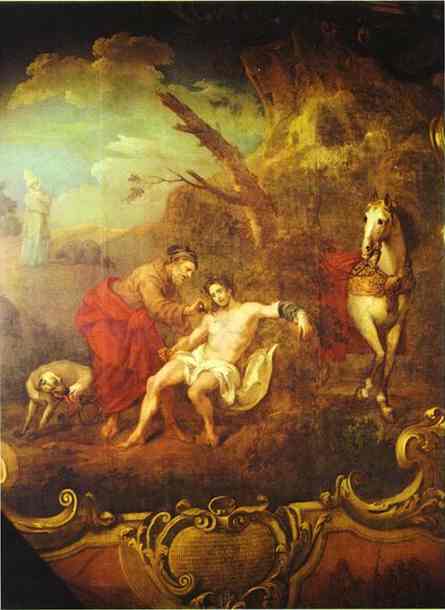
The painting portrays Jesus lying on the ground with two men attending to him; one holds a cup, while horses and dogs populate the scene. Hogarth's masterful use of light and color captures the essence of Rococo art, reflecting London’s social complexities.
The Good Samaritan: A Rococo Reflection on Compassion
William Hogarth’s “The Good Samaritan,” completed in 1730, stands as a remarkable testament to the artist's ability to distill complex social commentary into a visually arresting tableau. More than just a depiction of biblical narrative—the parable recounted by Jesus Christ concerning selfless aid—it embodies the spirit of the Rococo period, prioritizing opulent ornamentation and meticulous detail to convey profound moral truths.
The painting captures a scene of extraordinary vibrancy. At its center lies Jesus Christ, wounded and prone upon the ground, attended by two men. One man diligently pours water from a cup into Jesus’s mouth—a gesture symbolizing care and healing—while the other offers him wine, representing solace and divine grace. Surrounding these figures are elements that elevate the scene beyond mere piety; two horses dominate the upper portion of the canvas, their majestic presence signifying nobility and power. Beneath them roam three dogs, meticulously rendered with expressive musculature and fur textures, serving as a deliberate allusion to social hierarchy and the pervasive influence of animal imagery in Rococo art.
Hogarth’s technique is characterized by its masterful use of chiaroscuro—the dramatic interplay between light and shadow—which sculpts the figures and imbues the composition with palpable emotion. The artist employs a rich palette dominated by warm hues—gold, crimson, and ochre—to illuminate the central scene and create an atmosphere of grandeur. Furthermore, Hogarth’s meticulous attention to surface texture—evident in the smooth sheen of the horses’ coats and the textured fur of the dogs—demonstrates his unwavering commitment to realism within a stylized framework.
Historically, “The Good Samaritan” emerged during a period marked by Enlightenment ideals – specifically, a burgeoning interest in moral philosophy and social reform. Hogarth skillfully utilizes symbolism to critique prevailing societal attitudes toward poverty and compassion. The horses represent the aristocracy’s detachment from earthly concerns, while the dogs embody the vulgarity and corruption of lower classes. By juxtaposing these contrasting elements, Hogarth compels viewers to confront uncomfortable truths about human behavior and moral responsibility.
Ultimately, “The Good Samaritan” transcends its biblical origins to resonate with audiences across centuries. Its enduring appeal lies in its ability to evoke empathy and inspire contemplation on the importance of altruism—a timeless message conveyed through Hogarth’s unparalleled artistic vision. It remains a captivating exemplar of Rococo art's capacity for conveying moral instruction within an exquisitely ornamented visual experience.