William James Glackens’ “Children Roller Skating” – A Snapshot of Urban Joy
“Children Roller Skating,” painted in 1918 by William James Glackens, isn't merely a depiction of children enjoying an afternoon pastime; it’s a vibrant distillation of early 20th-century American life—a fleeting moment of unadulterated joy captured amidst the grit and bustle of New York City. Glackens, a key figure in the Ashcan School movement, rejected the idealized portrayals favored by the National Academy of Design, instead choosing to focus on the realities of everyday existence, often portraying it with a distinctive, almost frenetic energy. This painting exemplifies his talent for imbuing ordinary scenes with an extraordinary sense of life and movement.
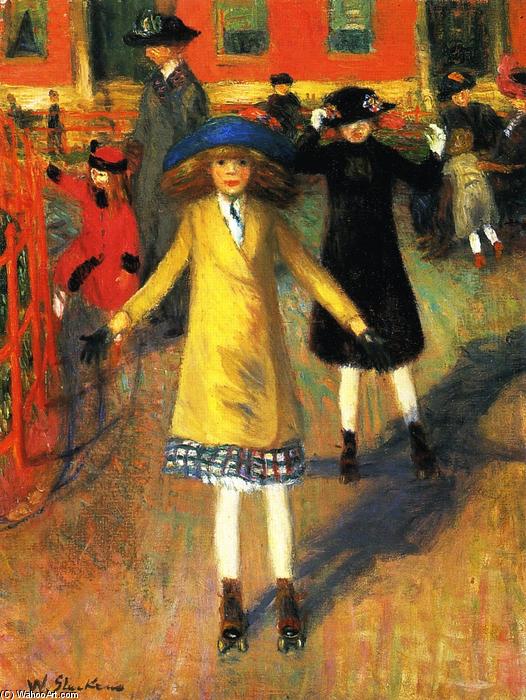
The scene unfolds on a busy city street, likely in Greenwich Village, a neighborhood known for its bohemian spirit during this period. A group of children, rendered in Glackens’ characteristic bold brushstrokes and rich, dark palette, are engaged in spirited roller skating. Their faces are alight with laughter and excitement, their limbs moving with an infectious energy that spills out onto the canvas. The composition is dynamic—a swirling mass of movement and color—reflecting the lively atmosphere of the street. Glackens masterfully uses loose brushwork to convey a sense of spontaneity and immediacy, as if he’s capturing the scene in real-time.
A Window into the Ashcan School
Glackens' work is deeply rooted in the principles of the Ashcan School, an artistic movement that emerged in New York City around 1908. Rejecting the polished surfaces and mythological subjects favored by academic art, the Ashcan artists sought to portray the realities of urban life—the crowded streets, the working-class neighborhoods, and the everyday struggles of ordinary people. Glackens’ “Children Roller Skating” perfectly embodies this ethos. It's a far cry from the carefully staged portraits that dominated the art world at the time; instead, it offers an unfiltered glimpse into the lives of New Yorkers.
The painting’s style is distinctly American—a blend of realism and impressionism. Glackens employs a vibrant color palette, using dark blues, greens, and browns to create a sense of depth and atmosphere. He also utilizes broken brushstrokes and contrasting colors to capture the movement and energy of the scene. The figures are not rendered with meticulous detail but rather suggested through loose brushwork and expressive gestures. This technique contributes to the painting’s overall dynamism and immediacy.
Symbolism and Context
Beyond its immediate depiction of children roller skating, the painting carries a subtle layer of symbolism. Roller skating was a popular pastime in early 20th-century America, particularly among young people. It represented freedom, recreation, and a break from the constraints of Victorian society. The scene captures a moment of carefree joy—a reminder that even amidst the challenges of urban life, there is always room for laughter and play.
Furthermore, the painting reflects the changing social landscape of New York City at the turn of the century. The city was undergoing rapid industrialization and urbanization, leading to overcrowding, poverty, and social unrest. However, despite these challenges, there was also a sense of optimism and progress—a belief in the potential for a brighter future. “Children Roller Skating” captures this duality—the juxtaposition of hardship and hope, chaos and joy.
A Timeless Image of American Life
“Children Roller Skating” is more than just a painting; it’s a snapshot of a bygone era—a vibrant testament to the spirit of New York City in 1918. Glackens' masterful use of color, brushwork, and composition creates an image that is both captivating and emotionally resonant. It invites us to step back in time and experience the joy and energy of a group of children roller skating on a busy city street. Reproductions of this work offer a beautiful way to bring a piece of American history into your home or office, reminding us of the simple pleasures of life and the enduring power of art.