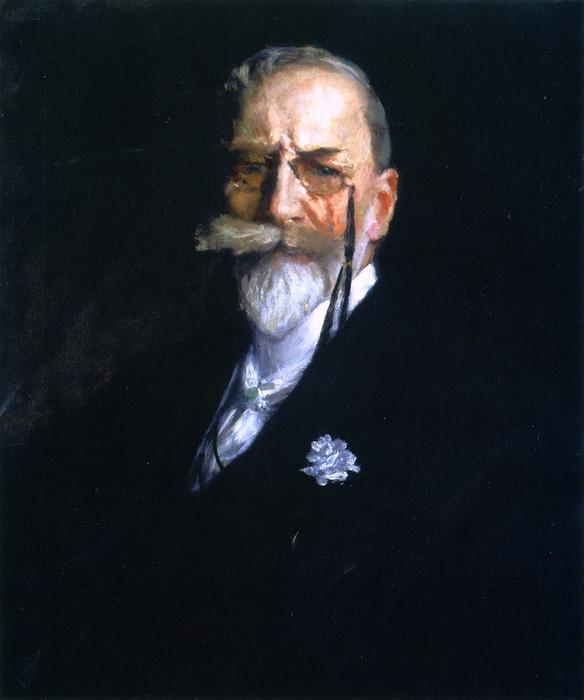
William Merritt Chase’s ‘Self Portrait’ (1914) is a stark black and white study in quiet reflection, showcasing the artist's mastery of Impressionism with its tonal modeling and introspective mood. Discover this iconic American artwork and bring its timeless beauty into your space.
William Merritt Chase’s “Self Portrait”: A Study in Quiet Reflection
“Self Portrait,” executed by William Merritt Chase in 1914, stands as a cornerstone of American Impressionism—a deceptively simple yet profoundly resonant depiction that speaks volumes about the artist's artistic vision and his engagement with the burgeoning modernist movement. More than just a likeness of Chase himself, it’s an exploration of form, light, and psychological nuance achieved through masterful tonal modeling and subtle brushwork.
- Subject Matter & Context: Created during Chase's prolific period, “Self Portrait” reflects the broader artistic currents of its time—a move away from academic conventions toward capturing fleeting moments of experience. It’s a portrait not merely of an individual but also of an artist grappling with his own identity and creative process, mirroring the anxieties and aspirations prevalent in early 20th-century American art.
- Style & Technique: Chase's approach aligns closely with Impressionism, prioritizing atmospheric effects over precise detail. The painting utilizes a predominantly monochromatic palette—primarily shades of gray—to heighten the sense of stillness and introspection. Visible brushstrokes contribute to a textured surface that conveys the materiality of paint itself, demonstrating Chase’s commitment to capturing the immediacy of observation.
- Composition & Lighting: The portrait's central symmetry draws the eye directly to Chase’s face, emphasizing his gaze—a deliberate gesture intended to establish a connection with the viewer. Light originates from the upper left corner, casting soft shadows that sculpt the contours of his features and creating depth within the composition. This careful manipulation of light underscores Chase’s understanding of how illumination shapes perception.
- Symbolism & Emotional Impact: The stark monochrome lends an air of solemnity to the piece, inviting contemplation on themes of self-awareness and artistic vocation. The inclusion of spectacles—a detail often overlooked—adds a layer of intellectual curiosity and perhaps hints at Chase’s engagement with scientific inquiry, reflecting his broader interests beyond painting.
- Material & Medium: Executed in oil paint on canvas, “Self Portrait” exemplifies the painterly technique favored by Impressionists. Layers of tonal variations build up form and depth, resulting in a luminous surface that captures the subtle nuances of light and shadow—a testament to Chase’s skill as a craftsman and his dedication to conveying emotion through visual representation.
Considered alongside works by contemporaries like Cecilia Beaux and Sidney Edward Dickinson, “Self Portrait” exemplifies the stylistic innovations of its era. Its enduring appeal lies in its ability to communicate profound ideas about artistic identity and human experience—a timeless masterpiece that continues to inspire admiration for its understated elegance and masterful execution.