A Vision in Light: The Ethereal Grace of Chase’s Impressionism
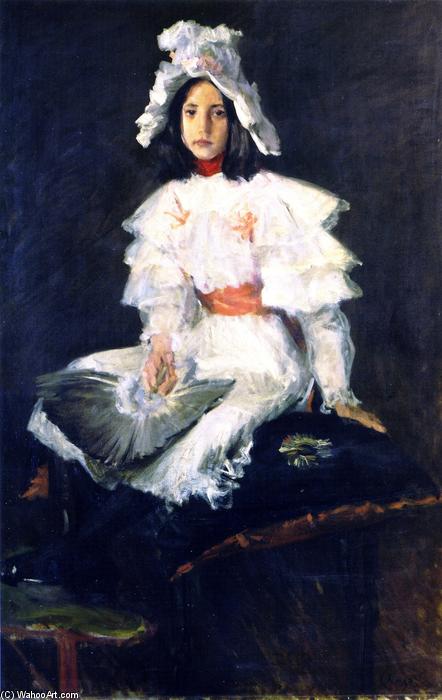
In the quiet corners of art history, few works capture the delicate intersection of human emotion and atmospheric beauty as masterfully as William Merritt Chase’s “The Feather Fan.” Painted around 1895, this exquisite portrait serves as a profound testament to the American Impressionist movement, a period defined by an intense desire to move beyond the rigid constraints of photographic realism. As one gazes upon the canvas, there is an immediate sense of stepping into a fleeting moment, frozen in time yet vibrating with life. The subject—a young woman seated gracefully upon a dark, plush velvet cushion—is not merely a figure in a portrait; she is the vessel through which Chase explores the interplay of light, texture, and mood.
The composition possesses a subtle, rhythmic dynamism. By positioning the figure slightly off-center, Chase avoids the static nature of traditional academic portraiture, instead inviting the viewer’s eye to wander through the soft, atmospheric depths of the scene. The background, rendered in an indistinct, dreamlike wash of blues and greens, recedes into a misty distance, ensuring that the luminous presence of the woman remains the undisputed heart of the work. This deliberate simplification of the environment creates a sense of profound intimacy, as if the world around her has dissolved, leaving only this singular, contemplative moment.
The Alchemy of Color and Brushwork
To understand the allure of “The Feather Fan,” one must look closer at Chase’s revolutionary use of technique. Eschewing the smooth, blended surfaces favored by his contemporaries, Chase embraced the broken color technique. He applied pigments in distinct, visible strokes, allowing individual hues to mingle optically within the viewer's eye rather than on the palette. This method produces a shimmering, iridescent effect that mimics the way natural light dances across fabric and skin. The stark, brilliant white of her gown stands in breathtaking contrast against the deep, somber tones of the velvet cushion, a use of complementary colors that heightens the painting’s visual energy.
The artist’s mastery is further revealed in his layering of thin, translucent washes. This meticulous process builds a sense of internal luminosity, making the light appear as though it is emanating from within the canvas itself. Every fold of her ruffled sleeves and every delicate detail of her wide-brimmed hat is rendered with a tactile richness that invites the touch. For the collector or interior designer, this texture provides a sophisticated depth that transforms a wall into a window of light, making it an ideal centerpiece for spaces that value elegance, nuance, and a connection to the classical beauty of the late nineteenth century.
A Legacy of Elegance and Emotion
Beyond its technical brilliance, “The Feather Fan” carries a weight of quiet melancholy and refined leisure. The subject’s downward gaze and the slight downturn of her lips suggest a moment of deep introspection or perhaps a gentle longing, adding an emotional layer that resonates long after the first viewing. The inclusion of the fan—a symbol of both high fashion and social grace in the Victorian era—adds a touch of period-specific sophistication, grounding the Impressionistic abstraction in a recognizable cultural reality.
For those seeking to curate a collection or design an interior that evokes a sense of timelessness, this work offers unparalleled inspiration. It is more than a reproduction; it is an invitation to experience the legacy of William Merritt Chase, an artist who taught America how to see light. Whether placed in a sun-drenched morning room or a moody, sophisticated study, “The Feather Fan” brings with it an aura of quiet prestige and an enduring, poetic beauty that transcends the decades.