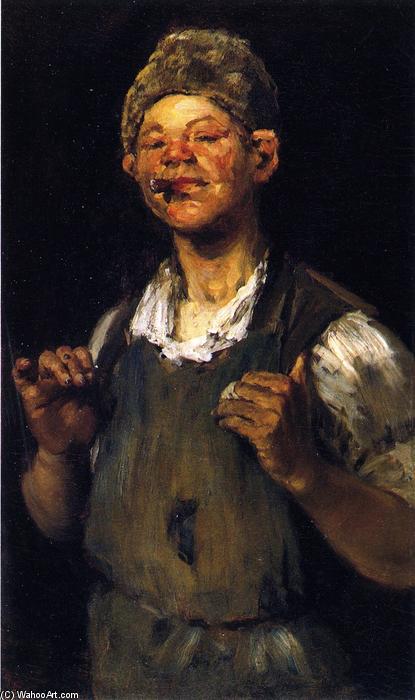
William Merritt Chase’s “The Leader,” A Portrait of Playful Command
William Merritt Chase's "The Leader," painted around 1875, is more than just a portrait; it’s a captivating study in character and a masterful example of the American Impressionist movement. This oil on canvas, measuring approximately 26 inches by 15 ¾ inches, depicts a man – likely a friend or acquaintance of Chase's – caught in a moment of unguarded delight. He’s not formally posed; instead, he leans back with an open mouth, hand raised to his cheek as if mid-gesture, and a mischievous twinkle in his eye. The overall effect is one of uninhibited joy, a rare and refreshing subject matter for portraiture of the era.
Chase’s style here is distinctly Impressionistic, prioritizing capturing fleeting moments and atmospheric effects over meticulous detail. Notice how he employs loose, broken brushstrokes—a hallmark of his technique—to render the man's face and clothing with a sense of immediacy. The colors are vibrant yet muted, relying on subtle shifts in tone to create depth and luminosity. Light plays a crucial role; it’s diffused and dappled, suggesting an outdoor setting bathed in late afternoon sun. Chase skillfully uses this light to highlight the contours of the man's face and the folds of his attire, adding to the painting’s overall sense of vitality.
A Glimpse into Victorian Social Life
To understand “The Leader,” it’s helpful to consider the social context in which it was created. The late 19th century was a period of rapid change and increasing leisure time for the upper classes in America. Portraiture, traditionally reserved for royalty or prominent figures, began to expand its reach, capturing scenes of everyday life and reflecting the growing emphasis on personal expression. Chase’s subject, with his relaxed posture and playful demeanor, embodies this shift—a departure from the stiff formality of earlier portrait conventions.
The painting likely depicts a gentleman engaged in a private joke or moment of amusement, perhaps with friends. The hat he wears – a stylish topper of the time – suggests a man of some social standing. While the identity of the sitter remains unknown, his expression and posture invite us to imagine him as a confident and spirited individual, comfortable in his own skin.
Symbolism and the Essence of Leadership
The title itself, “The Leader,” is laden with symbolic weight. It’s not simply a descriptive label; it suggests qualities of charisma, confidence, and perhaps even a touch of audacity. The man's gesture—raising his hand to his mouth as if about to speak or laugh—could be interpreted as an invitation to join in his merriment, a call to leadership through shared joy. The painting subtly celebrates the idea of informal authority, suggesting that true leadership isn’t necessarily found in power or status but in the ability to inspire and uplift others.
Furthermore, the slightly mischievous expression on the man's face hints at a playful spirit—a willingness to challenge conventions and embrace spontaneity. This element adds another layer of complexity to the portrait, transforming it from a simple likeness into a nuanced exploration of human character.
A Legacy of Impressionistic Brilliance
"The Leader" stands as a testament to William Merritt Chase’s artistic vision and his ability to capture the essence of human emotion. It's a painting that rewards close observation, inviting viewers to linger over its subtle details and contemplate its underlying themes. Chase’s masterful use of light, color, and brushwork creates an image that is both visually stunning and emotionally resonant—a timeless portrait of joy, confidence, and the enduring appeal of a good laugh.
Reproductions of this work offer a wonderful opportunity to bring Chase's vibrant style into any interior space. The painting’s lively energy and engaging subject matter will undoubtedly serve as a focal point, adding a touch of warmth and personality to any room.