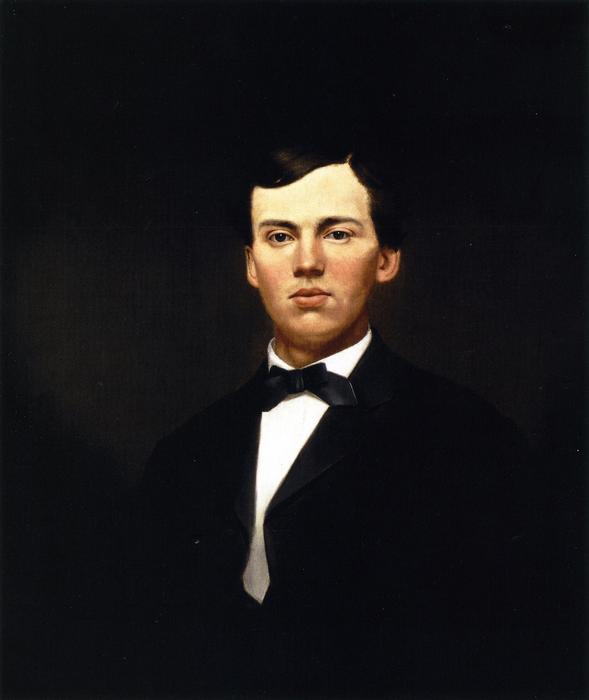
William Gurley Munson: A Glimpse of Victorian Grace
William Merritt Chase’s portrait of William Gurley Munson, completed in 1868, is more than just a likeness; it's a carefully constructed tableau of mid-Victorian ideals – a testament to status, refinement, and the subtle anxieties of a rapidly changing era. The painting captures Munson, a prominent figure in New York’s business community, not as a rugged individualist, but as an embodiment of societal expectations, rendered with Chase's signature blend of realism and Impressionistic brushwork. The composition immediately draws the eye to Munson’s face – his gaze direct yet slightly reserved, hinting at both intelligence and a certain guardedness. His attire, meticulously detailed in the dark fabrics of his coat and waistcoat, speaks volumes about his position within the social hierarchy; the rich textures and subtle folds suggest wealth and influence.
Chase masterfully employs light to shape the scene. The dominant illumination, seemingly originating from the upper left, casts delicate shadows that sculpt Munson’s features, emphasizing the planes of his face and clothing. This directional lighting isn't merely decorative; it creates a sense of depth and drama, pulling the viewer into the portrait and lending it an almost theatrical quality. The background, rendered in a deep, enveloping gradient of black and dark blues, serves as a powerful counterpoint to Munson’s figure, isolating him within a space that simultaneously suggests both confinement and importance. The darkness isn't oppressive, however; instead, it amplifies the richness of the colors and textures in the foreground, creating a harmonious balance.
The Language of Form and Texture
Technically, Munson’s portrait exemplifies Chase’s evolving style – a synthesis of academic training with burgeoning Impressionistic tendencies. The brushwork is remarkably controlled, particularly evident in the rendering of fabric; each thread and wrinkle is meticulously captured, demonstrating Chase's dedication to realistic detail. Yet, he avoids overly smooth surfaces, opting instead for visible strokes that contribute to the painting’s overall texture and vibrancy. Scumbling – a technique involving applying thin layers of paint in a broken, irregular manner – is used liberally to create subtle variations in tone and color, adding depth and luminosity to the portrait. The layering of oil paints builds up rich colors and creates an almost sculptural quality to the surface.
The use of geometric shapes—the oval of Munson’s face, the rectangular form of his jacket, and the circular knot of his tie—reinforces the formality of the scene. These simple forms are rendered with a remarkable degree of precision, reflecting Chase's commitment to capturing the subject’s likeness accurately. However, it is in the subtle nuances – the slight shift in color, the variation in brushstroke – that the portrait truly comes alive. The artist skillfully balances meticulous observation with expressive brushwork, creating an image that is both realistic and emotionally resonant.
Symbolism and Victorian Context
Beyond its technical merits, Munson’s portrait offers a fascinating glimpse into the social and cultural context of 1868 New York. The formal attire—the dark colors, the intricate details—reflects the prevailing Victorian emphasis on decorum, respectability, and social standing. The subject's posture, upright and composed, reinforces this sense of dignity and self-assurance. However, there’s also a subtle undercurrent of restraint in Munson’s gaze, suggesting perhaps the pressures and expectations placed upon men of his position.
Furthermore, the portrait can be interpreted as an exploration of masculinity within the Victorian era. The emphasis on outward appearance—the carefully groomed hair, the tailored clothing—reflects a societal obsession with projecting an image of strength and success. Yet, beneath this veneer of confidence lies a hint of vulnerability, suggesting that even the most outwardly composed individuals may harbor hidden anxieties and uncertainties. The inclusion of details like the watch chain – a symbol of punctuality and responsibility – further reinforces this duality.
A Legacy of Light and Observation
William Merritt Chase’s portrait of William Gurley Munson is a captivating example of American Impressionism at its finest. It's a work that rewards careful observation, inviting viewers to delve beneath the surface and uncover the complexities of Victorian society. The painting’s enduring appeal lies not only in its technical brilliance but also in its ability to evoke a sense of nostalgia for a bygone era – an era defined by both elegance and restraint, by both opportunity and constraint. Today, reproductions of this remarkable portrait continue to inspire appreciation for Chase's artistic vision and his profound understanding of the human condition.