Discover William Morris (1834-1896), a pivotal figure of the Arts & Crafts movement! Explore his iconic textiles, wallpapers, poetry, and socialist vision that redefined Victorian design.
Discover William Morris’s world at the Walthamstow Gallery! Explore stunning textiles, designs & his socialist legacy. Free admission – a celebration of Arts & Crafts beauty.
A Tapestry of Romance and Nature
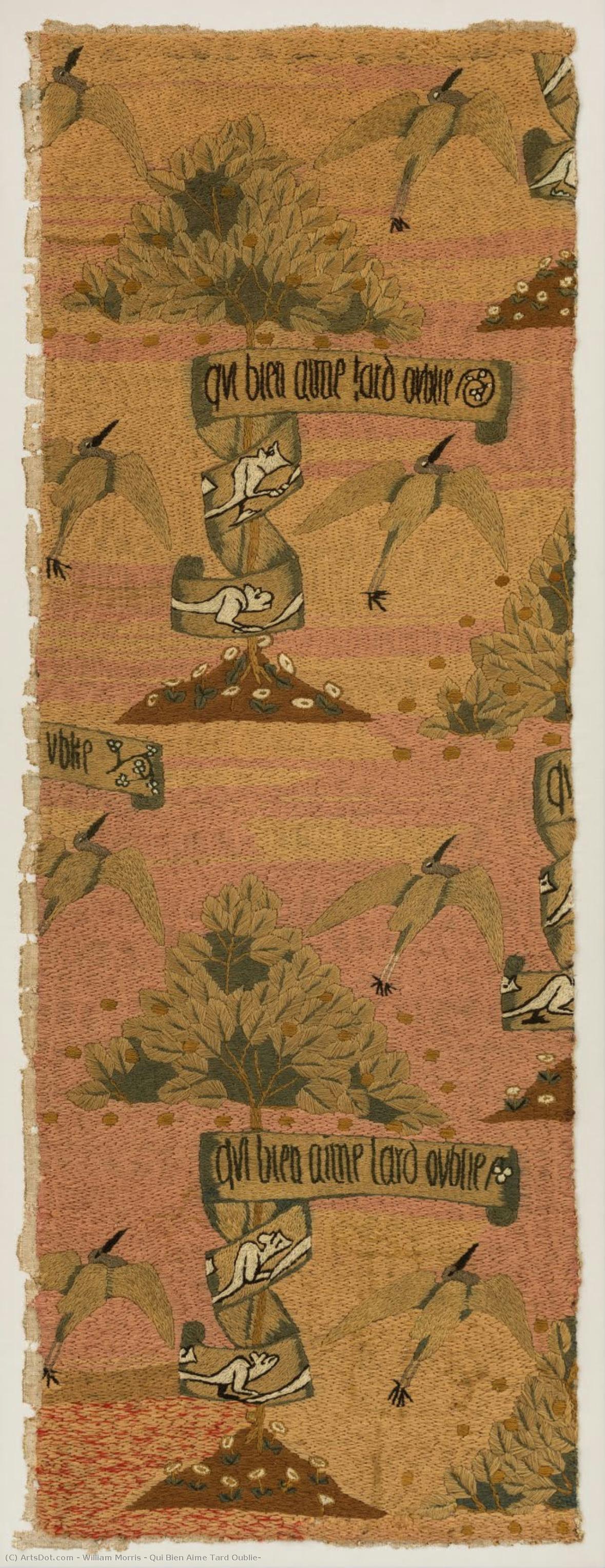
In the delicate interplay of thread and color, "Qui Bien Aime Tard Oublie" emerges as a breathtaking testament to the Pre-Raphaelite spirit and the profound connection between art and the natural world. Created in 1860 by the legendary William Morris, this extraordinary embroidery is far more than a mere decorative hanging; it is a window into a romanticized era where craftsmanship served as a vessel for deep emotion. The work captures a serene, almost ethereal moment: a woman, her hair adorned with a graceful bow, nestled within the lush, verdant embrace of a forest setting. Through the meticulous application of needlework, Morris transforms a textile medium into a painterly experience, where every stitch contributes to the soft, atmospheric depth of the woodland scene.
The historical heartbeat of this piece is inextricably linked to the prestigious circles of the 19th-century English avant-garde. Originally part of a set of identical hangings installed at Penkill Castle in Ayrshire, Scotland, the work was commissioned for Alice Boyd, a woman deeply embedded in the artistic fabric of her time. As the mistress of painter William Bell Scott and a close associate of Dante Gabriel Rossetti, Boyd provided the perfect sanctuary for such evocative works. The very fact that Rossetti himself took note of these embroideries underscores their significance within the Pre-Raphaelite movement, suggesting that even in the medium of needlework, Morris was able to communicate the same intense, symbolic language found in the era's most famous oil paintings.
Technically, the piece is a marvel of Victorian textile artistry. Measuring an impressive 185 x 66 cm, the elongated format lends itself to a sweeping, panoramic narrative that draws the eye across the landscape. The technique of embroidery allows for a unique texture that paint alone cannot replicate; there is a tactile richness to the forest floor and a soft, diffused light that seems to emanate from the very fibers of the work. This mastery of medium creates a sense of intimacy, inviting the viewer to lean in and discover the subtle details of the foliage and the gentle expression of the central figure.
For the discerning collector or interior designer, "Qui Bien Aime Tard Oublie" offers an unparalleled opportunity to introduce a sense of historical grandeur and organic beauty into a contemporary space. The artwork serves as a focal point that bridges the gap between the ruggedness of nature and the refined elegance of classical design. Whether displayed in a sunlit library or as a sophisticated accent in a modern living suite, a high-quality reproduction of this masterpiece brings with it an aura of timelessness. It is not merely an object of decoration, but an emotional anchor—a piece that whispers tales of medieval chivalry, the enduring power of love, and the restorative beauty of the English countryside.