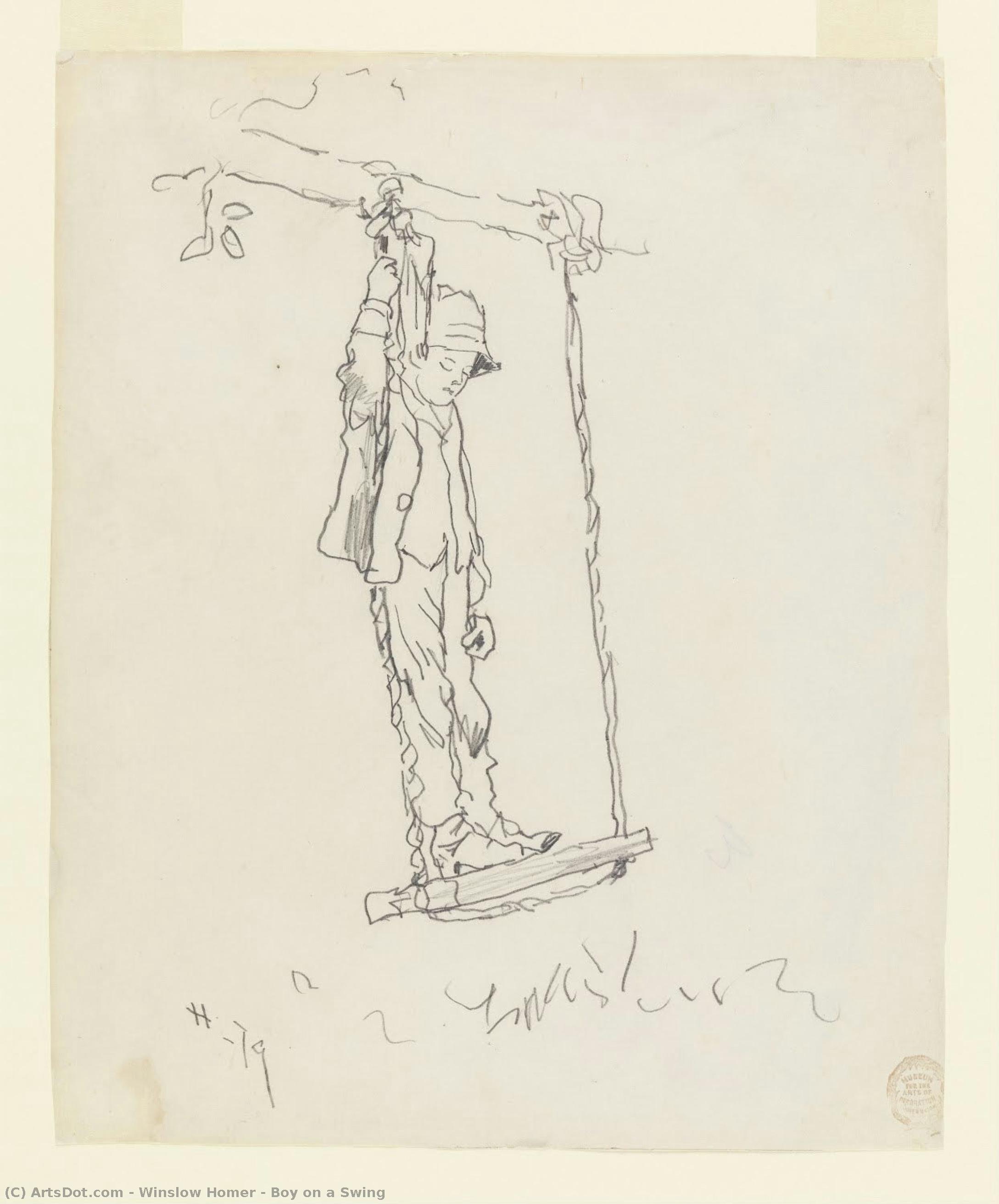
Winslow Homer’s haunting ‘Boy on a Swing,’ painted in 1879, captures a moment of profound vulnerability against a serene backdrop of trees and birds—a masterful depiction of American realism during the Gilded Age. Explore this evocative artwork and bring its timeless beauty into your home.
A Haunting Portrait of Vulnerability: Exploring Winslow Homer’s “Boy on a Swing”
Winslow Homer's "Boy on a Swing," completed in 1879, transcends mere depiction; it embodies the very essence of American Romanticism—a genre characterized by its unflinching gaze at the human condition amidst the grandeur of nature. This unsettling image captures a moment of profound distress, rendered with masterful precision and imbued with layers of symbolic meaning that continue to resonate with viewers today. Homer’s artistic journey began far from the gilded halls of European academies, instead nurtured by the pragmatic realities of commercial illustration and an acute sensitivity to the landscapes and lives of his homeland.
- Subject Matter: The artwork portrays a boy suspended precariously from a swing, presenting him as vulnerable and exposed against the backdrop of towering trees. This seemingly simple composition is deliberately unsettling, prioritizing psychological impact over conventional narrative conventions.
- Style & Technique: Homer employed watercolor—a technique favored for its luminosity and ability to capture subtle tonal variations—to achieve an ethereal quality that contrasts sharply with the boy’s palpable anxiety. The artist's meticulous attention to detail is evident in every brushstroke, meticulously rendering textures of bark, foliage, and fabric.
The painting emerged during a period marked by significant social upheaval in America – Reconstruction following the Civil War—and Homer skillfully reflects this turbulent era through his depiction of isolation and fragility. The boy’s posture speaks volumes about the anxieties surrounding identity and belonging within a nation grappling with its newfound freedoms and responsibilities. Furthermore, the inclusion of birds circling overhead adds another layer of interpretation. Traditionally associated with freedom and aspiration, their presence here serves as a poignant reminder of the boy's yearning for liberation—a desire tragically juxtaposed against his physical predicament. The swing itself symbolizes precarious balance and dependence, highlighting the vulnerability inherent in human existence.
Historical Context: Homer’s work aligns perfectly with the Romantic movement’s preoccupation with emotion and imagination, rejecting Neoclassical ideals of reason and order. He sought to portray the American experience authentically, prioritizing observation and emotional resonance over idealized representations.
- Symbolism: Beyond its immediate visual impact, “Boy on a Swing” operates on multiple symbolic levels. The boy’s vulnerability embodies universal themes of fear and uncertainty, while the swing represents precariousness and dependence—concepts central to Romantic thought.
- Emotional Impact: Homer's masterful use of watercolor creates an atmosphere of palpable tension and unease. The viewer is drawn into the boy’s experience of distress, prompting contemplation on themes of innocence lost and the burdens of responsibility.
“Boy on a Swing” remains a compelling testament to Homer’s artistic vision—a poignant exploration of human emotion within the context of American landscape and history. Its enduring power lies in its ability to provoke introspection and capture the unsettling beauty found at the intersection of vulnerability and aspiration. A reproduction offers an opportunity to appreciate this iconic artwork's nuanced artistry and profound emotional depth, bringing Homer’s evocative vision into any interior space.