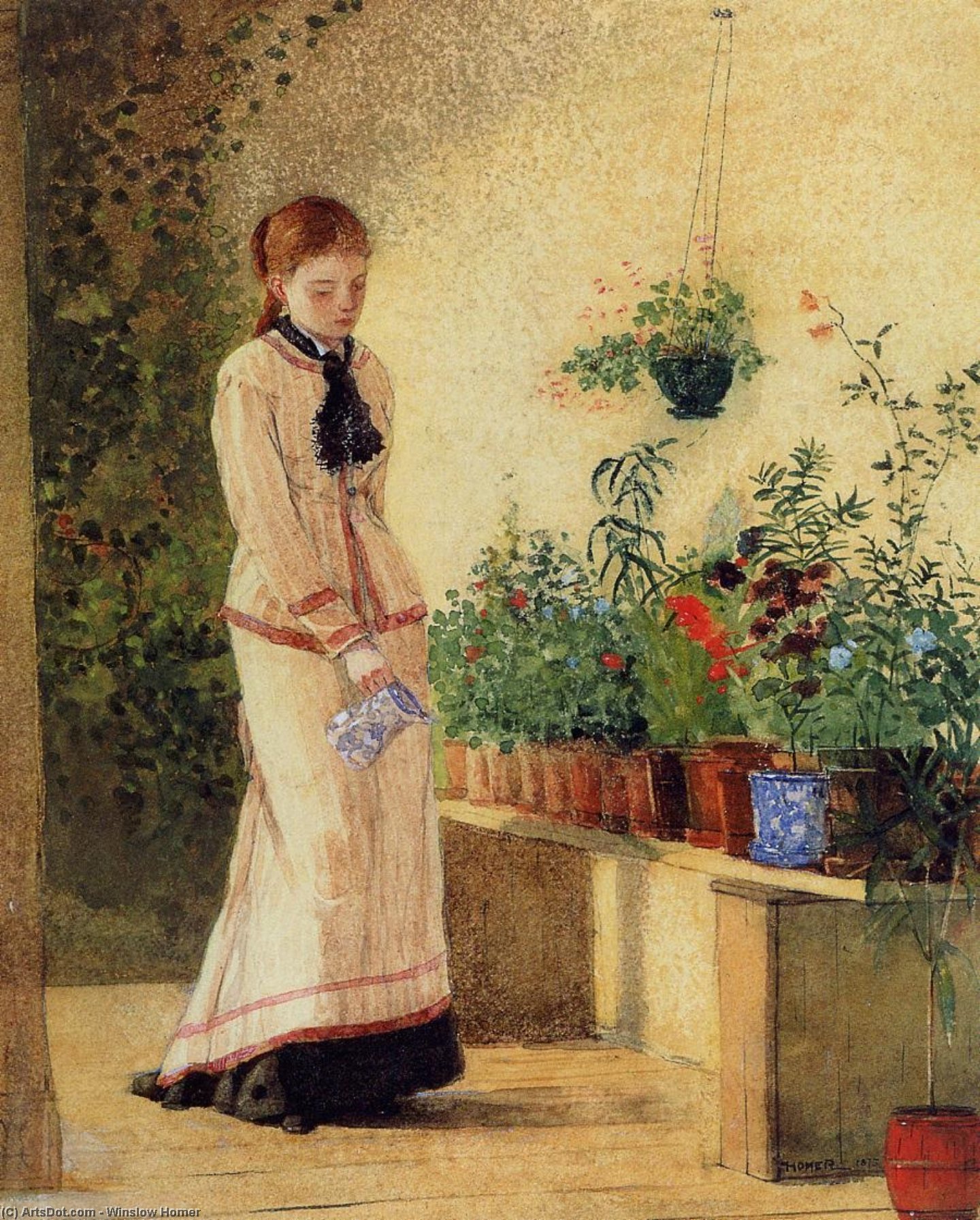
Winslow Homer’s Serene Observation: “Girl Watering Plants”
Winslow Homer, one of America's most celebrated 19th-century artists, possessed an extraordinary ability to distill the essence of everyday life onto canvas. His watercolors, often imbued with a quiet dignity and profound connection to nature, continue to resonate deeply with viewers today. “Girl Watering Plants,” created in 1875, exemplifies this talent—a deceptively simple scene that reveals layers of observation, light, and emotional resonance. More than just a depiction of a young girl tending her garden, the painting is a meditation on childhood innocence, rural beauty, and the restorative power of nature itself.
The artwork immediately draws the eye to its central figure: a young girl, dressed in a modest yet charming frock, carefully attending to a collection of potted plants. Homer’s masterful use of watercolor—a medium he embraced with particular skill later in his career—allows for an astonishing delicacy and luminosity. The colors are muted but vibrant, capturing the soft light filtering through the foliage and reflecting off the blossoms. Notice how Homer doesn't simply paint the scene; he seems to *capture* a fleeting moment, preserving its tranquility with remarkable precision.
Composition and Spatial Harmony
Measuring 30 x 24 centimeters, “Girl Watering Plants” is a compact yet remarkably detailed work. The composition is carefully balanced, creating a sense of visual harmony. Two vases—one positioned subtly in the upper left corner, the other on the right side—add vertical interest and draw the eye across the canvas. A single potted plant dominates the right foreground, anchoring the scene while the girl’s actions provide a dynamic focal point. The arrangement isn't merely decorative; it establishes a quiet rhythm, guiding the viewer through the space with subtle cues.
Homer’s attention to detail is evident in every element of the painting. From the delicate folds of the girl’s dress to the individual petals of the flowers, each component contributes to the overall sense of realism and immediacy. The artist's ability to render texture—the rough bark of the plants, the smooth surface of the pots—is particularly noteworthy, adding a tactile quality to the image.
The Language of Light
As with many of Homer’s works, light plays a crucial role in “Girl Watering Plants.” He wasn't simply replicating what he saw; he was actively shaping the scene through his manipulation of color and tone. The painting is bathed in a soft, diffused light that suggests an early morning or late afternoon—a time when the air is still cool and the world feels particularly peaceful. Homer skillfully uses highlights to draw attention to the girl’s face and hands, while shadows create depth and volume within the foliage.
Drawing on principles established by artists throughout history – as detailed in Wikipedia's article on Light in Painting – Homer understood that light isn't merely a technical element for representing form; it carries significant aesthetic and symbolic weight. In this painting, the gentle illumination evokes feelings of serenity, innocence, and connection to the natural world.
Winslow Homer’s Artistic Vision
“Girl Watering Plants” is representative of Winslow Homer's broader artistic vision—a commitment to portraying everyday life with honesty and empathy. Unlike many artists of his time who focused on grand historical or mythological subjects, Homer chose to depict the lives of ordinary people, capturing their struggles, joys, and quiet moments of connection. His work often reflects a deep appreciation for the beauty of the American landscape and the dignity of human experience.
Considered alongside other notable works like “Sailing the Catboat” and “The Milk Maid,” "Girl Watering Plants" showcases Homer’s ability to convey serenity and joy through simple compositions. These paintings, available for viewing on ArtsDot.com, offer a glimpse into the artist's remarkable talent and his profound understanding of human nature.
Conclusion: A Timeless Masterpiece
“Girl Watering Plants” by Winslow Homer is more than just a pretty picture; it’s a poignant meditation on childhood, nature, and the quiet beauty of everyday life. Its masterful composition, evocative use of light, and Homer's signature artistic style combine to create an image that continues to captivate viewers generations after its creation. For those seeking a piece of art that speaks to the soul—a reminder of the simple pleasures and enduring values of the natural world—this watercolor is a truly exceptional choice. Explore more of Winslow Homer’s captivating works, including “Sailing the Catboat” and “The Milk Maid,” on ArtsDot.com for a deeper appreciation of this American artistic icon.