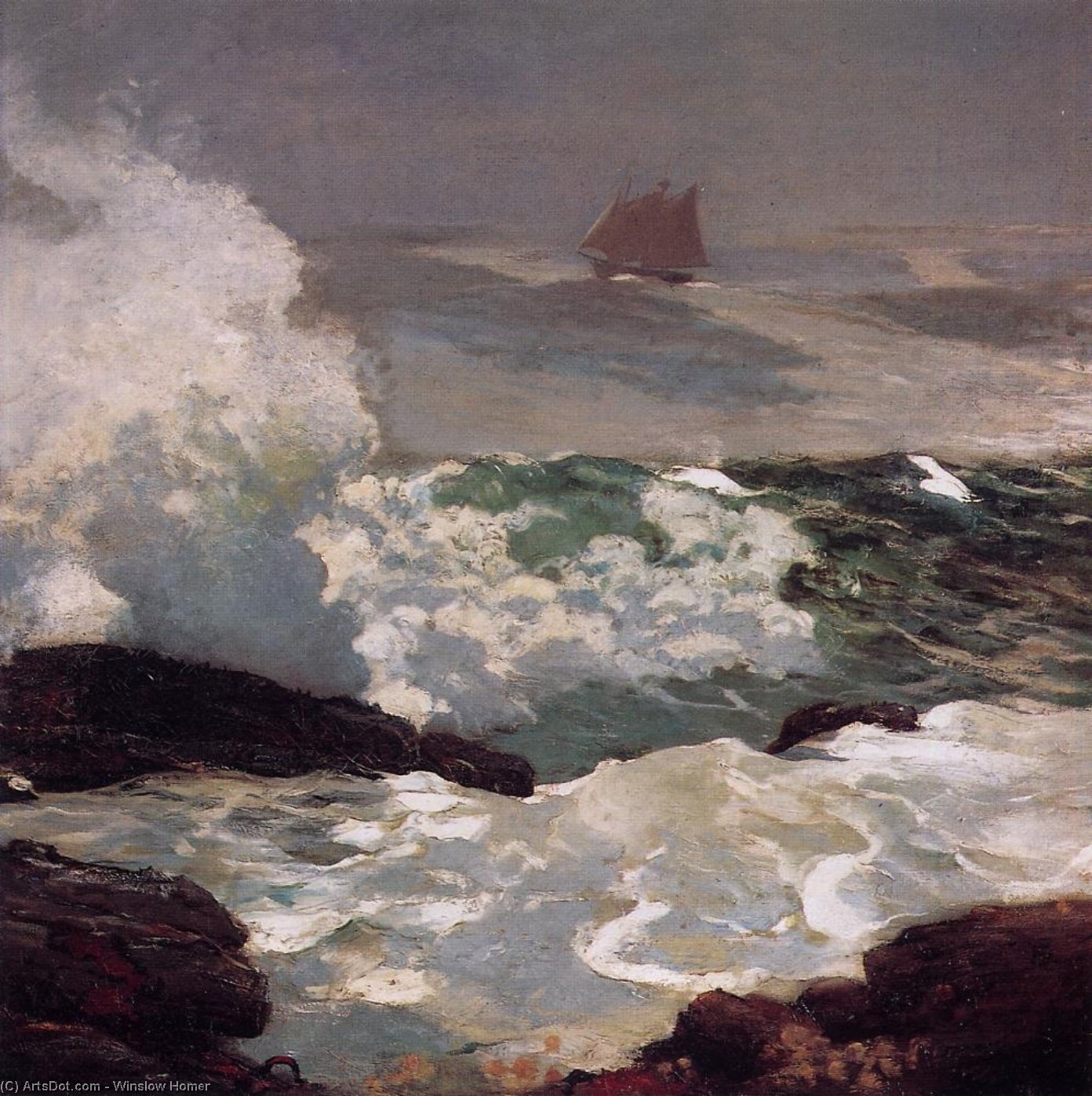
Experience the turbulent beauty of Winslow Homer's 1900 masterpiece On a Lee Shore, where crashing waves and jagged rocks capture the raw power of American Realism, inviting you to bring this dramatic seascape home.
Winslow Homer (1836-1910): Explore the iconic American Realist's powerful paintings of marine life, landscapes & 19th-century life. Discover masterpieces like 'The Gulf Stream' and 'Breezing Up'.
On a Lee Shore: A Study in Dramatic Maritime Landscape
Winslow Homer, one of the most celebrated American artists of his time, possessed an unparalleled ability to translate the visceral experience of nature onto canvas. “On a Lee Shore,” painted in 1900, exemplifies this talent—a monumental oil on canvas that transcends mere representation and delves into the profound emotional resonance of the sea’s turbulent beauty. Located at the Rhode Island School of Design Museum of Art, this artwork stands as a cornerstone of American Realism and continues to captivate viewers with its masterful execution and evocative atmosphere.
Composition and Visual Narrative
The painting's dramatic centerpiece is undoubtedly the confrontation between towering waves and jagged rocks along a rugged coastline. Homer skillfully employs compositional techniques—primarily diagonal lines—to heighten tension and guide the eye across the canvas. A large ship, positioned in the distant horizon, serves as an anchor point against which the dynamism of the sea is measured. Scattered smaller boats punctuate the water surface, adding to the sense of scale and emphasizing humanity’s vulnerability within the overwhelming force of nature. The placement of figures—two individuals observing the scene—further reinforces this narrative dimension, inviting contemplation on themes of resilience and observation.
Technique: Bold Brushstrokes and Atmospheric Depth
Homer's technique is characterized by assertive brushstrokes that convey an undeniable energy. Oil paint was applied with considerable vigor, capturing the movement of crashing waves and conveying a palpable sense of immediacy. The artist’s palette leans heavily on blues and grays—dominant hues reflecting the bleakness of the seascape—yet punctuated by flashes of white foam and darker shadows which create remarkable depth and atmospheric perspective. Homer's meticulous attention to detail is evident in the rendering of textures – from the rough surface of the rocks to the turbulent spray of seawater – demonstrating his commitment to capturing the essence of the natural world with uncompromising realism.
Historical Context: Echoes of American Maritime Tradition
“On a Lee Shore” emerged during a period marked by significant advancements in American maritime exploration and industry. Homer’s work aligns perfectly with the broader artistic movement of Realism, which rejected idealized depictions of beauty in favor of portraying everyday life with unflinching honesty. Like many of his contemporaries, Homer drew inspiration from the landscapes and traditions of New England—a region deeply connected to seafaring history. The painting reflects not only Homer's artistic vision but also a cultural preoccupation with confronting the challenges posed by nature – a theme that resonates powerfully across time periods.
Symbolism: Resilience Amidst Adversity
Beyond its visual splendor, “On a Lee Shore” carries symbolic weight. The ship represents human ambition and perseverance against formidable odds—a motif frequently explored in Homer’s oeuvre. Simultaneously, the crashing waves symbolize destructive forces but also offer an opportunity for contemplation and acceptance of life's inevitable hardships. The solitary figures gazing upon the scene embody a quiet dignity and underscore the importance of observing and appreciating the grandeur of the natural world.
Concluding Reflection: An Enduring Legacy
Winslow Homer’s “On a Lee Shore” remains a testament to his artistic genius—a painting that transcends its historical context to speak directly to our emotions. Its masterful composition, expressive technique, and evocative symbolism solidify its place as an iconic masterpiece of American Realism. As part of the Rhode Island School of Design Museum's impressive collection, this artwork continues to inspire admiration for Homer’s ability to transform observation into profound artistic expression.