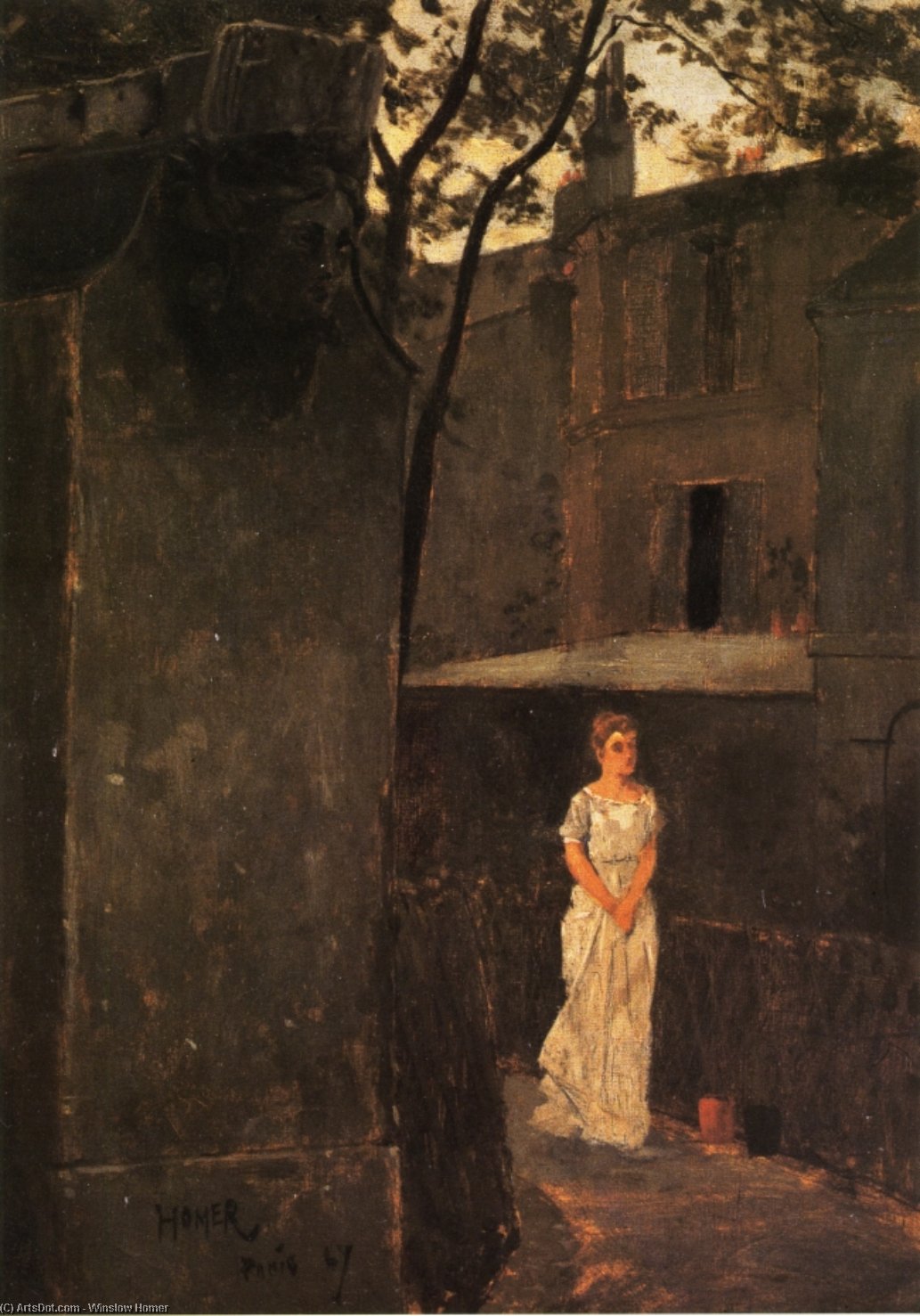
A Moment Suspended in Time: Winslow Homer’s *Paris Courtyard* (1867)
Winslow Homer's *Paris Courtyard*, housed at the Maier Museum of Art at Randolph College, offers a captivating glimpse into 19th-century Parisian life. Painted in 1867, this oil on canvas transcends a simple street scene; it’s a study in quiet contemplation and atmospheric realism, revealing a pivotal moment in Homer's artistic development as he honed his skills while working abroad as an illustrator for *Harper’s Weekly*.
Subject & Composition: An Intimate Encounter
The painting centers on a solitary woman positioned within a narrow courtyard. She stands before a weathered stone building, her gaze directed downwards – lost in thought or perhaps observing something just beyond the frame. The composition is deliberately constrained by the surrounding architecture; high walls and limited sky create a sense of enclosure, drawing attention to the figure and intensifying the feeling of introspection. Background figures suggest a bustling city life continuing around her, yet she remains detached, creating a poignant contrast between public space and private reverie. A clock visible on the building subtly emphasizes the passage of time, adding another layer of narrative depth.
Style & Technique: Embracing Realism
*Paris Courtyard* exemplifies Homer’s emerging mastery of realism. While not yet fully embracing the bold brushwork that would characterize his later seascapes, the painting demonstrates a keen eye for detail and an ability to capture the textures of stone, fabric, and light. The artist employs a muted palette dominated by browns, grays, and ochres, reflecting the somber tones of the Parisian cityscape.
Visible brushstrokes contribute to the work’s sense of immediacy and authenticity, while careful attention to light and shadow creates depth and dimensionality. This technique foreshadows his later explorations of atmospheric effects.
Historical Context: Paris in Transition
1867 was a period of significant transformation for Paris under Napoleon III's ambitious urban renewal project led by Baron Haussmann. While Homer doesn’t explicitly depict the grand boulevards and modern architecture associated with this renovation, *Paris Courtyard* offers a glimpse into the older, more intimate corners of the city that were rapidly disappearing. The painting captures a moment before complete modernization, preserving a sense of historical continuity amidst change. Homer's time in Paris was crucial for his development as an artist; he absorbed European artistic trends while maintaining his distinctly American perspective.
Symbolism & Emotional Impact: A Study in Solitude
The painting’s power lies in its subtle symbolism and emotional resonance. The woman’s downward gaze and isolated position evoke feelings of melancholy, longing, or quiet contemplation.
The courtyard itself can be interpreted as a metaphor for the complexities of urban life – a space both confining and connecting. The overall mood is one of understated drama, inviting viewers to project their own emotions onto the scene and contemplate the universal themes of solitude, memory, and the passage of time.
Winslow Homer: A Legacy of American Art
Winslow Homer (1836-1910) remains one of America’s most beloved artists. Beyond *Paris Courtyard*, his prolific career produced iconic works such as
Girl with Pitchfork (Phillips Collection) and
The Studio (Metropolitan Museum of Art), demonstrating his versatility across genres. Other notable pieces include
The Morning Bell. His ability to capture the essence of American life, from rural landscapes to dramatic marine scenes, cemented his place in art history.
Collecting & Reproduction
For those seeking to bring a touch of 19th-century elegance and artistic depth into their homes, high-quality
handmade oil painting reproductions of *Paris Courtyard* are available. This allows art enthusiasts to appreciate Homer’s masterful technique and evocative imagery firsthand. The painting's subdued palette and intimate scale make it a versatile addition to various interior design schemes, lending sophistication and quiet contemplation to any space.
- Explore more of Winslow Homer’s work at ArtsDot.com.
- Discover related artworks and artists on the ArtsDot platform.