Winslow Homer (1836-1910): Explore the iconic American Realist's powerful paintings of marine life, landscapes & 19th-century life. Discover masterpieces like 'The Gulf Stream' and 'Breezing Up'.
The Bathers: A Study in Quiet Observation
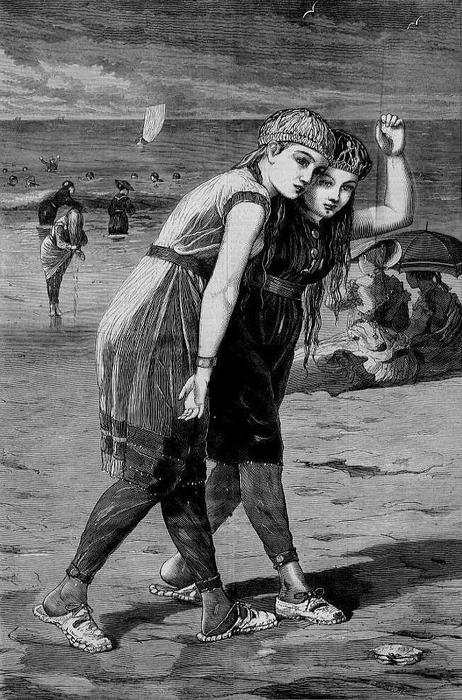
Winslow Homer’s *The Bathers*, executed in 1873 as a wood engraving for Harper's Weekly, stands as a testament to the artist’s singular approach – one rooted not in grand narratives but in meticulous observation of the American landscape and its inhabitants. Unlike many of his contemporaries pursuing stylistic innovation abroad, Homer honed his craft within the constraints of commercial illustration, developing an unparalleled ability to distill complex scenes into powerfully resonant images. This formative experience instilled a dedication to capturing reality with remarkable precision, a characteristic that would define his entire oeuvre.
Composition and Technique: Mastering Line and Tone
The engraving’s composition centers around two young women strolling along the shoreline, positioned prominently in the foreground. Surrounding them are scattered bathers – figures engaged in leisurely pursuits – creating an illusion of depth achieved through careful consideration of perspective and overlapping forms. A distant sailboat punctuates the horizon line, reinforcing the coastal setting. Homer skillfully employs fine lines to delineate details—clothing folds, hair strands, facial expressions—while hatching and cross-hatching techniques build up tonal variations that convey texture and volume. The absence of color is deliberate; it compels viewers to focus on the interplay of light and shadow, highlighting Homer’s mastery of line work as a tool for artistic expression.
Historical Context: Harper's Weekly and the Rise of Realism
Published in 1873 during a period marked by burgeoning interest in realism within American art, *The Bathers* exemplifies the stylistic trends of its time. Harper’s Weekly, a respected periodical known for its photographic illustrations alongside artistic renderings, championed depictions of everyday life with unflinching honesty. Homer's work aligns perfectly with this movement, rejecting idealized representations and instead presenting a scene imbued with palpable atmosphere—the diffused light of an overcast day casting subtle shadows across the sand and sea. This commitment to portraying the natural world truthfully reflects the broader cultural preoccupation with capturing the spirit of America during Reconstruction.
Symbolism and Emotional Resonance: Tranquility Amidst Change
Beyond its technical brilliance, *The Bathers* possesses a profound symbolic significance. The figures’ relaxed postures convey an unspoken serenity—a moment of respite from the anxieties of the era. Homer captures not just a visual record but also an emotional impression; the scene evokes nostalgia for simpler times and speaks to the enduring human desire for connection with nature. The quiet dignity of the women walking along the shore suggests resilience and grace, qualities that resonate deeply within the viewer’s imagination.
A Legacy of Observation: Homer's Enduring Influence
Winslow Homer’s *The Bathers* remains a cornerstone of American art history—a masterpiece born from disciplined observation and executed with unwavering technical skill. Its enduring appeal lies in its ability to convey both visual beauty and emotional depth, reminding us that the most powerful art often resides in capturing the essence of ordinary moments with extraordinary sensitivity. Reproductions of this iconic engraving continue to inspire interior designers and collectors alike, celebrating Homer’s legacy as a champion of realism and a profound interpreter of the American experience.