A Window into Victorian Refinement: Winslow Homer’s William Crook Rudman Jr.
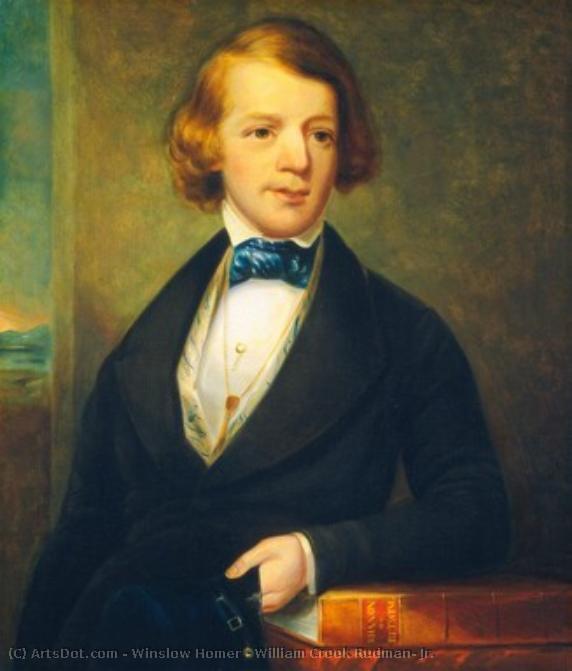
Winslow Homer's “William Crook Rudman Jr.” stands as a testament to the meticulous realism and understated elegance characteristic of American portraiture during the mid-19th century. Executed in oil on canvas, this artwork transcends mere representation; it captures a moment of contemplative repose within a meticulously crafted interior space.
Composition & Technique: Mastering Light and Texture
The painting’s central focus is Rudman Jr., positioned squarely within the frame, fostering an immediate connection with the viewer. Homer skillfully employs linear perspective to establish depth, guiding the eye towards a softly rendered background featuring indistinct bookshelves and a window—elements that subtly suggest intellect and erudition. Visible brushstrokes are layered throughout the canvas, creating rich texture and conveying a palpable sense of materiality. The directional lighting from the upper left casts shadows across Rudman Jr.’s face and clothing, enhancing volume and dimensionality.
Symbolism: Books as Vessels of Knowledge
Rudman Jr.'s hand rests upon a book—a deliberate inclusion that speaks volumes about his profession and intellectual pursuits. This symbolic gesture aligns perfectly with Homer’s stylistic choices, reflecting the values of Victorian society where education and scholarship were highly esteemed. The book serves not only as an object but also as a conduit for conveying ideas of wisdom and contemplation.
Historical Context: Academic Realism in Its Prime
“William Crook Rudman Jr.” embodies the spirit of academic realism—a dominant artistic trend during Homer’s era. Artists like Homer prioritized meticulous observation and accurate depiction, rejecting Romantic idealism for a grounded engagement with the observable world. This approach is evident in the painting's careful rendering of facial features, clothing folds, and skin texture—details that demonstrate Homer’s dedication to capturing likeness and conveying emotion through subtle tonal variations.
Emotional Resonance: Quiet Contemplation
Despite its formal composition, “William Crook Rudman Jr.” exudes a profound sense of tranquility. Homer's masterful use of light and shadow creates an atmosphere of intimacy and invites the viewer to contemplate the subject’s inner life. The painting’s understated beauty resides in its ability to convey dignity and quiet contemplation—qualities that resonate deeply with viewers seeking art that transcends mere visual spectacle.