A Labyrinth of Thought: Ad Reinhardt’s “How to Look at a Spiral”
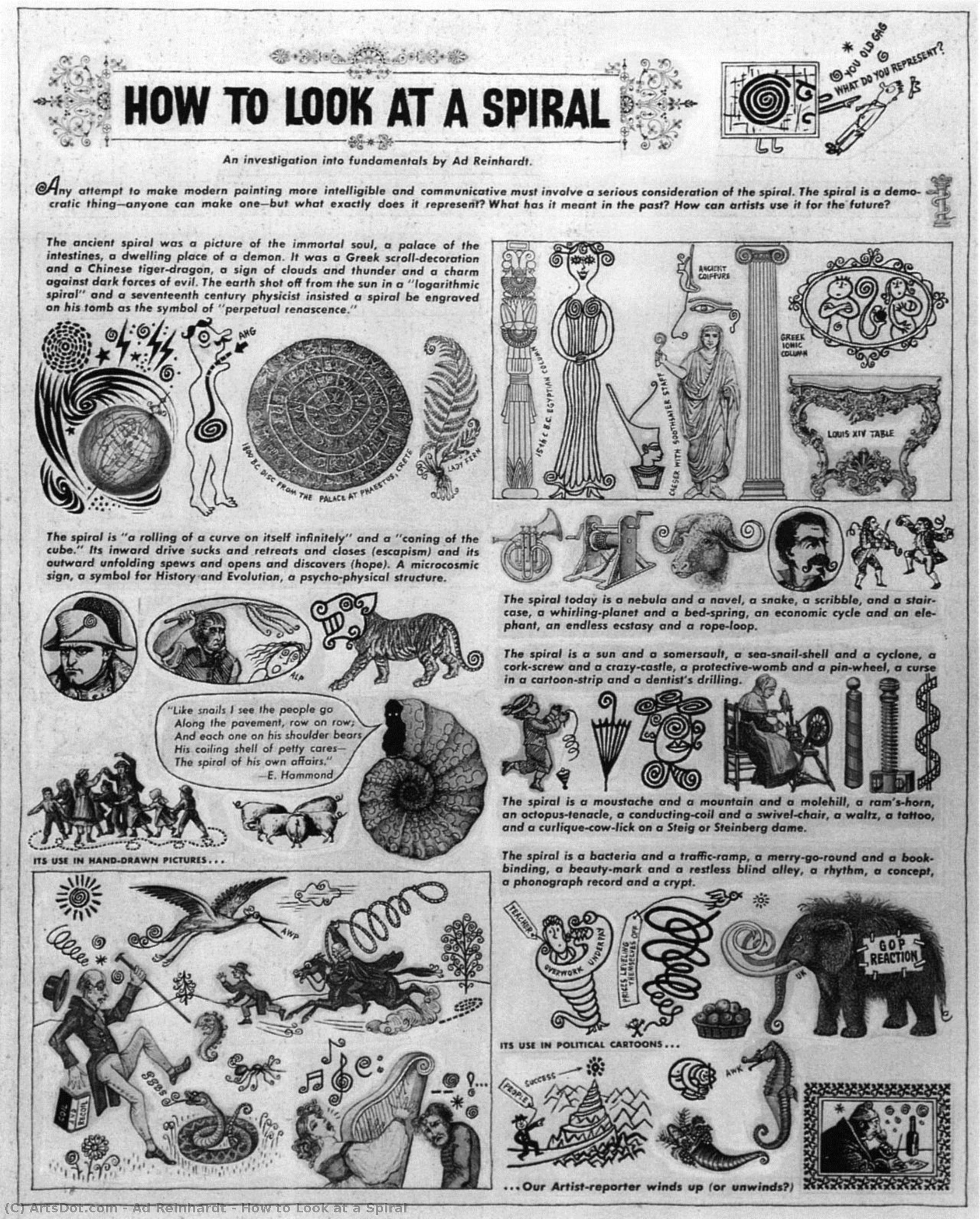
Ad Reinhardt's "How to Look at a Spiral," created in 1946, isn’t merely an illustration; it’s an invitation. An intellectual and deeply layered work, it embodies the artist’s core philosophy of stripping art down to its essential elements – a pursuit that profoundly influenced generations of abstract artists. The piece, rendered with meticulous hand-drawn detail on paper, likely incorporating subtle watercolor washes for shading, presents a densely packed visual argument about the spiral motif itself. It's a chaotic yet deliberate composition, overflowing with overlapping images, textual excerpts, and intricate decorative patterns, all arranged within a roughly circular framework that mirrors the very subject it explores.
The artwork’s style leans heavily into Art Nouveau, but with a distinctly Reinhardtian sensibility – a rejection of ornamentation in favor of pure form and conceptual clarity. The lines are predominantly curvilinear and flowing, guiding the eye through a complex network of symbols and ideas. Notice the deliberate flattening of perspective; depth is sacrificed for the sake of visual relationships, prioritizing the intellectual engagement over a realistic depiction. This choice immediately signals that “How to Look at a Spiral” isn’t about *seeing* something beautiful in the traditional sense, but rather about *understanding* its underlying structure and significance.
Decoding the Symbolism: Spirals and Beyond
At first glance, the image appears overwhelming – a visual feast of interconnected elements. However, closer inspection reveals a carefully orchestrated system of symbolism. The spiral itself is, of course, central, representing growth, evolution, history, and even consciousness. Reinhardt was fascinated by its appearance in diverse fields, from archaeology (tracing ancient civilizations) to psychology (exploring the human psyche), and literature (representing cyclical narratives). Within this larger framework, the artwork incorporates numerous specific symbols: spirals nested within spirals, stylized figures – including a woman depicted in classical robes, evoking notions of wisdom and knowledge – animals like lions and elephants representing power and instinct, and decorative patterns reminiscent of ancient artifacts, hinting at universal themes and timeless truths.
Crucially, the inclusion of textual excerpts throughout the composition adds another layer of interpretation. These fragments—references to historical figures, philosophical concepts, and literary allusions—serve as prompts for contemplation, encouraging the viewer to actively engage with the artwork’s meaning. Reinhardt wasn't simply illustrating a spiral; he was constructing an argument *about* spirals, inviting us to consider their significance within a broader context of human experience.
A Window into Reinhardt’s Philosophy
“How to Look at a Spiral” is deeply rooted in Ad Reinhardt’s unique artistic philosophy – what he termed “Art-as-Art.” He believed that art should be divorced from representational concerns, focusing instead on the pure essence of form and color. This approach was radical for its time, challenging conventional notions of beauty and demanding that viewers actively participate in the creation of meaning. The artwork’s dense composition reflects this philosophy; it's a deliberate attempt to overwhelm the senses, forcing the viewer to confront the fundamental questions about what constitutes art and how we perceive it.
The piece was created during a pivotal moment in Reinhardt’s career, as he began to explore his signature “black” paintings – works that appear at first glance to be simply black canvases but are actually composed of layers of nearly black shades. This exploration represented a culmination of his lifelong quest to reduce art to its most essential elements, stripping away all extraneous details and focusing solely on the experience of seeing.
A Timeless Masterpiece: Reproduction and Beyond
Originally created in 1946, “How to Look at a Spiral” remains a remarkably prescient work, anticipating many of the trends that would define abstract art in the decades to come. Today, high-quality reproductions offer an accessible way to experience Reinhardt’s complex vision. When selecting a reproduction, consider the detail and color accuracy – elements crucial to capturing the artwork's layered symbolism and intellectual depth. “How to Look at a Spiral” is more than just a beautiful image; it’s a testament to Ad Reinhardt’s profound understanding of art and its power to provoke thought and inspire contemplation.