A Fragment of Surrealist Memory
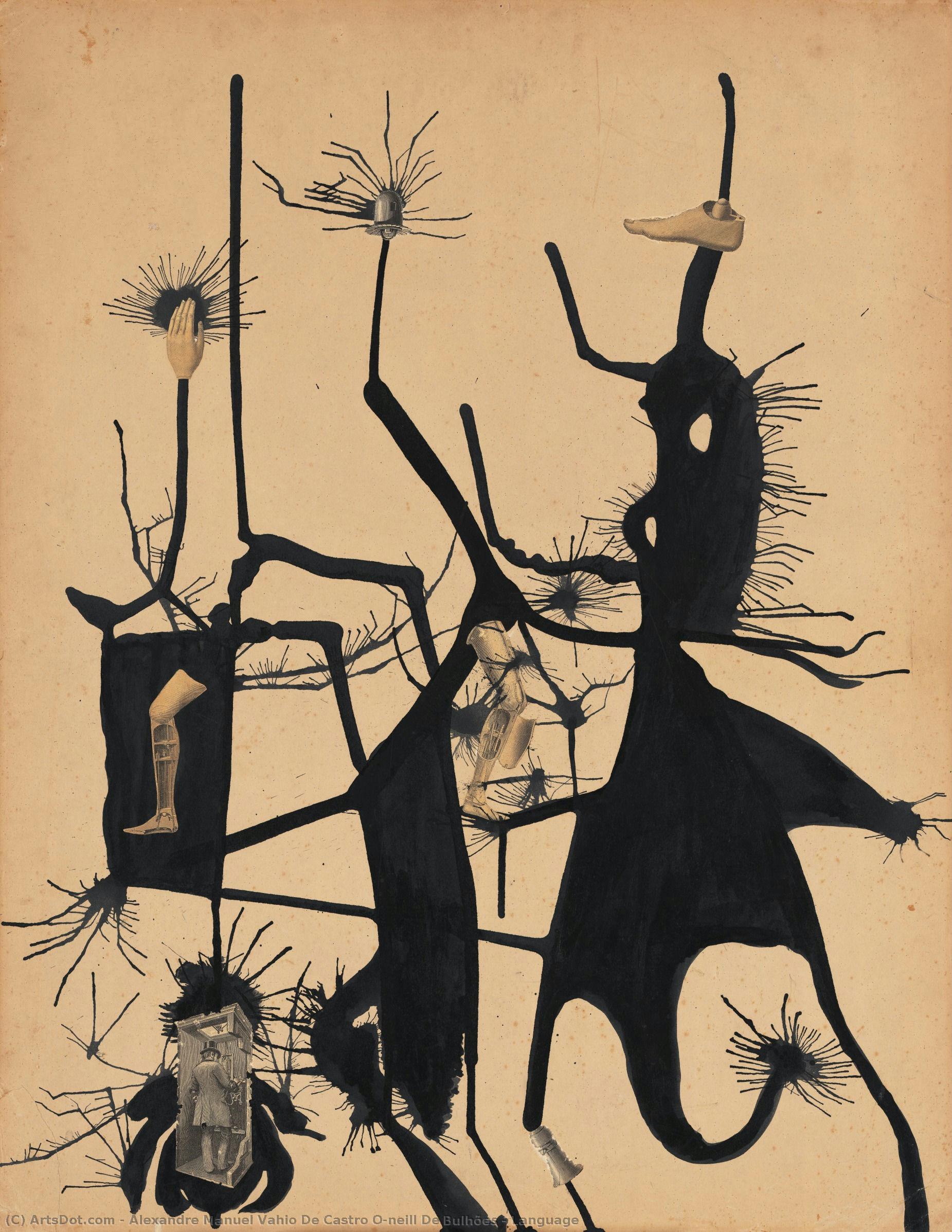
In the quiet corridors of art history, certain works exist as haunting echoes of lost eras, and "Language," created in 1948 by the Portuguese master Alexandre Manuel Vahio De Castro O'Neill De Bulhões, is precisely such a relic. As the sole surviving fundamental piece from a series of five, this work carries an inherent weight of rarity and preciousness. The painting presents itself as a complex, intricate collage—a visual tapestry where the boundaries between reality and dream dissolve. Through its monochromatic lens, we are invited into a world where figures, flora, and fauna are woven together in a delicate, almost spectral dance, capturing a moment of profound creative transition.
The composition is a masterclass in balanced chaos. At first glance, the eye is drawn to the three primary figures that anchor the work: one poised near the upper left, another nestled toward the center-left, and a third grounding the bottom right corner. These human elements are not isolated; they are part of an ecosystem of symbols. Birds flutter through the mid-ground and corners, acting as messengers between the terrestrial plants and the ethereal figures. This layering of organic shapes—the curve of a leaf, the silhouette of a wing, the presence of a human form—creates a sense of deep, multidimensional space that pulls the viewer into its labyrinthine structure.
The Poetics of Rebellion and Form
To understand "Language," one must understand the spirit of Alexandre O'Neill. As a founding figure of the Lisbon Surrealist movement, O'Neill brought an attitude of permanent revolt and a playful, often biting, disregard for social and literary conventions to his art. This piece reflects that very tension. While the technique utilizes the collage-like arrangement characteristic of early surrealism and concretism, the emotional core is deeply rooted in the artist's unique relationship with his homeland. The work does not merely depict a scene; it constructs a new vocabulary—a literal "language"—where disparate elements are forced into a meaningful, albeit fragmented, conversation.
The use of black and white photography to document this piece adds an extra layer of nostalgic depth, emphasizing the stark contrasts and the graphic strength of the composition. For the collector or the interior designer, this artwork offers more than just visual interest; it provides a sophisticated focal point that speaks to themes of complexity, history, and the beauty found in fragments. It is a piece that demands contemplation, inviting those who dwell within its presence to decode its symbols and find their own meaning within its intricate, beautifully reconstructed reality.