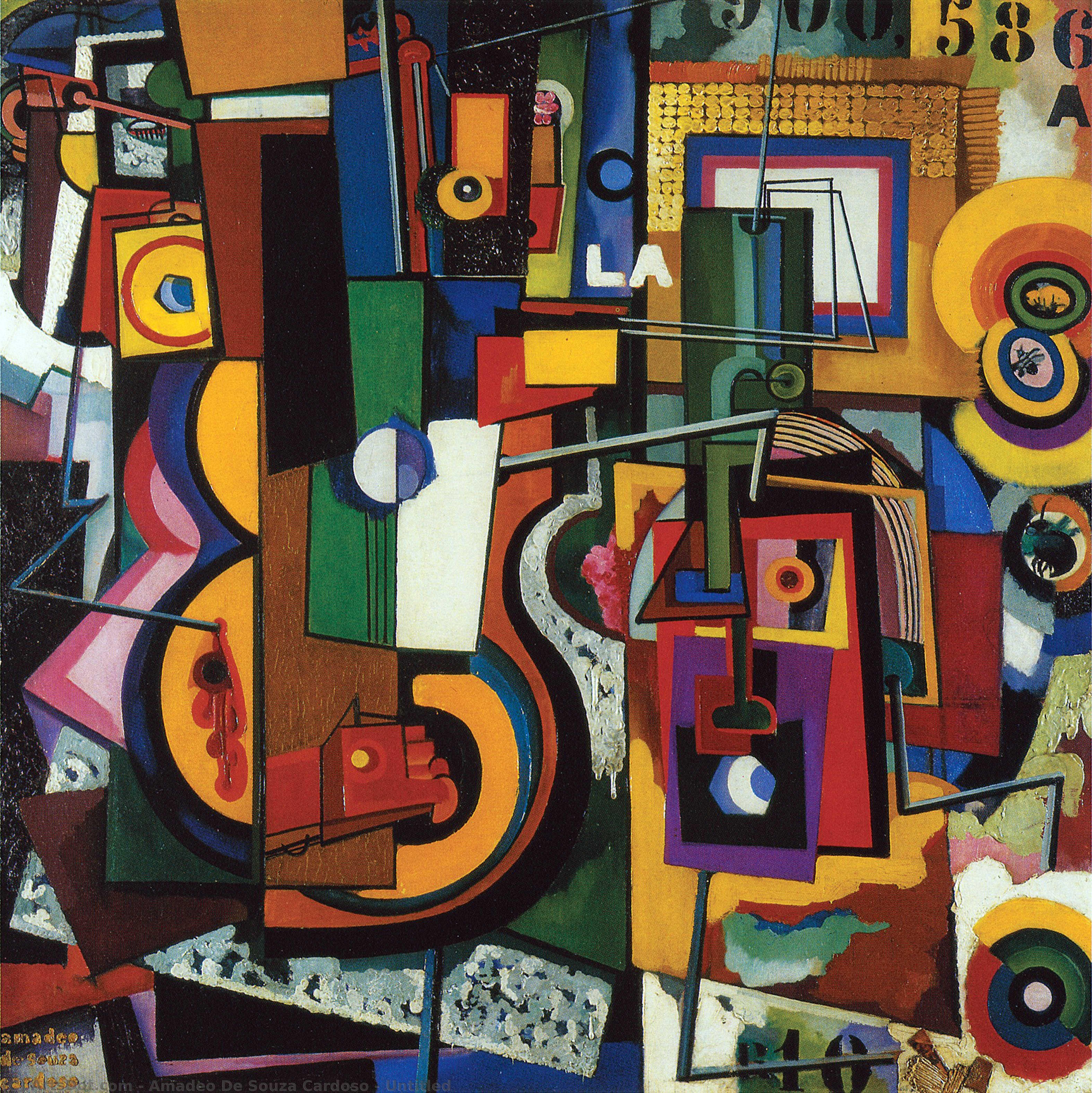
A vibrant collage of geometric shapes, clocks, and books defines this 1917 masterpiece by Portuguese modernist Amadeo de Souza-Cardoso, offering a dynamic window into the avant-garde for your private collection.
A Symphony of Modernist Fragments
In the vibrant landscape of early twentieth-century avant-garde, few works capture the restless, kaleidoscopic energy of the era quite like Amadeo de Souza-Cardoso’s Untitled. Created in 1917, this masterpiece serves as a breathtaking window into the soul of Portuguese Modernism, acting as a bridge between the structured traditions of the past and the fractured, exhilarating possibilities of the future. The painting presents a mesmerizing collage of geometric forms—circles, squares, and triangles—that dance across the canvas in a rhythmic arrangement. Scattered throughout this abstract topography are unexpected elements: the familiar silhouettes of books and the ticking presence of two clocks, one perched near the top left and another nestled toward the center-right. These objects do not merely sit upon the surface; they are woven into a complex tapestry of color and shape, creating a visual dialogue that challenges the viewer to find order within a beautiful, orchestrated chaos.
The technique employed by Souza-Cardoso is nothing short of masterful, showcasing a sophisticated command over the language of Cubism and Futurism. Through a dynamic interplay of overlapping planes and bold, saturated hues, the artist achieves a sense of depth that feels both multidimensional and flatly graphic at once. The brushwork, while contributing to the overall texture of the piece, is secondary to the structural brilliance of the composition. Each shape is meticulously placed to guide the eye on a journey through a labyrinth of light and shadow. For the discerning collector or interior designer, this work offers an unparalleled sense of movement; it is a painting that refuses to remain static, instead vibrating with a life force that transforms any space it inhabtes.
Historical Resonance and Emotional Depth
Beyond its formal brilliance, Untitled carries a profound historical and emotional weight. Painted during the height of World War I, a period of immense global upheaval, the work reflects the fragmented reality of a world in transition. The juxtaposition of mechanical symbols, such as the clocks, with more organic or intellectual elements like books, suggests a tension between the relentless march of time and the enduring nature of human thought. This duality creates an emotional resonance that is both unsettling and deeply captivating, inviting the viewer to contemplate the fleeting nature of existence amidst the rapid industrialization of the early 1900s.
To possess a reproduction of this work is to bring a piece of history into the modern home. It serves as a conversation starter, an intellectual anchor, and a burst of color that can breathe new life into a minimalist or contemporary interior. Whether placed in a quiet study or a grand living hall, the painting’s ability to evoke curiosity and wonder makes it a timeless choice for those who appreciate the profound intersection of art, history, and emotion.