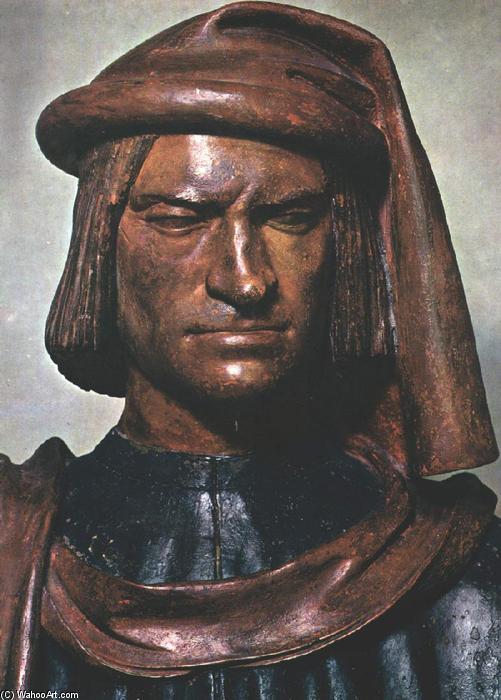
A Vision of Renaissance Majesty
In the heart of the Florentine Renaissance, where the pursuit of beauty met the complexities of political intrigue, Andrea del Verrocchio captured a moment of eternal dignity. His terracotta bust of Lorenzo de' Medici is far more than a mere sculptural likeness; it is a profound meditation on power, intellect, and the humanist spirit that defined an era. As one gazes upon the profile of "Lorenzo the Magnificent," one does not simply see a ruler, but feels the weight of a statesman whose influence shaped the very fabric of European culture. The sculpture presents Lorenzo in a contemplative pose, his gaze directed thoughtfully to the left, inviting the viewer into a silent dialogue with a man who navigated the turbulent currents of Italian politics with unparalleled grace.
The mastery of Verrocchio’s technique is palpable in the warm, earthy texture of the terracotta. Unlike the cold permanence of marble, this medium lends an intimate, lifelike vitality to the portrait. The artist’s meticulous attention to detail—from the subtle, rhythmic folds of Lorenzo's high-collared aristocratic garment to the delicate, fine lines etched around the eyes—demonstrates a virtuosity that bridges the gap between stone and soul. Against a deep, subdued blue background, the warm tones of the clay emerge with a striking three-dimensionality, creating a visual harmony that is both grounded in reality and elevated by artistic intention.
Symbolism and the Soul of Florence
Every element of this bust serves as a symbol of the era's burgeoning intellectual movement. The deliberate use of light and shadow across the contours of the face does not merely define form; it imbue the subject with an emotional depth, suggesting a temperament marked by both solemn seriousness and profound wisdom. Lorenzo’s attire, indicative of his high social standing, speaks to the stability and opulence of the Medici reign, while his focused expression reflects the humanist ideal of reason and observation. To possess or display a reproduction of this work is to invite the spirit of the Florentine Golden Age into a contemporary space, bringing with it an aura of classical sophistication and historical gravity.
For the discerning collector or interior designer, this piece offers a unique opportunity to anchor a room with a sense of timelessness. Whether placed in a sunlit study or a grand hallway, the bust acts as a focal point of intellectual prestige. It serves as a reminder of a period when art, science, and politics were inextricably linked, and when masters like Verrocchio—and his most famous pupil, Leonardo da Vinci—transformed the world through their vision. This artwork is not merely a decoration; it is an enduring emblem of human achievement and the lasting legacy of the Medici dynasty.