A Vision of Classical Grace and Resilience
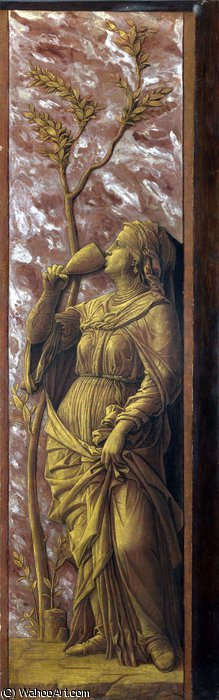
In the quiet intimacy of Andrea Mantegna’s “A Woman Drinking,” we encounter far more than a mere portrait; we step into a meticulously reconstructed world of Roman grandeur. This masterpiece, housed within the hallowed halls of The National Gallery in London, serves as a profound meditation on the spirit of antiquity. At first glance, the scene appears deceptively simple—a woman delicately poised, holding a cup to her lips. Yet, beneath this serene surface lies a narrative of immense gravity. Many scholars believe the subject is Sophonisba, the Carthaginian princess who chose to drink poison rather than endure the humiliation of being paraded in a Roman triumph. This layer of tragic heroism transforms the painting from a domestic moment into an emblematic portrait of fortitude and honor.
The emotional impact of the work is deeply tied to its ability to dissolve the boundary between the viewer and the canvas. Through a breathtaking trompe l'oeil technique, Mantegna invites us into a space where the textures of stone, skin, and ceramic feel tangibly real. For the collector or interior designer, this piece offers an unparalleled sense of depth; it does not merely hang on a wall but creates a window into a lost era, bringing a sophisticated, historical weight to any curated space.
The Sculptural Mastery of the Renaissance
Mantegna’s style is undeniably sculptural, reflecting his deep-seated obsession with the archaeological fragments of the Roman Empire. Having spent his formative years studying ancient ruins under the tutelage of Francesco Squarcione, Mantegna approached the canvas not just as a painter, but as an excavator of history. His figures possess a certain flinty, metallic quality, as if they were carved from marble rather than rendered in oil. This is achieved through a masterful use of perspective and linear foreshortening, techniques that create an illusionistic space so convincing it seems to breathe.
The technique employed here is a testament to the artist's patience and precision. Utilizing oil paint on panel, Mantegna applied delicate glazes to build up color gradually. This meticulous layering results in luminous surfaces and subtle tonal variations that catch the light, enhancing the atmospheric depth of the scene. The interplay of light and shadow—the chiaroscuro—gives the woman's form a monumental presence, making her appear as much a part of the classical landscape as the ancient vases and bowls surrounding her.
A Symphony of Symbolism and Humanist Ideals
Every element within the composition is infused with the humanist ideals prevalent during the Italian Renaissance. The inclusion of secondary figures—a man to the left and another to the right—reinforces a broader social and philosophical perspective, portraying human emotion through the lens of classical learning. The objects scattered throughout the scene, from the intricate vases to the central bowl, are not mere decorations; they are carefully chosen echoes of antiquity that ground the subject in a specific historical consciousness.
For those seeking to adorn a home with art that inspires contemplation, "A Woman Drinking" offers a rich tapestry of meaning. It is a work that rewards repeated viewing, revealing new details of texture and historical allusion with every glance. Whether appreciated for its technical brilliance, its tragic historical narrative, or its ability to evoke the dignified splendor of the Quattrocento, this painting remains a timeless testament to the enduring power of the human spirit.