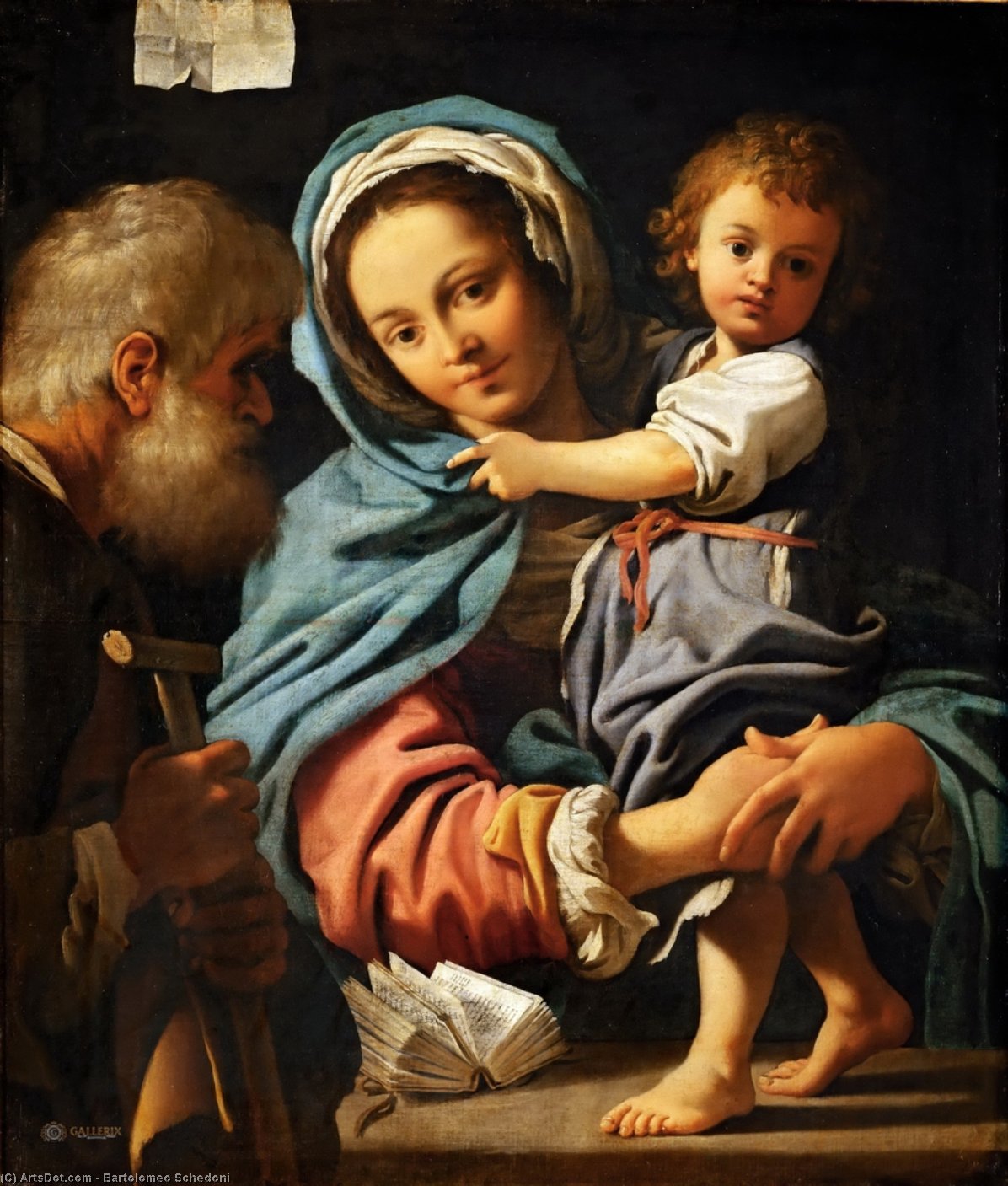
Explore Bartolomeo Schedoni's masterpiece 'The Holy Family,' a dramatic baroque painting depicting the Virgin Mary and Child with a contemplative observer, capturing the grandeur of Parma’s Farnese court.
A Baroque Vision of Sacred Intimacy
To stand before Bartolomeo Schedoni's depiction of The Holy Family is to step directly into the dramatic, richly colored atmosphere of early 17th-century Parma. This painting is not merely a portrait of sacred figures; it is a carefully orchestrated moment of profound human connection set against the brooding drama of an interior space. Schedoni masterfully captures the weight of divine mystery filtered through the lens of intimate domesticity. The composition centers on Mary, whose blue drapery immediately draws the eye, contrasting beautifully with the surrounding shadows. She cradles the Christ Child, a gesture that speaks volumes of both maternal tenderness and divine destiny. Behind this central tableau stands another figure, an observer whose gaze seems to penetrate the veil between the sacred and the mundane, inviting the viewer into their contemplation.
Mastery in Shadow and Light: Technique and Atmosphere
The technical brilliance evident in this work is a hallmark of the Baroque period. Schedoni employs dramatic chiaroscuro—the stark contrast between deep shadow and brilliant illumination—to heighten the emotional stakes of the scene. The dark room, hinted at by the visible dining table in the background, serves not as mere setting but as an active participant in the narrative, deepening the sense of drama. Observe how the light seems to emanate from within the grouping itself, spotlighting the skin tones and the folds of Mary's gown. This sophisticated handling of paint and pigment allows Schedoni to imbue the canvas with a palpable, almost tangible atmosphere—a hushed moment suspended in time.
Historical Echoes: The Farnese Court Context
Understanding the context of Bartolomeo Schedoni’s life enriches our appreciation for this piece. Trained within the orbit of the powerful Farnese court in Parma, his work carries the sophisticated polish and dramatic flair characteristic of that influential patronage. While rooted in deep religious subject matter, the execution speaks to a worldly understanding of spectacle and emotion—a hallmark of Baroque art designed to move the soul as much as it educated the mind. It is a piece steeped in the grandeur of Italian artistic life at the turn of the 17th century.
Symbolism and Emotional Resonance for the Modern Collector
For those seeking an artwork that transcends mere decoration, this reproduction offers deep symbolic resonance. The Holy Family itself represents themes of divine grace, human nurturing, and enduring faith. For a collector or designer, incorporating such a piece into a space—be it a formal drawing-room or a private chapel—brings an immediate sense of gravitas and cultured depth. The emotional impact is one of quiet awe; the painting invites pause, reflection, and contemplation. Owning this work allows one to curate not just a wall hanging, but a focal point for thoughtful repose.