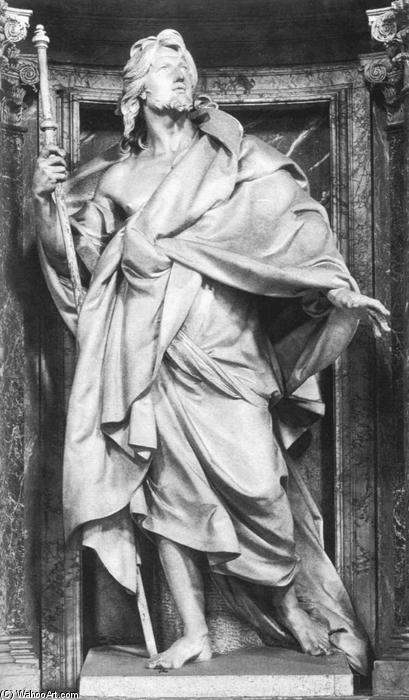
Admire Camillo Rusconi's masterful Baroque sculpture of St James the Great, housed in Sint-Jacobskerk Antwerp & Leuven. Explore its symbolism and artistic legacy at Art Renewal Center.
Camillo Rusconi (1658-1728): Escultor barroco italiano en Roma, que conecta el Barroco y el Neoclasicismo. Conocido por los Apóstoles en San Juan Laterano y su refinada pintura de retratos.
Descubre la basílica más antigua de Roma: San Giovanni in Laterano. Admira mosaicos impresionantes, explora el legado papal y vive la sagrada Scala Santa. ¡Un monumento imprescindible!
St James the Great by Camillo Rusconi – A Synthesis of Baroque Grandeur and Neoclassical Restraint
The sculpture “St James the Great” by Camillo Rusconi stands as a pivotal exemplar of artistic transition within the late Baroque period, deftly bridging the stylistic gap between opulent ornamentation and emerging clarity. Executed in 1715-1718, this monumental marble work resides within the Great Offley Church in Hertfordshire, England, offering visitors a tangible connection to both Flemish art heritage and the grandeur of Roman artistic life during Rusconi’s formative years.
A Legacy Rooted in Milanese Tradition
Rusconi's artistic journey commenced under Giuseppe Rusnati’s tutelage in Milan, where he absorbed the influence of Ercole Ferrata’s workshop – a crucible for stylistic innovation at the time. This early exposure instilled within him a foundational understanding of Baroque principles, notably its dramatic use of chiaroscuro and dynamic sculptural form. However, Rusconi wasn't merely replicating established conventions; he subtly steered them toward the burgeoning aesthetic sensibilities of Neoclassicism, marking himself as an artist attuned to the evolving tastes of his era.
Compositional Mastery: Contrapposto and Architectural Framing
The sculpture’s composition embodies masterful technique—primarily through the application of contrapposto posture, wherein St James's weight is borne on one leg while the other relaxes, creating a naturalistic stance that conveys both strength and repose. This pose is expertly complemented by an ornate architectural niche framing the figure, establishing spatial relationships and enhancing the sculpture’s visual impact. Strong vertical lines dominate the sculptural form and frame, mirroring the grandeur of Roman architecture, while curvilinear drapery introduces movement and dynamism—a characteristic Baroque element skillfully balanced against Neoclassical restraint.
Materiality and Technique: Marble Sculpture's Elegance
Rusconi’s choice of marble – a material synonymous with prestige and permanence – underscores the sculpture’s enduring quality. The artist meticulously honed his craft, achieving remarkable smoothness and luminosity through polishing techniques that capture the subtle nuances of light and shadow. This chiaroscuro effect isn’t merely decorative; it serves to delineate the form and volume of St James's figure, conveying a profound sense of physicality and emotional depth. Furthermore, the sculpture’s surface texture reflects the meticulous attention to detail demanded by Baroque artistry.
Symbolism and Emotional Resonance: Piety and Martyrdom
Beyond its formal brilliance, “St James the Great” resonates with symbolic significance—reflecting St James's historical role as a martyr for Christian faith. The sculpture embodies piety and solemn contemplation, inviting viewers to contemplate themes of sacrifice and spiritual devotion. Rusconi’s masterful execution captures not only the physical likeness of St James but also his inner essence, conveying an emotional impact that transcends mere visual representation—a testament to the artist's ability to imbue stone with profound meaning.
A Bridge Between Eras: Rusconi's Contribution to Artistic Evolution
Camillo Rusconi’s legacy extends beyond this singular masterpiece; he represents a crucial link between Baroque exuberance and Neoclassical elegance. His work exemplifies the artistic dynamism of his time, demonstrating how artists could simultaneously embrace tradition while anticipating stylistic advancements—a characteristic that secures his place as one of the most influential sculptors of the eighteenth century.