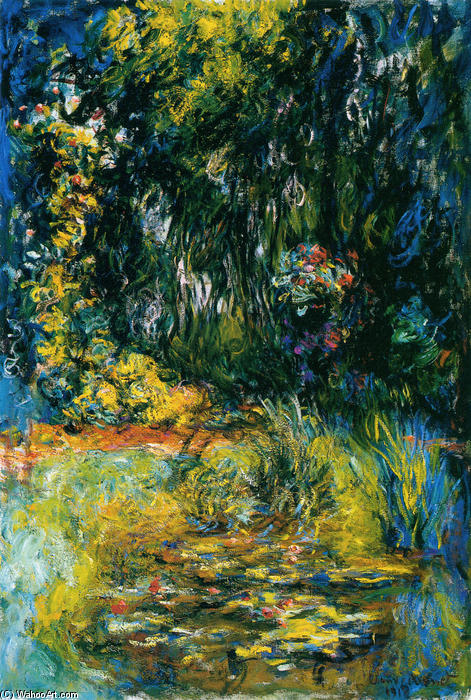
Water Lily Pond: A Symphony of Light and Reflection
The
Water Lily Pond stands as arguably Claude Monet’s most iconic achievement—a cornerstone of Impressionism and a testament to his unparalleled ability to capture the ephemeral beauty of nature. Created in 1897 during his formative years at Giverny, this monumental canvas transcends mere representation; it embodies Monet's philosophical quest to distill the essence of experience into visual form. More than just a depiction of flowers floating on water, it’s an invitation to contemplate the transformative power of light and color—a core principle that defines Monet’s artistic vision.
Style and Technique: Impressionistic Brilliance
Monet's approach to painting is instantly recognizable through his characteristic brushstrokes – loose, visible marks that prioritize capturing the fleeting effects of sunlight rather than meticulous detail. Unlike academic painters who sought to reproduce reality with precision, Monet aimed to convey *perception*, prioritizing color and texture over accurate representation. The
Water Lily Pond exemplifies this brilliantly—the canvas is dominated by horizontal bands of shimmering blues and greens, punctuated by splashes of yellow and crimson. These pigments aren’t blended smoothly but layered thickly onto the surface, creating a palpable sense of materiality and enhancing the illusion of depth. Monet meticulously observed how light refracted through the water and foliage, translating these observations into vibrant hues that dance across the canvas.
Historical Context: The Pursuit of Atmosphere
Painted during a period of profound artistic experimentation—the Impressionist movement—the
Water Lily Pond reflects the broader intellectual currents of its time. Artists like Monet were influenced by scientific discoveries concerning optics and color theory, particularly Eugène Chevreuil’s work on atmospheric perspective. They rejected traditional compositional conventions—such as linear perspective—favoring instead arrangements that prioritized conveying mood and emotion. The painting's creation coincided with Monet’s growing fascination with Japanese prints—known as *ukiyo-e*—which championed flattened perspectives and bold color palettes, profoundly impacting Impressionist aesthetics.
Symbolism: Tranquility and Transcendence
Beyond its formal qualities, the
Water Lily Pond resonates with deeper symbolic meanings. The lily pads themselves represent purity and rebirth—recurring motifs in Buddhist iconography—while the tranquil surface of the pond symbolizes serenity and contemplation. Monet’s deliberate use of color—particularly the dominant blues and greens—evokes feelings of peace and harmony, mirroring his own desire to escape the pressures of urban life and reconnect with the natural world. The painting invites viewers to immerse themselves in a meditative experience, capturing not just what is seen but also what is felt.
Reproductions and Prints: Bringing Monet’s Vision Home
At
ArtsDot.com, we offer exceptional reproductions of the
Water Lily Pond on canvas—crafted by formally and classically trained artists who meticulously recreate Monet’s masterful technique. Explore our curated selection:
For more information on Claude Monet and his legacy, visit
ArtsDot.com or delve into his biography on
Wikipedia.