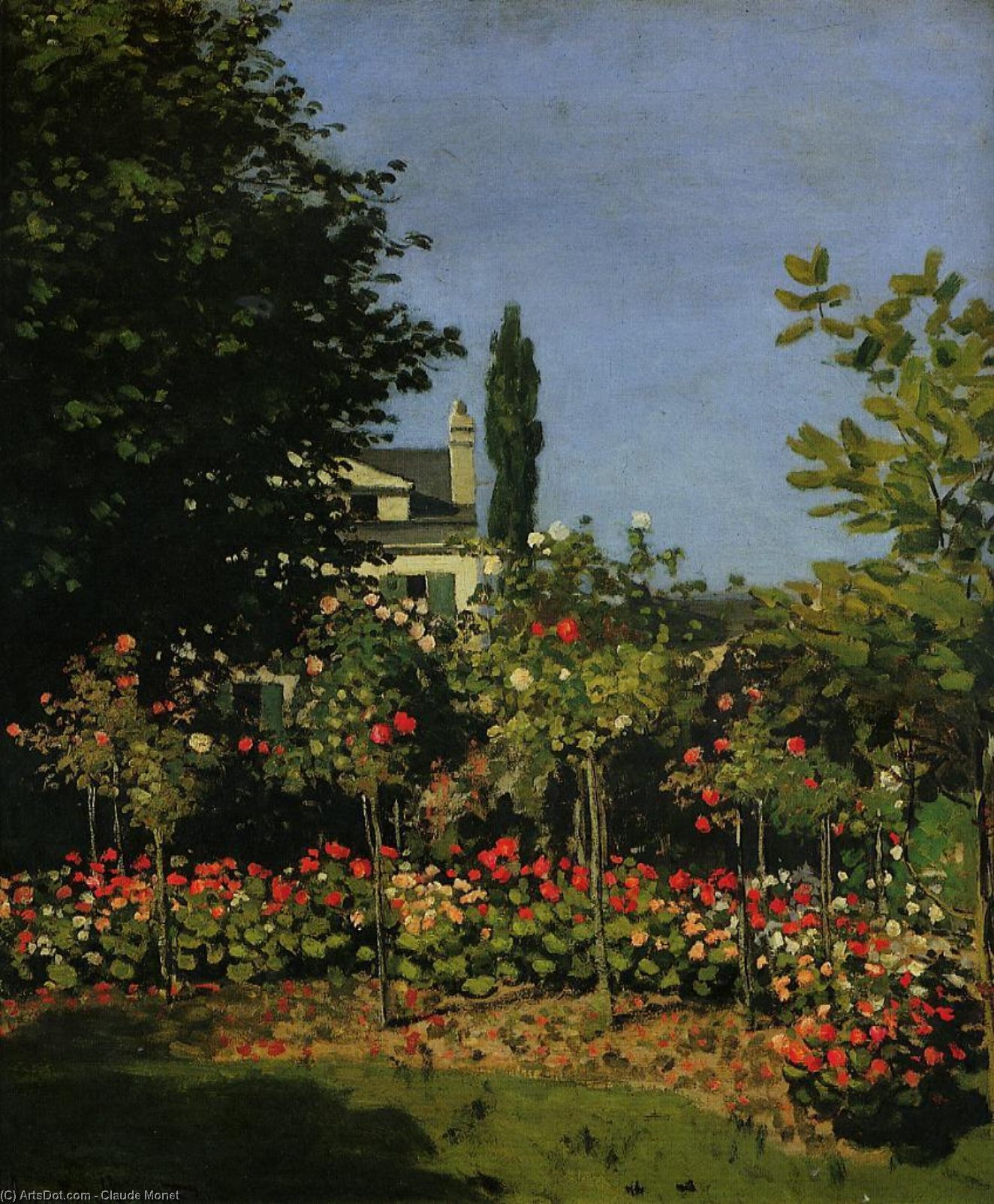
Garden in Flower: A Symphony of Impressionist Light
Claude Monet, one of the most revered figures in Impressionism—a movement that irrevocably altered the course of art history—captured the essence of fleeting beauty with unparalleled skill.
Garden in Flower (Musée d'Orsay (Paris, France), Oil On Canvas,) exemplifies Monet’s groundbreaking approach to portraying the natural world—a technique that continues to inspire artists and collectors alike. Completed in 1866, this painting resides within the hallowed halls of Musée d'Orsay, offering visitors a glimpse into the artistic vision of a true innovator.
Composition and Technique: Embracing Ephemeral Light
The canvas depicts a tranquil garden scene dominated by vibrant red flowers—a bold choice for Monet’s palette at that time. Surrounding these blossoms are mature trees, creating an atmosphere of serene contemplation. Scattered throughout the composition are potted plants, adding to the lushness of the setting and enriching the visual texture. Notably, in the background, a modest house provides context to the garden's location—a detail that subtly anchors the scene within its domestic environment. Monet’s masterful technique is immediately apparent: he employs broken brushstrokes—characteristic of Impressionism—to capture the shifting qualities of light as it filters through the foliage. Layers of color blend seamlessly together, creating a sense of depth and dimensionality that transcends mere representation. This deliberate disregard for traditional academic conventions was revolutionary for its time, prioritizing sensory experience over meticulous detail.
Historical Context: The Birth of Impressionism
“Claude Monet: Garden in Flower” emerged during the formative years of Impressionism—a movement born from dissatisfaction with the rigid rules and idealized depictions favored by the Salon Académique. Artists like Monet sought to depict what they *saw*, rather than what they remembered or imagined, prioritizing immediacy and capturing the transient effects of natural light on color and form. The painting reflects the broader intellectual currents of the era, influenced by thinkers such as Auguste Comte and Charles Darwin—ideas that challenged established notions of reality and championed scientific observation. Monet’s fellow Impressionists were experimenting with new pigments and techniques, pushing boundaries and redefining artistic standards.
Symbolism and Emotional Resonance: A Celebration of Nature's Grace
Beyond its technical brilliance, “Garden in Flower” resonates deeply with themes of beauty, tranquility, and the passage of time—concepts central to Impressionist philosophy. The vibrant red flowers symbolize passion and vitality, juxtaposed against the muted greens and browns of the trees—representing stability and permanence. Monet’s intention was not merely to reproduce a visual scene but to convey an emotional response—a feeling of awe and appreciation for the sublime grandeur of nature. Like many Impressionist paintings, this artwork invites viewers to contemplate the ephemeral beauty of the present moment, encouraging them to savor the fleeting sensations of light and color.
Notable Works by Monet: Expanding Horizons
Monet’s artistic legacy extends far beyond “Garden in Flower,” encompassing a vast oeuvre that includes masterpieces such as
Luncheon on the Grass, Left Panel (Musée d'Orsay),
Water-Lily Pond, Symphony in Rose (Musée d'Orsay), and
Camille with a Small Dog. These paintings demonstrate Monet’s unwavering commitment to exploring the complexities of perception and capturing the transformative power of light—solidifying his position as one of the most influential artists of the 19th century.
/art/list/?Filter=8XXDK9-Claude-Monet-Garden-in-Flower
/art/list/?Filter=8YDELR-Claude-Monet-Luncheon-on-the-Grass-Left-Panel
/art/list/?Filter=8YE8JQ-Claude-Monet-Water-Lily-Pond-Symphony-in-Rose
/art/list/?Filter=8XX5LS-Claude-Monet-Camille-with-a-Small-Dog
https://en.wikipedia.org/wiki/List_of_paintings_by_Claude_Monet