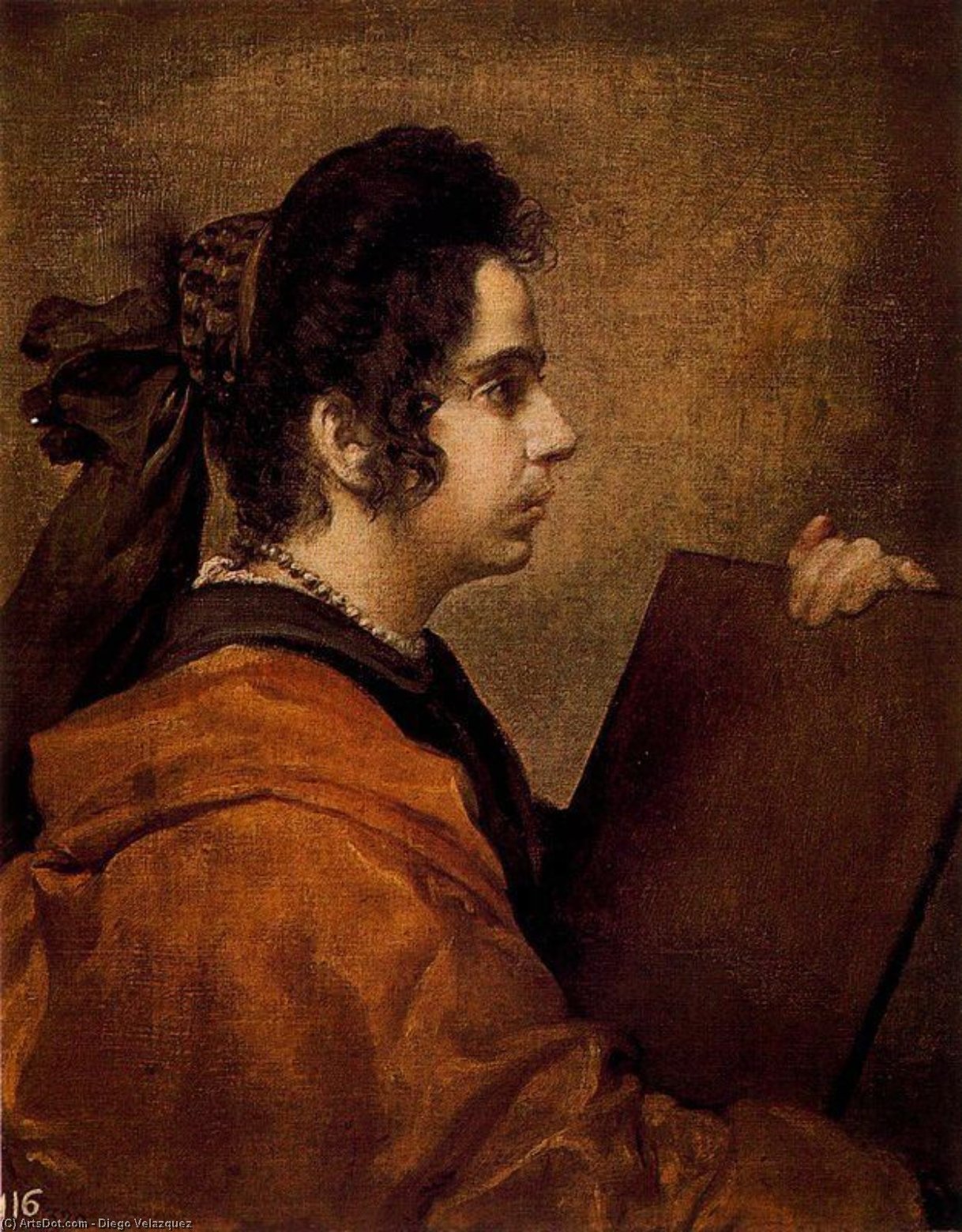
"Una Sibila" de Velázquez: Un retrato fascinante de una mujer en el Barroco español, símbolo de sabiduría y belleza, capturado con maestría por el pintor maestro."
Una Sibila: A Portrait of Wisdom and Mystery
Diego Rodríguez de Silva y Velázquez’s *Una Sibila* stands as an emblem of the Baroque era, embodying its fascination with idealized beauty alongside profound psychological depth. Painted between 1630 and 1631 during Spain's Golden Age—a period marked by imperial grandeur and artistic innovation—this oil on canvas masterpiece resides in the Museo del Prado’s hallowed halls in Madrid.
Subject Matter and Style: The painting depicts a woman, conventionally interpreted as a sibyl – figures revered for prophetic visions and wisdom – presented in profile view. This deliberate compositional choice emphasizes her contemplative gaze and enigmatic presence, inviting viewers to ponder upon the secrets held within her serene countenance. Velázquez’s masterful handling of light and shadow—a hallmark of Baroque technique—creates an illusionistic depth that transcends mere representation.
Artistic Significance and Influences: Diego Velázquez was arguably Spain's most celebrated artist, profoundly impacting subsequent generations of painters. *Una Sibila* exemplifies his unwavering commitment to realism combined with artistic vision. Considered alongside monumental works like *Las Meninas* and *The Fable of Arachne*, it demonstrates Velázquez’s ability to capture not only physical likeness but also the inner life of his subjects—a feat achieved through meticulous observation and subtle modeling of facial features.
Technique: Velázquez employed oil paint, a medium favored during this period for its luminosity and versatility. The artist skillfully blended pigments to achieve nuanced tonal gradations, capturing the delicate interplay of light on skin and drapery. This technique contributes significantly to the painting’s atmospheric quality and enhances its expressive power.
Historical Context: Created amidst the Habsburg court's opulent celebrations of royal authority, *Una Sibila* reflects the Baroque preoccupation with conveying emotion and grandeur. The sibyl figure itself harkens back to ancient pagan traditions—specifically, prophecies delivered by women—symbolizing divine inspiration and intellectual contemplation.
Emotional Impact: More than just a portrait, *Una Sibila* evokes a sense of timeless beauty and contemplative serenity. Its muted color palette—dominated by earthy tones—creates an atmosphere of quiet dignity, inviting viewers to engage in a dialogue with the depicted woman’s gaze and inner thoughts. It remains a testament to Velázquez's unparalleled ability to capture the essence of human experience.
Resources: For further exploration of Diego Velázquez’s artistic legacy, visit /art/list/?Filter=8EWEVR-Diego-Velazquez-Una-sibila. Learn more about oil painting at /art/list/?Filter=A@D3CLRF-The-Art-Media-Oil-Painting. Discover the Museo del Prado’s impressive collection of European art: https://en.wikipedia.org/wiki/Museo_del_Prado. Explore more hand-made oil paintings reproductions at ArtsDot.com.