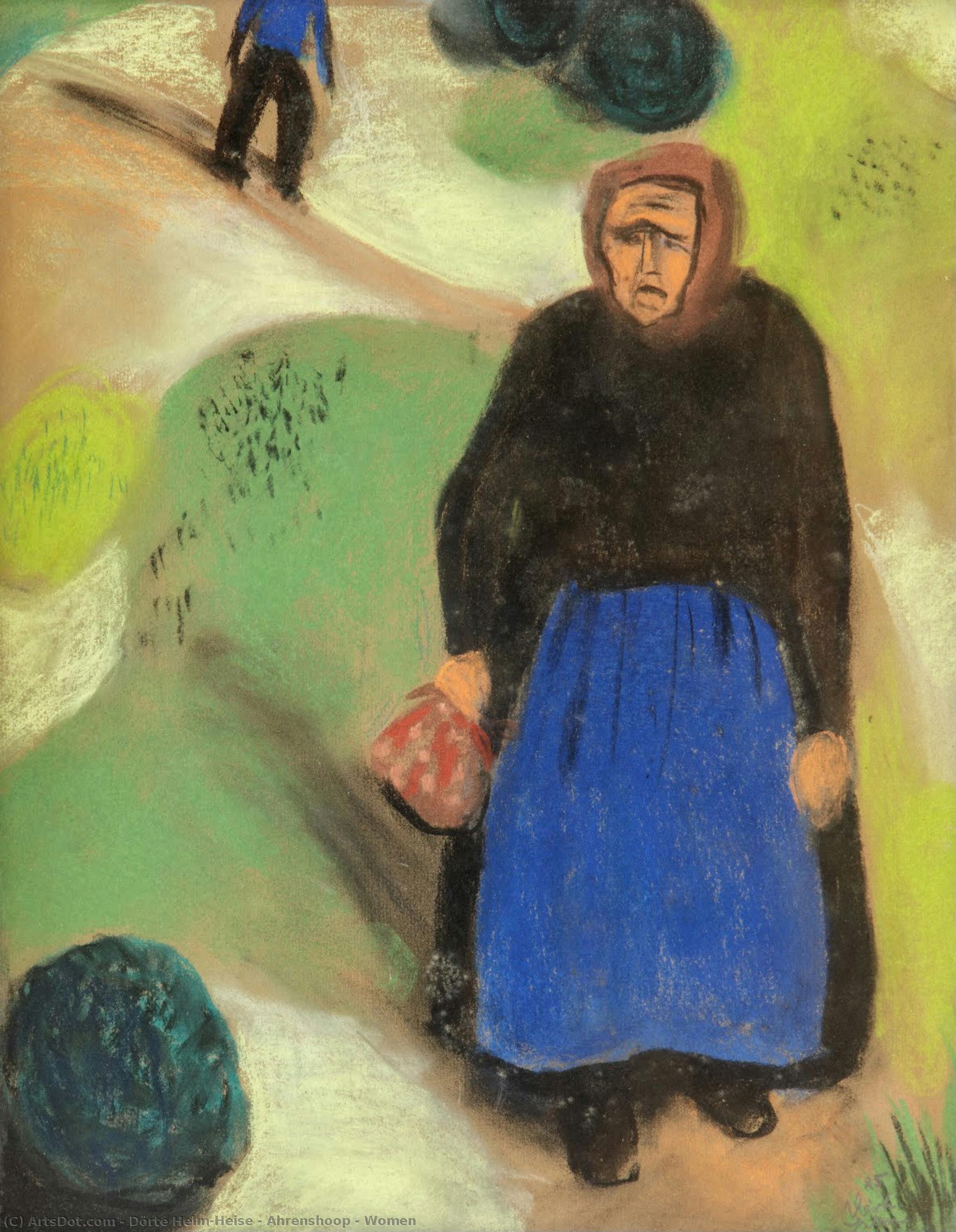
Explore Dörte Helm-Heise’s ‘Ahrenshoop – Women,’ a poignant pastel depiction of hardship & resilience. Capturing Expressionist style, this 1925 artwork offers a glimpse into early 20th-century German art.
Explora el arte de dörte helm-heise, artista de la Bauhaus conocida por su pintura, diseño gráfico y obra textil. Descubre sus aportaciones al arte moderno y la influencia de la Bauhaus en su estilo único.
¡Explora 130 años de arte del Mar Báltico en el Kunstmuseum Ahrenshoop! Descubre obras maestras de Müller-Kaempff, Gerresheim y muchos más en un entorno moderno. Sumérgete en el impresionismo alemán y los paisajes marítimos.
Dörte Helm was a striking artistic personality in Ahrenshoop in the 1920s. As the daughter of a university professor, the classical philologist Rudolf Helm, who was called from Berlin to Rostock in 1909, and his wife Alice, who came from the Jewish Bauer-Rothschild family, she was comprehensively educated in the humanities. At the art academy in Kassel, which admitted women to regular education at an early stage, she studied sculpture from 1915 and went to Weimar in 1918 to study graphics. When the Bauhaus was founded in April 1919, Dörte Helm was one of the first female students at this avant-garde art school. Teachers such as Johannes Itten and Georg Muche, Lyonel Feininger, Oskar Schlemmer, Paul Klee and Wassily Kandinsky, and last but not least the Bauhaus director Walter Gropius, gave her a concentrated essence of the leading ideas of the time. She underwent a broad craft-theoretical education in the applied and free fields. Gropius held Dörte Helm in such high esteem that he enlisted her to work on his own projects while she was still a student. In 1924, she received a position as a journeywoman at the Bauhaus. This success, which was unusual for a young artist, provoked conflicts, so that Dörte Helm left the Bauhaus in 1924 and returned to Rostock. She joined the