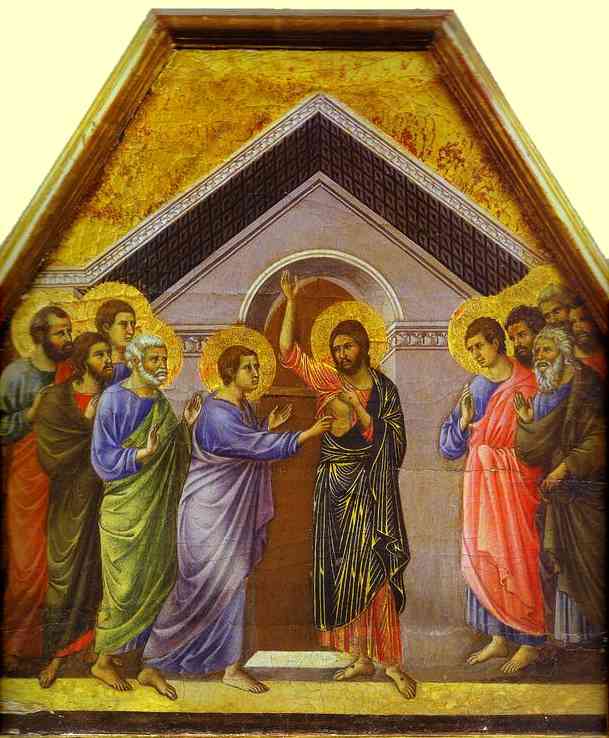
MaestÓ (back, crowning panel)

{'meta_description': 'Este impresionante cuadro de Duccio Di Buoninsegna, MaestÓ (back, crowning panel), parte del ciclo Maestà de Siena, ejemplifica el arte gótico con colores ricos y una maestría excepcional.'}


Duccio di Buoninsegna (1255 - 1319)

Descubra a Duccio di Buoninsegna (c. 1255-1319), un pintor italiano fundamental del estilo gótico del Trecento y la Escuela Sienesa. Explore su innovador uso del espacio, el color y la profundidad emocional en obras maestras como la Madonna de Rucellai y la Maestà. Un Renacimiento.

MaestÓ (back, crowning panel), Doubting St. Thomas: A Window into Gothic Faith

Duccio di Buoninsegna’s *MaestÓ* (back, crowning panel), Doubting St. Thomas stands as a monumental achievement of the Trecento school in Siena and embodies the profound spiritual aspirations of its time. Commissioned by the city itself in 1308, this altarpiece wasn't merely an artistic endeavor; it was a deliberate attempt to articulate the theological core of medieval Christianity – the belief that God’s divine plan unfolded throughout history, beginning with Abraham and culminating in Christ’s resurrection.

  • The Narrative Depth: The panel depicts St. Thomas Aquinas's agonizing doubt regarding Jesus’s divinity following the Resurrection. This wasn’t a simple matter of skepticism; it represented a crisis of faith—a questioning that resonated deeply with theologians and artists alike. Duccio masterfully captures this psychological complexity, portraying St. Thomas as wrestling with his convictions in a moment of palpable vulnerability.
  • Gothic Style Elevated: The painting’s stylistic hallmarks are quintessential Gothic – the luminous gold leaf painstakingly applied to illuminate the drapery and architectural elements, creating an ethereal glow that speaks to divine grace. Simultaneously, Duccio eschews the rigid formalism characteristic of Byzantine art, favoring a supple draftsmanship that imbues the figures with expressive movement and palpable emotion.
  • Symbolism Rich in Detail: Beyond the central scene, the panel overflows with symbolic imagery. The doorway represents purgatory—the intermediary realm between earthly existence and paradise—while the building symbolizes Jerusalem, the Holy City and the seat of divine authority. Each element contributes to a layered tapestry of meaning that invites contemplation.
  • Technique: Duccio’s mastery lies in his innovative use of tempera paint on wood panels – a technique known for its durability and ability to achieve astonishing levels of detail. The meticulous layering of pigments, combined with the subtle gradations of color achieved through glazing, produces textures that are remarkably realistic yet infused with spiritual resonance.

The *MaestÓ*’s influence extended far beyond Siena. It served as a blueprint for subsequent altarpieces across Italy and Europe, establishing a new standard for artistic expression within the religious sphere. Its enduring appeal stems from its ability to convey not just visual beauty but also the profound yearning for spiritual understanding that defines human experience.

If you wish to immerse yourself in this masterpiece’s legacy or acquire a stunning reproduction of Duccio’s *MaestÓ*, ArtsDot.com offers exceptional handmade oil paintings crafted with meticulous care and attention to detail. Explore the artwork on ArtsDot.com and delve deeper into Duccio’s life and work via Wikipedia.